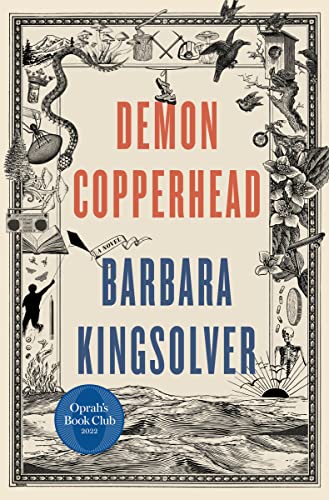
Demon Copperhead is about six when we first meet him, as he and his cousin Maggot ramble happily around the mountains and streams of rural Appalachia, contented residents of Lee County, Virginia, a community that is both solace and trap. Demon lives in a trailer with his mother; Maggot lives next door with his grandparents. The book follows Demon for the next 15 years as he becomes an orphan, tobacco picker, foster child, football star, drug addict, husband, widower, friend, lover, grandson, cartoonist, and nascent graphic novel author. It’s a life mirrored after Charles Dickens’ David Copperfield, but with foster homes in place of orphanages, oxycontin instead of gin. Poverty, powerlessness, and child exploitation are much the same.
Our group had varied responses to the novel. At 548 pages of intense prose and chaos, it is daunting. Some found it mesmerizing and were sucked into the story, eager to keep reading to see how Demon approached his next trauma. Others needed to regularly take a breather, not wanting to face another bad decision and more destruction of Demon’s brittle life.
The book’s voice is its biggest strength. Demon narrates with the angst of a child, the naivete of a teen, and the hope of a young adult. He shares humor, pain, wisdom, and cluelessness in what is essentially a journal in which he is trying to figure himself out. Kingsolver nails it, showing us how a life of deprivation and degradation can lead to what more privileged people consider poor choices; for those in the middle of the storm, they simply feel like the best of multiple bad options. As the story builds and Demon’s life destructs, we begin to understand why he is how he is, why he does what he does, and how he ultimately becomes who he is. His voice is full of heart, but it is also heartbreaking.
The book won the 2023 Pulitzer Prize for fiction.
This is the seventh Kingsolver book we have read as a group, and we have watched as she has grown as a writer, starting with The Bean Trees, published in 1988. Most of her books contain themes of social justice and environmental stress. The villains in Demon Copperhead are the mining companies that degraded the land, extracting what they wanted and leaving the residents to live with their mess; the drug companies that knew how addictive pills like oxy were, but pushed them anyway; a frayed social network that has no place for kids in poverty; and a healthcare system that doesn’t reach rural America.
Lee County is its own social ecosystem in which you can’t hide from your past. Old acquaintances pop up in Demon’s life, some for the better, others for the worse. The Peggots are always somewhere in the background, showing Demon how home looks. Aunt June leaves the Doom Castle (her apartment in Knoxville) to practice medicine “back home,” and helps Demon find the care, and cure, he needs. Fast Forward, the football star who first introduced Demon to drugs, returns and causes one of the book’s most traumatic events. Emmy follows Demon on a downhill spiral. Tommy, the lost foster kid who seemed destined for a dead-end life, helps Demon discover his future. Mr. Armstrong and Miss Annie never waver in their support of Demon. And, of course, Angus is Demon’s truth.
For Demon, Lee County is home. He cannot envision living anywhere else, especially in a city apartment where people don’t even have lawns, let alone woods and mountains. His people may be a mess, but they are his. He loves them and learns that they love him too. Throughout the novel, he strives to belong and, finally, at the end he does. And we assume he will finally see the ocean—because Angus is in charge.
— Pat Prijatel
 Books, Brews & Banter