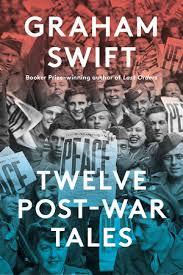
Twelve Post-War Tales, by Graham Swift

Reading British author Graham Swift’s short stories in Twelve Post-War Tales is a little like eating a small bowl of dulce de leche ice cream. Each bite is rich and complex, leaving an intriguing after-taste, calling us to read and re-read. To savor each story.

A paradox of literary fiction is that its extreme specificity is what allows it to feel universal. I, for instance, have nothing in common with seventy-year-old Dermot, a Cork man from York, who banters in a pub with his mates on a rainy night about a sweet girl he once knew who worked in chocolate. Innuendo, wink-wink, laughter. But who among us can read the closing passage of the story “Chocolate,” without sighing Ah yes. I have felt that way. Surely everyone has felt that way. Thank God we can feel that way.

Everything had an inky sheen. On the strip of pavement, on the kerbstones and gutter, on the surface of the street and the droplet-covered bodywork of parked cars, the reflections from the streethlights shone and shimmered. From inside looking out, before you had to go back out into it, and with two pints inside you, it all had a way of even looking quite appealing.

Who can read “Hinges” without recognizing Annie’s grief, the pointless ubiquity of the best poems to read at a funeral, and the mother’s limp, unresponsive hand Annie tries to hold? Who hasn’t had bizarre memories pop up at such times, like the one Annie has as her dad’s funeral begins, of Joe Short, a man she “fancied” when she was little, who fixed a door she later realizes has similarities to the coffin in which her dad lies.

Who, of a certain age, hasn’t imagined losing their mind (and their memories) as Anna-Maria Anderson does on her eighty-second birthday in “Passport?” Swift treats this character—and all his characters—very tenderly, but uncompromisingly.

It was 6:30 a.m. Still dark. She sat, looking forward, braced and prepared, clutching the proof of her identity, but she was really somewhere else already and she knew, as well as she ever would, who she was. She sat and she waited. She waited. She waited for the light to flash.

Our group spent three weeks discussing these twelve tales, having our favorites and least favorites, but we agreed each story was, in its own way, a remarkable capture of what it means to be a human among humans. To grow older, to be formed by memory, to wait—knowing who we are—for the light to flash.

We equivocated a little over the title and cover since—together—they imply the stories will be about the aftermath to World War II, and that’s not true of all of them. But Swift touches on various other times of turmoil (the Cuban missile crisis, North Ireland, President Kennedy’s assassination, the riots of the sixties, the pandemic) as if to argue it’s always post-war somewhere, thus a tale may be told.

— Sharelle Moranville

James, by Percival Everett

Percival Everett’s novel, James, which recently won the 2025 Pulitzer for fiction, is a reimagining of Mark Twain’s Adventures of Huckelberry Finn told through the sensibility of the slave Jim.

Everett introduces the story with pages from the notebook of Daniel Decatur Emmett, a 19th Century composer who formed the first black minstrel troupe. Some of these songs, like “Old Dan Tucker” and “Turkey in the Straw,” were disconcertingly familiar to our group because we had learned them as children and sang them with innocent ignorance.

Everett rips away that band-aid of ignorance with Jim’s opening reflection:

Those little bastards were hiding out there in the tall grass. The moon was not quite full, but bright, and it was behind them, so I could see them plain as day . . . Lighting bugs flashed against the black canvas. I waited at Miss Watson’s kitchen door . . . Waiting is a big part of a slave’s life, waiting and waiting to wait some more. Waiting for demands. Waiting for food. Waiting for the end of days. Waiting for the just and deserved Christian reward at the end of it all.

Waiting for someone to get raped or beaten or burned alive or sold away from their family.

The little bastards, of course, are Huck and Tom conspiring to play some kind of demeaning joke on Jim the slave, a grown man who understands he must show white folks what they need to see: a docile darky, happy under the massa’s thumb. So Jim obligingly calls out to Huck and Tom, “Who dat dere in da dark lak dat?” and introduces the fascinating construct that builds the irony that drives the story: the slaves are not the dumb, insensitive, superstitious, sub-human creatures the white folks need them to be. Among themselves, they speak in cultured voices with rich vocabularies, read the great thinkers, and parse the subtle difference between dramatic and proleptic irony. In the slave quarters, they drill the children in situational translations. How, for instance, to tell a white lady her house is on fire. Not by yelling, “Fire, fire!” because that is too direct, but by exclaiming, “Lawdy, missum, looky dere!” because whites must be the ones to name the trouble.

Miss Watson soon names the trouble that launches the story when she is overheard declaring her intention to sell Jim away from his wife and daughter, and Jim decides he must run—though he knows the horror of what can happen to a runaway slave. At the same time, Huck stages his own murder and runs to avoid the blows of his abusive father. When the Jim and Huck coincidentally end up together on Jackson Island, their river adventure begins. Sometimes they are together, and sometimes they are separated. They are always growing in their understanding of the world and their places in it, in their understanding of their connection to each other. They grapple with what it means to be black or white or slave or free.

The story is narrated by Jim in his “real” voice, and the tension from the irony of who this person really is, versus who white people believe he is, builds an intimacy with the reader that makes the pages fly by, sometimes showing foolishness, sometimes tenderness, sometimes the omnipresent violence of a slave’s world. Rape so common it’s almost banal, a slave hanged for stealing a pencil, a slave burned alive, a wife and young daughter sold to a slave breeding farm.

At the beginning of this gripping story, Jim is understandably reactive and runs away from the threat of being sold. But as the story develops, he becomes determinedly proactive. This turning occurs at the midpoint when he is caught up in Daniel Emmett’s racist minstrel show. He is sold as a slave, bought as a tenor. He becomes a black man who must be made blacker with shoe polish so people will believe he is white.

The wrenching irony of all this finally twists Jim from reactor into protagonist. He steals the journal with Daniel Emmett’s songs and the beautiful blank pages beyond them and runs like only a slave can run: this time, toward his wife and child to somehow save them. Eventually getting a pencil stub, he begins to write, which becomes a metaphor for his emerging fully into his own and daring to reveal his true self to the white world on the final page of a truly brilliant novel.

“Are any of you named Nigger Jim?”
I pointed to each of us.
“Sadie, Lizzie, Morris, Buck.”
“And who are you?”
“I am James.
“James what?”
“Just James.”

Before James became the book everybody was reading and raving about, few of the people in our group were familiar with Percival Everett’s work. Now we are eager to read more.

— Sharelle Moranville

The Waters, by Bonnie Jo Campbell

Bonnie Jo Campbell’s novel The Waters begins with “Once upon a time . . .” So we know to expect larger than life characters, clashes of good and evil, and a happily-ever-after ending. Yet The Waters is also a rural noir story, which means, in the author’s own words, it’s going to be “muddy and bloody,” with muck rattlers and rape, with the moral ambiguity of Wild Will Zook. And disgruntled men with lots of guns.

The story carries many themes: our relationship to the land and animals, religion versus spirituality, the meaning of family, math and logic versus intuition, aging, motherhood, reproductive rights, modern medicine versus folk medicine. But what drives the narrative is the division in the community. The men of Whiteheart are angry and discontent with Hermine (aka Herself), the matriarch of M’sauga Island, where no men are allowed and women do what they please. These men are suffering with problematic feet, bad backs, dark moods, and love problems. And Herself isn’t coming through with the cures the way she used to.

The men are troubled, sure their glory days are over. Once Whiteheart claimed its name from the delicate white-hearted celery grown by the effort of the whole community working harmoniously together. Now the land is row cropped and most of it is owned by the Clay family whose men are shadowed by hemophilia. Wild Will Zook has been banished. Wives are talking back, kids are disappointments, and Reverend Roy keeps telling them that to be a man is to suffer. Because they feel so beat down, they start shooting at stuff (animals, trees, machinery, M’sauga Island, Herself). In a memorable scene, they fell a beautiful old willow tree in an orgy of chain sawing—all the time keeping up an annoying Greek-chorus like commentary (aka whining) about the state of their world.

The only relief they get is when Rose Thorn (Herself’s youngest daughter) returns home, usually in the Spring. Rose Thorn doesn’t do anything to make them feel better because she’s a lazy woman. Yet, inevitably, when she’s around she can somehow “spin straw into gold and make people more interested in what might happen next.”

We meet Rose Thorn for the first time when the men discover her walking down the road, bedraggled and bleeding, secretly carrying a frail newborn in her backpack. The effect on the men is instant. They become considerate and loving. Interested. Hopeful.

The newborn in the backpack is Donkey, a child of rape, who comes of age in the story. On the island, she sleeps with either her grandmother or mother, sharing their dreams. She loves the swamp and the two donkeys just across the bridge. She crawls on her belly to meet the big m’sauga snake who she believes to be her sister. She turns to math and logic to try to understand a confusing world.

She is curious about the men and boys of Whiteheart and often slips away to observe them from behind the faded curtains of the house Wild Will built for Herself. But most of all, Donkey so wants Titus (who loves Rose Thorn passionately) to be her dad.

Titus, heir to the biggest farm in Whiteheart, has great passion for Rose Thorn, but he also loves practical, competent, Catholic, fertile Lorena, who can cut a pie into five perfectly even pieces (a source of wonderment to Donkey).

The climactic scene in the story, where the division in the community is finally resolved, is when the Greek chorus guys help Rose Thorn deliver her baby—Rose Moon, Titus’s child. This scene is hectic, funny, slapstick and very tender. When Titus finally shows up to carry Rose Thorn across the bridge, he is about to be bitten by the big m’sauga when Donkey tries to intervene and the snake bites her. And Herself falls in the water, only to be saved by Two Inch Tony.

As everyone is finally on the way to the hospital in Whiteheart, Donkey reflects on their dilemma.

If the Zook women continued living mysterious lives separate from the town, the men would continue watching them like prey from Boneset and making up stories about them, good and bad, calling them witches and angels. Burning fires and pissing Rosie into the snow. Standish might not shoot at them again, but someone else would; there was no end of men with guns.

So they abandon the island. Rose Thorn seeks medical care for her breast cancer, and eventually the women, Donkey, and baby Rose Moon move into Wild Will’s house. They accept the delicacies he leaves at the door, but they do not invite him in. He has become a kind of good ghost. He realizes that taking care of Rose Thorn in her pregnancy has “finally made a woman out of him, which is to say it has made him a better man.”

Titus has his epiphany too, when, having trapped and planned to kill the m’sauga, he instead submits to it and listens to the voice of God, which is not a man’s voice, telling him to take care of his kids.

Campbell’s writing is so marvelously detailed and specific that we see, hear, smell, taste, and touch the world of the waters. And because she uses an omniscient narrative voice, we can know everything about everybody—even what the crows think of all the human messing around down below.

Campbell invites us to roll our eyes, be creeped out, laugh, think about, but not judge, the world of the waters. And perhaps that’s the fairy dust sprinkled on Rose Thorn that lets her lift people’s spirits. She doesn’t judge them. Our group hadn’t read rural noir before, and it times it felt like a bit much, but that didn’t deter us from lively discussions.

— Sharelle Moranville