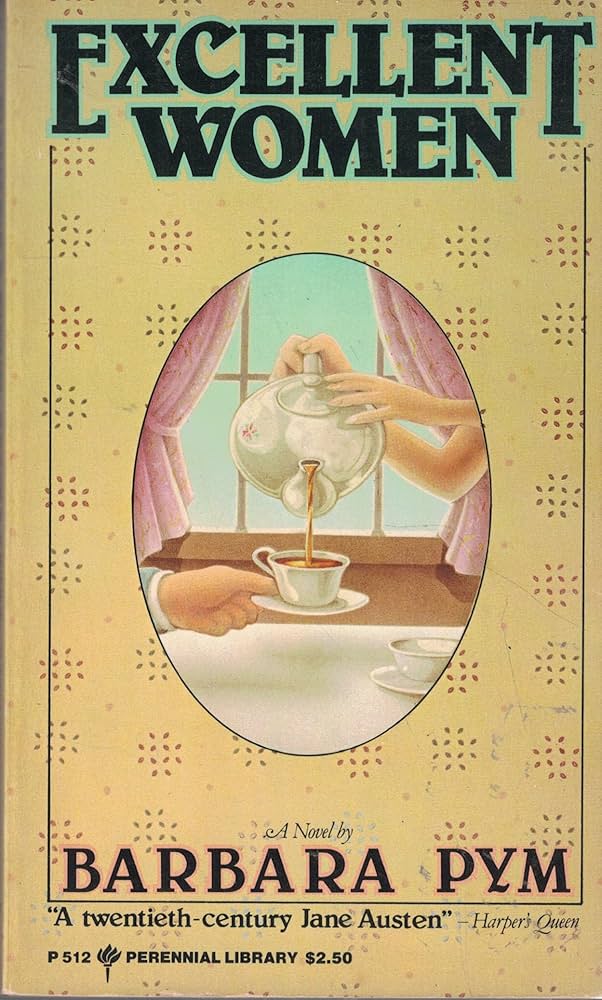
Excellent Women, by Barbara Pym

The comic novel Excellent Women by Barbara Pym immerses the reader in a time long past, an unfamiliar country and a unique culture.  It’s 1952 post-World War II London. Rationing is still in effect and various structures, such as parts of churches, remain in ruins.  The male population has been much reduced by the war, and the female population appears to be divided into marriageable women  – young, attractive with the feminine wiles to know how to attract men and then the “excellent women ” – those who actually know how to run a household and address the common tasks of everyday life, women who are always open to serving others, regardless of how presumptuous the task or clueless the originator. The protagonist is one of the latter.

Excellent Women is a  comedy of social manners in the style of Jane Austen.  The plot, such as it is, is driven by a cast of fascinating characters whose personal foibles and everyday activities comprise the narrative. There is a great deal of tea drinking, going out to lunch and participating as helpful and productive members of an Anglican parish where jumble sales and Christmas bazaars require hours of planning, quibbling and execution. This placid, comforting way of life is disrupted  by a married couple representing and introducing a new social order and a conniving, marriage-seeking female.    

The book opens with the main character and narrator Mildred Lathbury, a thirty something single woman of just sufficient independent means, welcoming  new neighbors to the flat below hers in very much not the best part of London or the most desirable house, since she must share a bathroom with the new tenants, married couple Helena and Rockingham (Rocky) Napier.  The Napiers are totally outside the normal orbit of Mildred’s quiet, solitary life.  Rocky is a flamboyantly charming naval officer, and Helena is an anthropologist, currently focused on marital kinship mapping in some foreign clime with her fellow anthropologist Everard Bone, an acerbic and socially inept unmarried male. Helena is a drama queen and a domestic slob – quite a contrast to Mildred who is a fastidious housekeeper with a quiet social life and part time job aiding distressed gentlewomen – an occupation that remains a mystery to the reader. Everard seems to take an interest in Mildred though his invariably dismissive communication style motivates Mildred’s sacrifice for Lent  – trying to like him.

As the book progresses, Helena and Rocky split, dragging Mildred into writing letters between them and even arranging  furniture transfers for both these self-centered, presumptuous moderns.  But  – Mildred is one of those excellent women, always ready to step in and help sort out other people’s problems.

The book’s other main characters are Mildred’s good friends, brother and sister Julian and Winifred Mallory. He is the unmarried parish Vicar, and she, an excellent woman, runs his household. Winifred is given to wearing items from the parish’s jumble sales that Mildred describes as drab and unsuitable. She notes that Julian has some good features but is not so good looking that women are constantly after him, thereby implying that marriage with him does not interest her. The siblings’ current preoccupation is finding a renter for the rectory’s upstairs apartment. Eventually, here enters the very attractive divorcee Allegra Gray, whom Mildred in one of her witty but acid observations speculates may or may not have been named after Dante’s “natural” child.  

Mrs. Gray is a consummate manipulator– very definitely not an excellent woman, and even perhaps one who deliberately sets out to target a man as if she “were going to buy a saucepan or a casserole.” The vicar is enamored, but when the secret engagement is revealed, Mildred and Winifred and other parishioners are thrown into chaos. Eventually the vicar comes to his senses, and the engagement is called off.  Quiet parish life goes on.

The book concludes with Mildred acceding to a near jaw dropping presumptuous request as her lot in life, ostensibly because it will be “a nice change of pace.”  Some book club members who had admired Mildred’s choice of a quiet, solitary life and her witty observations were quite disappointed in the ending, but overall, most members enjoyed this book and its window into the past.

Fans of Barbara Pym will be pleased to learn that award-winning British film producer Ellie Wood has acquired rights to Excellent Women, with an option to develop other Pym books.  She said, “I look forward to creating a “Pymverse” and bringing this iconic author’s uniquely British tales of comic observations and unrequited love not only to her legions of fans but also to a wider TV audience.”  

— Sue Martin
Neighbors and Other Stories, by Diane Oliver

Diane Oliver died in a motorcycle accident at age 22 in 1966. At the time she was a graduate student at the Iowa Writers’ workshop at the University of Iowa. Today reviewers laud this phenomenal black author, a master of the short story, with their highest praise for the economy of her prose, the empathy and insight she demonstrates in her character development and the intimate glimpses of life in the Jim Crow south. The stories are gems of compelling insight far beyond the tumultuous media coverage of the civil rights era. Critics’ reviews are in response to the 2024 collection and publication of fourteen of her stories in a volume titled Neighbors. Only four of her stories were published in her lifetime, none in main stream media.

A particularly remarkable feature of Oliver’s brilliance as a writer is her ability to show rather than tell – to reveal the story line with phrases and details that communicate much more effectively than direct narrative in informing the reader. In the title-based story “Neighbors” for example, Oliver begins revealing the core of the narrative in the third paragraph when Ellie stands up to look over the shoulder of a man reading the newspaper to see if she can read the headline. Immediately the reader suspects the story is about something momentous, but what? “Traffic Jam” finds maid Libby icing Christmas cookies, putting a ham in the oven and soup on the stove for her wealthy white employer’s lunch while she worries about her children scavenging for apples for lunch or alternatively eating cold boiled potatoes, because they have no other food – a powerful, heart breaking contrast.        

Throughout the collection a number of common themes are woven into the fabric of the narratives. Her main characters – mainly strong black women – are all aspirational – some, striving for a better world to raise their families as in “Neighbors” where parents are agonizing over whether to send their young son the next morning to integrate a neighborhood grade school. In “Health Services” the mother is focused on a better day-to-day existence for her children by trying desperately to access health care in the face of bureaucratic inhumanity and dire poverty. In “Key to the City” the mother insists on moving her children to Chicago, keeping up the charade that their father will meet them at the depot. She’s confident there’s got to be a better life in the big city even without his support.

In a twist on the theme of aspiration, the main character in the “Closet at the Top of the Stairs” is a young woman who has been sent by her father to integrate a southern women’s college. She is exhausted and on the verge of a mental breakdown due to the unchecked civil rights activism of her father, who has turned her into what feels like an “Experiment.”

Aspiration does indeed have a downside too as in “The Visitor” where socialite and doctor’s wife Alice faces the lies and games of the artificial life she aspired to and now inhabits. Also achieving marriage to a doctor, Meg in “Spiders Cry Without Tears” realizes she is simply an interchangeable object to her husband rather than a unique human being when he gifts her with his former wife’s fur stole, just back from the furriers, as if it were a special present from him.

Oliver’s use of bright colors often serves to emphasize the bleakness of a situation. In “The Closet at the Top of the Stairs,” mentally unstable Winifred has a pink plaid hatbox, and, in a seeming effort to cling to her childhood and her family, a menagerie of stuffed animals including a yellow bunny, a green duck and a pink dog with orange eyes which she carefully wraps in plastic every night. Emphasizing her efforts to fit in even as she spirals mentally, Winifred has her parents send her a white rain coat – what everyone is wearing – to replace the blue one she brought to college. The yellow ribbon the mother in “Key to the City” is carefully ironing for her daughter who cherishes it and wants to wear it to church, vividly contrasts the dire situation of a family stranded in Chicago with a paucity of festive normality.  In “Traffic Jam” the fact that the car the father has bought instead of food for his family is blue, his wife’s favorite color when they were courting, provides the reader with a very clear understanding that this man is not focused on the reality of his starving children.

Adding to the compelling nature of these spare and exceptional stories, is the irony of many of the titles.  “Mint Julips Not Served Here” focuses on a family who has fled to the woods to live a primitive life, where visitors are met with firearms, in order to protect their young son who no longer speaks after having been brutally bullied. As the reader soon learns, there is no “Key to the City” in that story, rather desperation and fear when the reality of the abandonment by the father sinks in. There is also no health service in “Health Service,” only denial of service and disregard for health.  “Traffic Jam” has two disrupting “jams  – Libby’s employer is constantly in her way and irritatingly nosy as Libby works in the kitchen, and her clueless husband “jams” up her life by buying an obviously unneeded car.

Book club members were moved by the exceptional skill of Diane Oliver as a short story writer and by  the intimacy of these insightful stories of an era they all lived through. They wished she had lived to develop her talent even beyond the high standard of Neighbors. The only adverse comments were about “Frozen Voices,” the experimental story which most found difficult to follow, although some made some sense of by reading it as poetry. Without question, everyone did agree “Neighbors” needs no editing.   

— Sue Martin

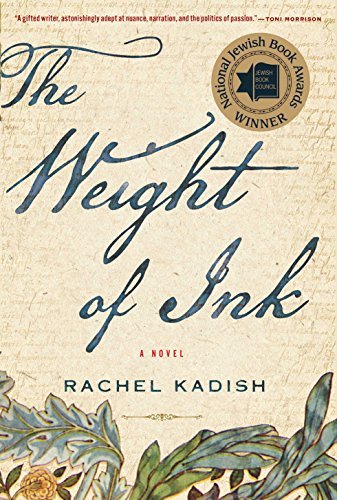
The Weight of Ink, by Rachel Kadish

Readers in search of good historical fiction may question whether they really want to learn about the everyday life and challenges of Jewish immigrants in London in the 17th century, but The Weight of Ink by Rachel Kadish quickly draws the reader into a compelling, atmospheric and skillfully written account of the period surrounding the Great Plague of 1665 alongside its impact and meaning to the professional and personal lives of two historical researchers in the 21st century.

In The Weight of Ink, the story moves back and forth, chapter by chapter, between the late 1660s and modern day London – between the household of Rabbi HaCoen Mendes who has followed his flock from Amsterdam, now, after Cromwell’s abdication, a somewhat more accepting place for Jews to practice their religion, and Helen Watt, professor and historical researcher who, at the end of her university career, is battling Parkinson’s disease and her brash, American assistant Aaron Levy.

Rabbi HaCoen Mendes is a survivor of the Inquisition, who was blinded as a concession for renouncing his faith, otherwise to die in agony on the rack. Also in the HaCoen Mendes household is Ester Valazquez, an Amsterdam orphan. She has a brilliant, open and inquisitive mind along with a strong aversion to the arid state of marriage.  Ester becomes the rabbi’s scribe by default, since she had been educated alongside her brothers, despite cultural norms against it. This work frees her from household drudgery, the only culturally acceptable alternative to marriage for a young woman.

Helen is a brilliant researcher and seemingly revered teacher, but she is lonely and emotionally repressed, having retreated from her first and only love and “…wasted her life fleeing from it ” (p. 452).  Aaron is obnoxious, arrogant and immature, but a highly intelligent graduate student whose dissertation on some minutia of Shakespeare’s Influence has stalled, likely irretrievably.  The personalities of these two accomplished researchers clash again and again until a seemingly terminal confrontation initiated by Aaron clears the air and marks the beginning of an unconventional friendship.   

But the main character of the narrative is a trove of old documents discovered during the 21st century renovation of the former Mendes, now historic HaLevy house. The narrative thereafter shuttles back and forth, chapter by chapter from one century to the other as Helen and Aaron decipher, analyze and puzzle over the documents. In alternate chapters the story of Ester, the originator of many of the documents as the rabbi’s scribe, is gradually revealed in fascinating detail, including vivid descriptions of life in London in the late 17th century.

Description is indeed the author’s strong point. Just one example – not long after Ester’s arrival in London, the rabbi sends her out into the city alone on an errand.  At first terrified by the jostling crowd,–“She was in a crush of English strangers and her breath came quick with fear – but their unfamiliar smells and rough fabrics and stout limbs carried her and the heat of their bodies warmed her” (p. 132) –and she soon comes to recognize a strong desire for life drives existence in London and in her – desire, strong enough to override the cultural conventions constricting her.  Ester’s craving for a life centered on books and ideas and how she addresses this life force through her work as a scribe is a major theme of the narrative and one shrouded in mystery.

Although The Weight of Ink would not be classified as a mystery, it reveals the secrets of the documents in a gradual way that nourishes suspense and propels the reader through the narrative. Two revelations near the end are especially surprising – one involving what momentarily seems like a contradiction of Ester’s desire for a life of the mind and the other that raises, but does not resolve, a mystery about her origins. This final jaw-dropping revelation also offers a profound gift to Aaron.

The book club enjoyed The Weight of Ink, and deemed it well written, especially the vivid descriptions, but the consensus was it would benefit from a thorough editing of its 559 pages.

— Sue Martin