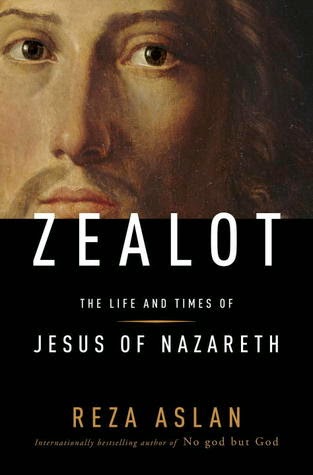
 For the past few weeks, the Books, Brew, and Banter crowd has been reading and discussing Zealot: The Life and Times of Jesus of Nazareth (Random House, July, 2013), by Reza Aslan (a #1New York Times bestseller, named one of the best books of the year by Booklist and Publishers Weekly). Of the nine BB&Bers at the wrap-up discussion of Zealot, there were nine thumbs-up.
Aslan describes himself as “a kid raised in a motley family of lukewarm Muslims and exuberant atheists.” At an evangelical youth camp in northern California when he was a teen, Aslan accepted Jesus Christ as his savior and invested in the literal God-inspired truth of the greatest story ever told. He went on to evangelize others, including his mother who converted to Christianity. But years later, as a student of religious studies, Aslan was faced with what he saw as a fact: much of the Bible could not possibly be literally true.
In his Author Note at the end of the book, he writes, “Ironically, the more I learned about the life of the historical Jesus, the turbulent world in which he lived, and the brutality of the Roman occupation that he defied, the more I was drawn to him. Indeed, the Jewish peasant and revolutionary who challenged the rule of the most powerful empire the world had ever known and lost became so much more real to me than the detached, unearthly being I had been introduced to in church. Today, I can confidently say that two decades of rigorous academic research into the origins of Christianity has made me a more genuinely committed disciple of Jesus of Nazareth than I ever was of Jesus Christ. My hope with this book is to spread the good news of the Jesus of history with the same fervor that I once applied to spreading the story of the Christ.”
Because Aslan is a terrific writer and a diligent scholar, ordinary readers (not people schooled deeply in history or theology) can finish the book in a kind of “Aha!” place. Jesus as a particular person, living in a particular time and place, comes alive. And Aslan has made his case that “Jesus the man is every bit as compelling, charismatic, and praiseworthy as Jesus the Christ. He is, in short, someone worth believing in.”
What may be hard for some readers is learning about all the messiahs that were wandering around that part of the world in those days, and the fractiousness between Jesus’s brother James the Just and Paul of Tarsus. And the committee decision that led to the Nicene Creed in the 4th Century. One element of the creed, the mystery of the Holy Trinity, was a committee effort to please everybody. As he grew older, Aslan found the complexity of the Trinity a stumbling block, and it became important factor in his decision to return to the Muslim faith of his roots.
Zealot is a page-turner that gives a vivid sense of the historical Jesus and a crisp, succinct explanation of what happened in the church’s development between the crucifixion of Jesus and the Council of Nicea.
—Sharelle Moranville.
 He is one of the few prolific writers of whom I can say that I’ve read all his books. And I’m sorry there will be no more. But I’d love to read at least one again (Plainsong would be my preference) and discuss it with the BB&Bers. (Also, it would address Ken’s lament that we’ve been reading a disproportionate number of women authors lately. ) 🙂