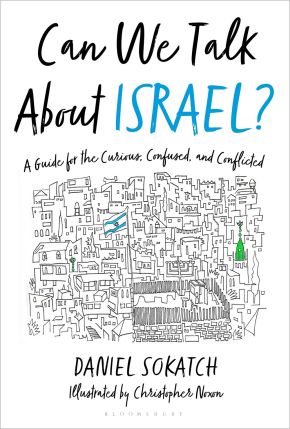
Can We Talk About Israel?: A Guide for the Curious, Confused, and Conflicted was written by Daniel Sokatch, an American Jewish activist and CEO of the New Israel Fund since 2009. His aim with this book, as he states in the first chapter, is to break down the conflict between Israel and Palestine into a thorough but understandable narrative so that the average uninvolved (but interested) person can understand it enough to participate in discussion to some degree.
Based on the fact that our group had several interesting discussions about it, I think he achieved that goal.
The first half of the book starts at the very beginning – God telling Abraham of Canaan – and steps through the full history of the conflict, highlighting the major incidents, competing interests and philosophies, milestone events, and most notable leaders on both sides to the present day. Though it was definitely engaging, this part was so full of facts that it was hard to stay focused and keep the details straight. Overall, it left us with a better understanding of the motivations and emotions behind both sides.
The second half went into greater detail about the “current” state of the conflict, such as it was in 2021 when the book was published. Sokatch stated that he endeavored to present it in a balanced way, and we felt that he achieved this also (or as our Bill Smith said, as even-handed a resource as we’re likely to find). We learned about the carved-up and walled-off map of the territory, the political climate and living conditions of the major hubs, the bond between America and Israel, the creeping Israeli Settlements, the debates around apartheid and BDS (Boycott, Divestment and Sanctions against Israel), what constitutes antisemitism versus fair criticism of Israel, and so much more. None of it told us how to feel, which is not a comfortable place for Americans who are used to being able to claim one position or another for every issue.
Much has happened since the book was published, most notably the attack on Israel by Hamas on October 7th, 2023, which is still a full-scale conflict at this moment. Sokatch continues to weigh in on the subject on the website for The New Israel Fund, an organization which was established in 1979 and “designed to expand the work that the United Jewish Appeal was then doing … to protect Israel’s strength by protecting democracy, human rights, justice, and equality for all Israelis – Jews and Arabs” (from jewishvirtuallibrary.org). His latest post can be found here: https://www.nif.org/blog/finding-light-in-the-darkness/. In it, he makes a statement that I find to be somewhat more hopeful than the last chapter of the book, which was titled “The Case for Hope.”
President Biden has offered us a light in this darkness. But there is another light, one that shines today in the darkness in Israel: Activists in Israeli civil society—regular Israelis, Arab and Jews, seeking a better, shared future—are leading the way towards a different path—especially grantees like Standing Together, Combatants for Peace, Bereaved Parents—Families Forum, Breaking the Silence, and Yesh Din—who either are co-led by Arabs and Jews or have worked hand in hand with Palestinians for years.
They know that Israelis share the responsibility for envisioning a horizon where tomorrow is better than today—for everyone.
On December 20, 2023, my daughter came home from college on Christmas break and we didn’t get through one full day before the issue of Israel/Palestine came up at the dinner table. I was glad to be able to understand her fervent opinion and offer thoughts of my own, which I would not have been comfortable doing if not for this book. I would definitely recommend it to anyone who is interested in learning more.
— Julie Feirer
 Books, Brews & Banter