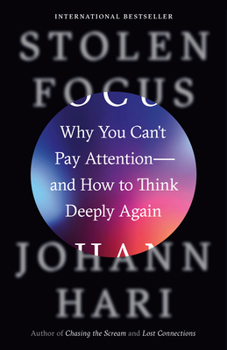
In Stolen Focus, Johann Hari argues that elements of our existing culture are eroding our ability to concentrate and stealing our ability to truly enjoy life. Hari makes clear that this is not a self help book with an easy recipe for personal improvement. To be sure, there are practices that we all can take up to battle this assault on our focus. However, much of the challenges we face are societal and need a society-wide movement to address them.
Hari explores his own recognition that his focus was being stolen. In an attempt to reclaim it, Hari took a personal months long screen-free technology detox in Provincetown. While somewhat successful in helping Hari reclaim the ability to read books, creatively write, daydream, and sleep again, the effects did not last long past the end of the detox. Hari also recognizes that such an exorcise is not feasible for most of us, and it does not address the root causes of our focus being stolen.
From processed food to environmental pollutants to a lack of unsupervised play, Hari takes us on a tour of factors impacting our attention. In particular, Hari takes a long look at how social media actively uses subconscious techniques to covertly keep us engaged online. Such online engagement is used to feed the profits of the existing “surveillance capitalism” business model. Silicon Valley designers use various tools such as building virtual “voodoo doll” models of individuals to predict our future behavior. Likewise, they use “negativity bias” to keep us engaged by feeding us increasingly negative or fringy content. However, many of these Silicon Valley designers have come to regret their long term impact on society.
“One day, James Williams–the former Google strategist I met–addressed an audience of hundreds of leading tech designers and asked them a simple question: “How many of you want to live in the world you are designing?” There was a silence in the room. People looked around them. Nobody put up their hand.”
But, if this is not the world we want to live in, then what can we do about it? One of the interesting concepts discussed in the book is “cruel optimism.” In our society, we have a tendency to lean on rugged individualism to face problems. While such self-reliance may be admirable in some circumstances, it can be “cruel” when faced with challenges that have deeply rooted societal causes. Such deeply rooted societal causes often go beyond the ability for us to address on an individual-by-individual basis. With our focus, it is tempting to believe that we are completely in control of our own fate, but Hari argues that there are tremendous societal forces acting against us that need society wide solutions.
— Jim Lynch
 Books, Brews & Banter