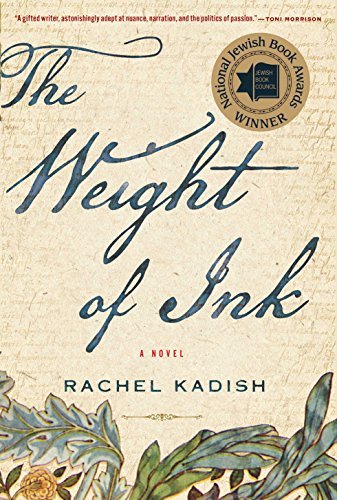
Readers in search of good historical fiction may question whether they really want to learn about the everyday life and challenges of Jewish immigrants in London in the 17th century, but The Weight of Ink by Rachel Kadish quickly draws the reader into a compelling, atmospheric and skillfully written account of the period surrounding the Great Plague of 1665 alongside its impact and meaning to the professional and personal lives of two historical researchers in the 21st century.
In The Weight of Ink, the story moves back and forth, chapter by chapter, between the late 1660s and modern day London – between the household of Rabbi HaCoen Mendes who has followed his flock from Amsterdam, now, after Cromwell’s abdication, a somewhat more accepting place for Jews to practice their religion, and Helen Watt, professor and historical researcher who, at the end of her university career, is battling Parkinson’s disease and her brash, American assistant Aaron Levy.
Rabbi HaCoen Mendes is a survivor of the Inquisition, who was blinded as a concession for renouncing his faith, otherwise to die in agony on the rack. Also in the HaCoen Mendes household is Ester Valazquez, an Amsterdam orphan. She has a brilliant, open and inquisitive mind along with a strong aversion to the arid state of marriage. Ester becomes the rabbi’s scribe by default, since she had been educated alongside her brothers, despite cultural norms against it. This work frees her from household drudgery, the only culturally acceptable alternative to marriage for a young woman.
Helen is a brilliant researcher and seemingly revered teacher, but she is lonely and emotionally repressed, having retreated from her first and only love and “…wasted her life fleeing from it ” (p. 452). Aaron is obnoxious, arrogant and immature, but a highly intelligent graduate student whose dissertation on some minutia of Shakespeare’s Influence has stalled, likely irretrievably. The personalities of these two accomplished researchers clash again and again until a seemingly terminal confrontation initiated by Aaron clears the air and marks the beginning of an unconventional friendship.
But the main character of the narrative is a trove of old documents discovered during the 21st century renovation of the former Mendes, now historic HaLevy house. The narrative thereafter shuttles back and forth, chapter by chapter from one century to the other as Helen and Aaron decipher, analyze and puzzle over the documents. In alternate chapters the story of Ester, the originator of many of the documents as the rabbi’s scribe, is gradually revealed in fascinating detail, including vivid descriptions of life in London in the late 17th century.
Description is indeed the author’s strong point. Just one example – not long after Ester’s arrival in London, the rabbi sends her out into the city alone on an errand. At first terrified by the jostling crowd,–“She was in a crush of English strangers and her breath came quick with fear – but their unfamiliar smells and rough fabrics and stout limbs carried her and the heat of their bodies warmed her” (p. 132) –and she soon comes to recognize a strong desire for life drives existence in London and in her – desire, strong enough to override the cultural conventions constricting her. Ester’s craving for a life centered on books and ideas and how she addresses this life force through her work as a scribe is a major theme of the narrative and one shrouded in mystery.
Although The Weight of Ink would not be classified as a mystery, it reveals the secrets of the documents in a gradual way that nourishes suspense and propels the reader through the narrative. Two revelations near the end are especially surprising – one involving what momentarily seems like a contradiction of Ester’s desire for a life of the mind and the other that raises, but does not resolve, a mystery about her origins. This final jaw-dropping revelation also offers a profound gift to Aaron.
The book club enjoyed The Weight of Ink, and deemed it well written, especially the vivid descriptions, but the consensus was it would benefit from a thorough editing of its 559 pages.
— Sue Martin
 Books, Brews & Banter