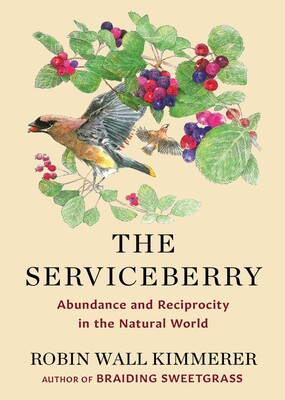
This is an exquisite book—112 lovingly designed pages of thoughtful commentary, elegant language, and engaging drawings. It’s essentially an essay packed with a call to reconsider capitalism by injecting it with what Robin Wall Kimmerer calls the gift economy.
The back cover, with a luscious drawing of hands brimming with purple and red fruit, carries the message we’re to take with us: “All Flourishing is Mutual.”
Kimmerer uses a simple springtime fruit, the serviceberry (also called a juneberry, shadbush, wild plum, saskatoon and a litany of other names), as a metaphor for the difference between indigenous beliefs and capitalism. (Kimmerer is a member of the Citizen Potawatomie Nation, professor at the State University of New York’s College of Environmental Science and Forestry, and director of its Center for Native Peoples and the Environment.)
A gift economy, she writes, is built on sharing and recycling. When the serviceberry produces too much fruit for one family, the tradition is to give the remainder to neighbors and friends. In a capitalist approach based on concerns of scarcity, the rest might be hoarded or sold. There is no room in a gift economy for hoarding; great wealth is frowned upon because indigenous societies value reciprocity over accumulation.
It’s a system in which everybody gets a bit of the bounty, nobody goes hungry, but all involved—insects, birds, humans—reciprocate. “Just as all beings have a duty to me, I have a duty to them,” she writes. “If an animal gives its life to feed me, I am in turn bound to support its life. If I receive a stream’s gift of pure water, then I am responsible for returning a gift in kind.”
Kimmerer uses multiple examples of current gift economies, including Little Free Libraries, and the larger public version on which they are based; sites such as Buy Nothing, which digitally connect neighbors who give away household items they no longer need; and recycling stores like The Freestore in Des Moines.
She acknowledges problems in the system, and points to the Tragedy of the Commons, in which those wishing to make a profit take control of community resources. In one case, a neighbor puts up a “free farm stand” full of fresh produce to share, and somebody steals the entire stand. (Kimmerer acknowledges that it was, in all fairness, advertised as free.) In response, an Eagle Scout replaces the stand and organizes other members to build similar structures in their communities.
The book is an easy, pleasant read that allowed us to dip our toes in economic theory, making it accessible and almost fun. It’s an antidote to the greed that is currently the operating philosophy in our government.
— Patricia Prijatel
 Books, Brews & Banter