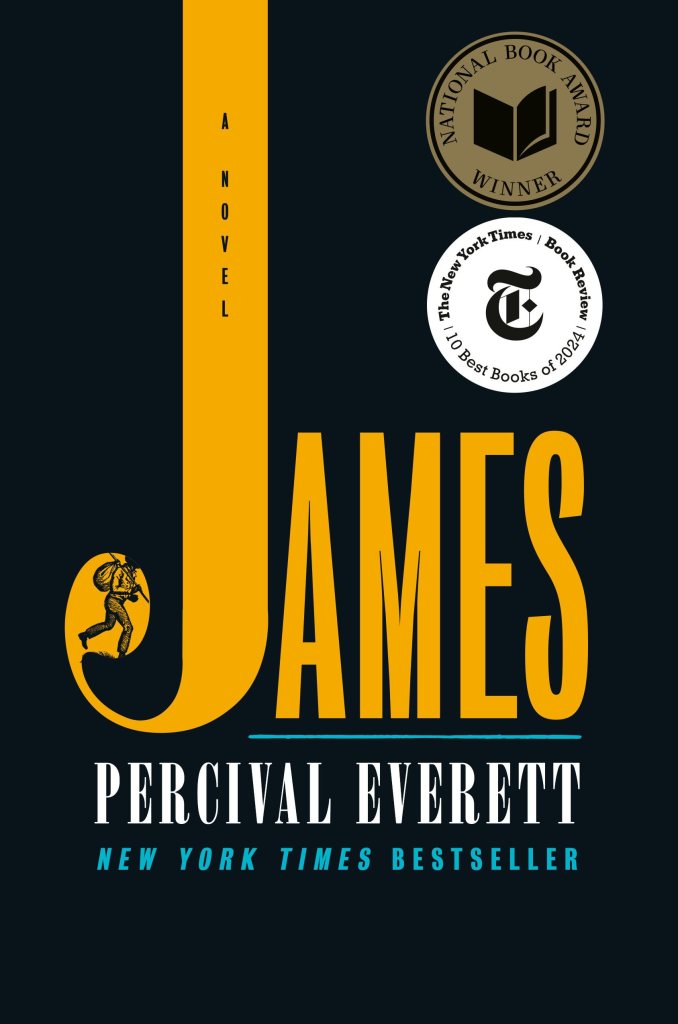
Percival Everett’s novel, James, which recently won the 2025 Pulitzer for fiction, is a reimagining of Mark Twain’s Adventures of Huckelberry Finn told through the sensibility of the slave Jim.
Everett introduces the story with pages from the notebook of Daniel Decatur Emmett, a 19th Century composer who formed the first black minstrel troupe. Some of these songs, like “Old Dan Tucker” and “Turkey in the Straw,” were disconcertingly familiar to our group because we had learned them as children and sang them with innocent ignorance.
Everett rips away that band-aid of ignorance with Jim’s opening reflection:
Those little bastards were hiding out there in the tall grass. The moon was not quite full, but bright, and it was behind them, so I could see them plain as day . . . Lighting bugs flashed against the black canvas. I waited at Miss Watson’s kitchen door . . . Waiting is a big part of a slave’s life, waiting and waiting to wait some more. Waiting for demands. Waiting for food. Waiting for the end of days. Waiting for the just and deserved Christian reward at the end of it all.
Waiting for someone to get raped or beaten or burned alive or sold away from their family.
The little bastards, of course, are Huck and Tom conspiring to play some kind of demeaning joke on Jim the slave, a grown man who understands he must show white folks what they need to see: a docile darky, happy under the massa’s thumb. So Jim obligingly calls out to Huck and Tom, “Who dat dere in da dark lak dat?” and introduces the fascinating construct that builds the irony that drives the story: the slaves are not the dumb, insensitive, superstitious, sub-human creatures the white folks need them to be. Among themselves, they speak in cultured voices with rich vocabularies, read the great thinkers, and parse the subtle difference between dramatic and proleptic irony. In the slave quarters, they drill the children in situational translations. How, for instance, to tell a white lady her house is on fire. Not by yelling, “Fire, fire!” because that is too direct, but by exclaiming, “Lawdy, missum, looky dere!” because whites must be the ones to name the trouble.
Miss Watson soon names the trouble that launches the story when she is overheard declaring her intention to sell Jim away from his wife and daughter, and Jim decides he must run—though he knows the horror of what can happen to a runaway slave. At the same time, Huck stages his own murder and runs to avoid the blows of his abusive father. When the Jim and Huck coincidentally end up together on Jackson Island, their river adventure begins. Sometimes they are together, and sometimes they are separated. They are always growing in their understanding of the world and their places in it, in their understanding of their connection to each other. They grapple with what it means to be black or white or slave or free.
The story is narrated by Jim in his “real” voice, and the tension from the irony of who this person really is, versus who white people believe he is, builds an intimacy with the reader that makes the pages fly by, sometimes showing foolishness, sometimes tenderness, sometimes the omnipresent violence of a slave’s world. Rape so common it’s almost banal, a slave hanged for stealing a pencil, a slave burned alive, a wife and young daughter sold to a slave breeding farm.
At the beginning of this gripping story, Jim is understandably reactive and runs away from the threat of being sold. But as the story develops, he becomes determinedly proactive. This turning occurs at the midpoint when he is caught up in Daniel Emmett’s racist minstrel show. He is sold as a slave, bought as a tenor. He becomes a black man who must be made blacker with shoe polish so people will believe he is white.
The wrenching irony of all this finally twists Jim from reactor into protagonist. He steals the journal with Daniel Emmett’s songs and the beautiful blank pages beyond them and runs like only a slave can run: this time, toward his wife and child to somehow save them. Eventually getting a pencil stub, he begins to write, which becomes a metaphor for his emerging fully into his own and daring to reveal his true self to the white world on the final page of a truly brilliant novel.
“Are any of you named Nigger Jim?”
I pointed to each of us.
“Sadie, Lizzie, Morris, Buck.”
“And who are you?”
“I am James.
“James what?”
“Just James.”
Before James became the book everybody was reading and raving about, few of the people in our group were familiar with Percival Everett’s work. Now we are eager to read more.
— Sharelle Moranville
 Books, Brews & Banter