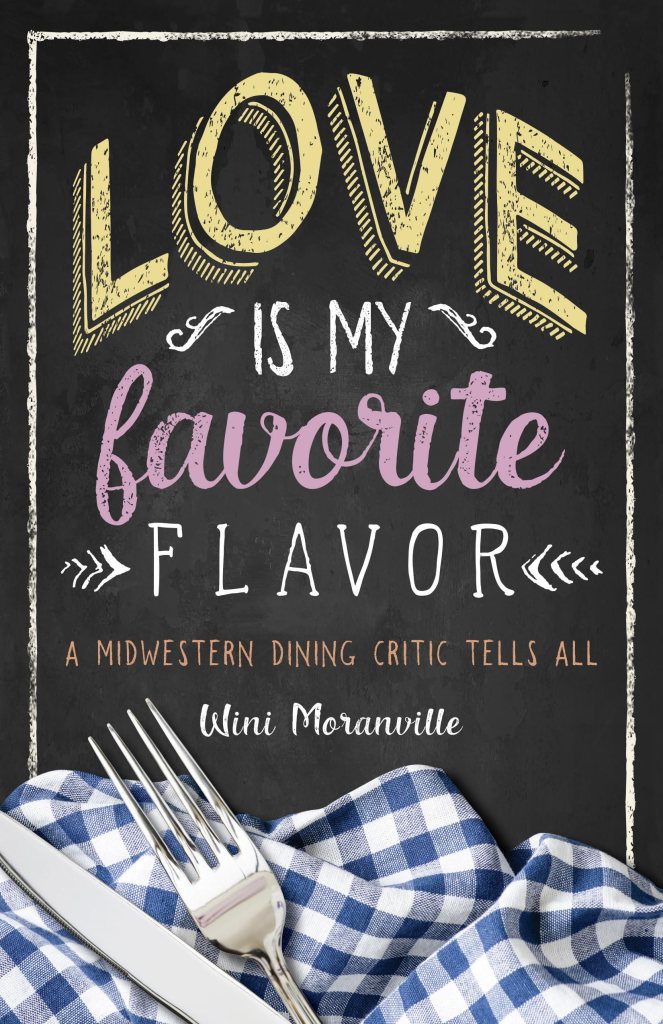
Early in her career, Wini Moranville decided her lifetime goal would be “to rearrange a modest but sweet life” around small moments and great meals. She was in the Rhine River valley on a backpacking trip through Europe, where she discovered food and wine that “tasted like the joy of knowing something good had settled into your soul and will be there forever.” These were the moments to live for, she realized.
And so she did. She became a food and wine writer, summer resident of France, and restaurant critic for the Des Moines Register. And now, she shares this sweet life in her memoir, Love is My Favorite Flavor, an engaging book that demonstrates how food is all about love—growing it, preparing it, serving it, and sharing it.
She started waitressing when she was 13 at Baker’s Cafeteria, a family-run, family-focused place with plenty of mashed potatoes, gravy, and cream pie. For the next ten years, through high school and college, she worked at some of Des Moines’ iconic restaurants——Younkers’ Tea Room, the Meadowlark, and Parkade Pantry— building the foundation on which her career was forged.
She still remembers instances in which she failed a customer in need of sustenance, like the woman in the houndstooth suit who wanted a tuna salad sandwich at The Soup Kitchen, one of Des Moines’ earliest vegetarian restaurants. In hindsight, rather than turning the woman away, Moranville wishes she had encouraged her to try one of the restaurant’s satisfying alternatives and helped her enjoy her lunch. Or the little boy whose family mocked him for mispronouncing pecan to the point he couldn’t enjoy the pie he had been savoring. The memory of somebody being deprived of the joy of a meal still rankles.
And she remembers a fussy customer who wanted her tea in a teapot so she could brew it just the way she wanted. First, the woman seemed unsufferable, but then Moranville caught a glimpse of her “staring contemplatively into space and sipping tea brewed just the way she liked it. She simply looked so…happy.”
She realized the woman, like most customers, had her own drudgery, and the treat she allowed herself was her afternoon cup of tea. “And it took so little to make her happy: hot water in a teapot, tea bag on the side, two packets of honey.”
In the best restaurants, the staff shares a meal together before their shift begins, testing menu items, but also bonding, creating an atmosphere in which serving feels like a calling, not a job. She saw this in full color on a trip to France, when she and her husband Dave came upon a raucous group on a restaurant terrace, finishing a meal and enjoying the food and one another. They learned this was the staff, which was just about ready to go to work, after finishing the espresso being served by the restaurant owner. They talked to a chef, who encouraged them to return later, which they did, enjoying their own delicious and convivial meal. Moranville observes:
It occurred to me that the staff seemed to operate from a kind of pact: they had their turn sitting down at the table and being nourished and cared for. When it was our turn to sit at the table, the promise was that we would be in equally good hands.
The book charts Des Moines’ growth from a meat-and-potatoes backwater to a place where chefs win James Beard awards. But the strain of being the town food critic eventually took the fun out of that job, so she resigned as the Datebook Diner. And the wine junkets to exotic places never were much fun because she seldom saw the beauty of the landscape but was stuck in a stuffy room with stuffier writers. She turned to writing books, several on French cooking; she blogs about food at Dining Well in Des Moines with Wini Moranville.
Perhaps the most enjoyable part of the book was the discussion, especially the stories book club members shared about their own relationships with food. We talked about the weirdness of carrot Jell-O salad, and learned how to make Jell-O in England without a refrigerator, about a picnic with salmon and peas, and about our own experiences as young, energetic and occasionally not sober wait staff. This was a relaxing read in a stressful time, reminding us that our tables can be sanctuaries, sacred places for friends and family, and that through food we build community.
— Pat Prijatel
 Books, Brews & Banter