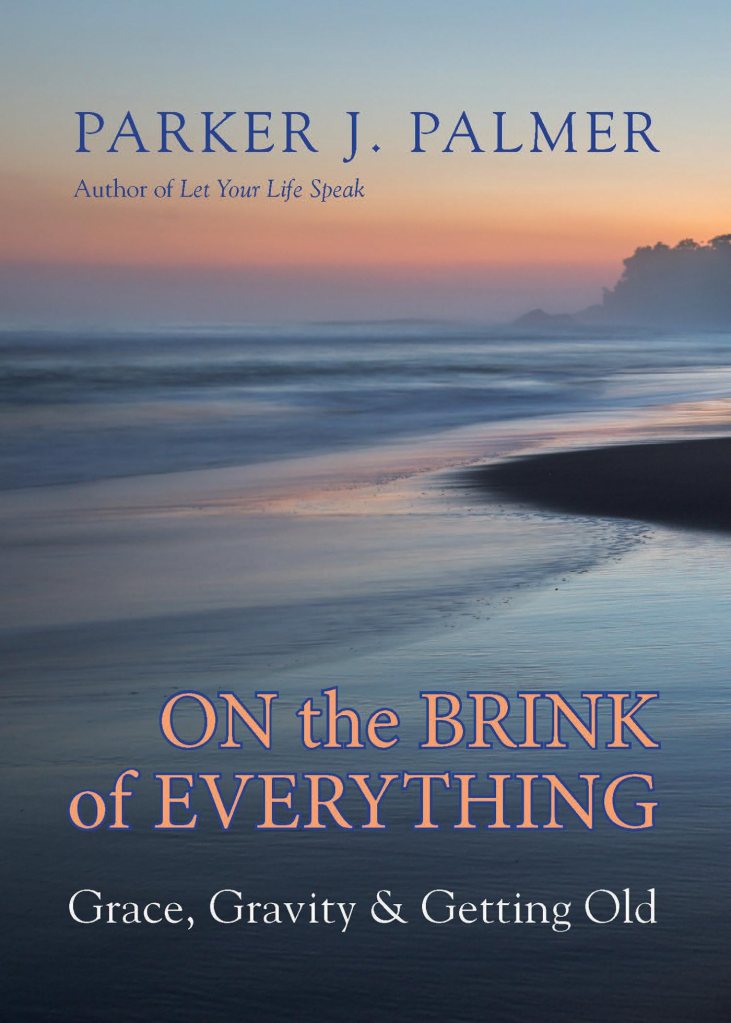
Parker Palmer describes an exchange he had with his friend and long-time editor Sheryl Fullerton. She asked him if he was interested in writing another book. His reply, “I don’t have the energy for it. But I’m really enjoying short-form writing—brief essays and a little poetry.” She went on to suggest weaving the essays and poetry into a book. His reply: “…a book has to be about something. My short pieces have been all over the map.” She went on: “That’s not true….Parker, do you ever read what you write?” Parker: “Of course not. Why should I? I write the stuff. But, OK, I’ll bite. What pray tell, have I been writing about?” Sheryl: “Getting old! That’s what you’ve been writing about. Didn’t you know?”
Thus, the genesis of this little book. As our group read along, we had many criticisms. Some thought the writing was not as good as it should have been. More critiqued the editing. Each of the seven sections of the book has an introduction, a collection of two or three essays, perhaps some poetry, and a conclusion. And the seven sections are preceded by a Prelude and followed by a Postlude! It’s sort of “First I’m gonna tell you what I’ll tell you. Then I’ll tell you. Then I tell you what I told you.”
Interestingly, however, much as many of us found things to criticize, we also found much to admire. There are gems here, some from Palmer himself and some from those whom he quotes, notably Thomas Merton.
From a commencement address he gave in 2015: “To grow in love and service, you must value ignorance as much as knowledge and failure as much as success…Everyday, exercise your heart by taking in life’s pains and joys. That kind of exercise will make your heart supple, so that when it breaks—which it surely will—it will break not into a fragment grenade but into a greater capacity for love.”
From his musings on being contemplative: “Catastrophe, too, can be a contemplative path, pitched and perilous as it may be. I’m still on that path, and daily I stay alert for the disillusionment that will reveal the next thing I need to know about myself and/or the world.”
And on how we take on tasks: “As long as we’re wedded to results, we’ll take on smaller and smaller tasks, the only ones that yield results. If we want to live by values like love, truth, and justice—values that will never be fully achieved—‘faithfulness’ is the only standard that will do. When I die, I won’t be asking about the bottom line. I’ll be asking if I was faithful to my gifts, to the needs I saw around me, and to the way I engaged those needs with my gifts—faithful, that is, to the value, rightness, and truth of offering the world the best I had, as best I could.”
For me, specially, I was much affected by this poem from Parker J. Palmer:
Waving Goodbye from Afar
(for Angie, Ian, Vincent, and John)
One by one, their names have been
exhaled in recent weeks, fading into thin air
on their final breath: Angie, Ian, Vincent, John.
I talked, laughed and worked with them, we
cared about each other. Now they are gone.
No, they do not live on—just watch the world
keep turning in their absence, a tribute here
and there depending on the fame of the fast-
fading name. I’ve always thought it would
be good if a few who loved me sat with me
as I died. Now, as I learn from friends who’ve
taken sudden leave, I’m glad all I can do is
wave goodbye from afar, knowing they can’t
see me. It feels right to offer them an unseen
final salute, seeking no attention, unable to
distract them from a journey each of us must
make alone. It must be a breathless climb, the
kind I’ve made many times in the mountains
of New Mexico. The last thing I wanted there
was someone who just had to talk, when it was
all I could do to climb, to breathe, then stop—
marveling at the view, wondering what’s up top.
— Jeanie Smith
 Books, Brews & Banter