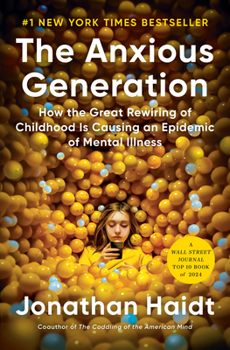
If your child were given an invitation to join a colony living on Mars, would you let her go? What if she begged and pleaded? What if she reassured you that all her friends’ parents were allowing their children to go? What if several well-respected scientists chimed in, saying that it was probably safe, but they weren’t really sure because they hadn’t done any long-term studies about how life on Mars might affect her future growth and development? Would you let her go? Of course not, explains author Jonathan Haidt, in his compelling introduction to The Anxious Generation: How the Great Rewiring of Childhood Is Causing an Epidemic of Mental Illness.
Haidt goes on to explain that children, of course, were never being sent to colonize Mars, but that we took a comparable gamble with our children’s mental health and social development when we handed them smartphones in the early 2010s. And our children are the ones who have lost.
Haidt, a social psychologist and professor at NYU, has amassed a staggering amount of research into an absorbing and highly readable book. He argues that the generation born since 1995 are experiencing a mental health crisis, citing alarming statistics about increased loneliness, isolation, anxiety, depression, and rates of suicide and self-harm.
Although his statistics are terrifying, Haidt’s examination of the cause of this mental health crisis is fascinating. He effectively argues that the linchpin of this mental health epidemic came in the early 2000s, when we became overzealous in the protection of our children in the real world, while simultaneously underprotecting them on the Internet and on social media. Haidt takes on the role of historian and sociologist as he describes how the ‘play-based childhood’ of the 1980s and prior decades faded away and gave rise to what he calls the ‘phone-based childhood.’ He becomes an anthropologist and psychologist as he explains basic human biological needs for risky play, independence, and rites of passage in order to become fully-realized adults. Haidt closes the book by offering hope and practical suggestions for the rehabilitation of our skewed relationship with technology, but the overall effect of the book is sobering.
The Anxious Generation has spent over a year parked on the NYT bestseller list, and Fareed Zakaria called it the “defining book on the generation that grew up with technology in the palms of their hands.” This book is engrossing, timely, important, and highly recommended for anyone who wants to help the children in their lives develop into mentally healthy, emotionally well-adjusted adults.
— Marcy Luft
 Books, Brews & Banter