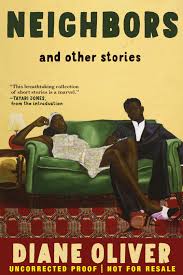
Diane Oliver died in a motorcycle accident at age 22 in 1966. At the time she was a graduate student at the Iowa Writers’ workshop at the University of Iowa. Today reviewers laud this phenomenal black author, a master of the short story, with their highest praise for the economy of her prose, the empathy and insight she demonstrates in her character development and the intimate glimpses of life in the Jim Crow south. The stories are gems of compelling insight far beyond the tumultuous media coverage of the civil rights era. Critics’ reviews are in response to the 2024 collection and publication of fourteen of her stories in a volume titled Neighbors. Only four of her stories were published in her lifetime, none in main stream media.
A particularly remarkable feature of Oliver’s brilliance as a writer is her ability to show rather than tell – to reveal the story line with phrases and details that communicate much more effectively than direct narrative in informing the reader. In the title-based story “Neighbors” for example, Oliver begins revealing the core of the narrative in the third paragraph when Ellie stands up to look over the shoulder of a man reading the newspaper to see if she can read the headline. Immediately the reader suspects the story is about something momentous, but what? “Traffic Jam” finds maid Libby icing Christmas cookies, putting a ham in the oven and soup on the stove for her wealthy white employer’s lunch while she worries about her children scavenging for apples for lunch or alternatively eating cold boiled potatoes, because they have no other food – a powerful, heart breaking contrast.
Throughout the collection a number of common themes are woven into the fabric of the narratives. Her main characters – mainly strong black women – are all aspirational – some, striving for a better world to raise their families as in “Neighbors” where parents are agonizing over whether to send their young son the next morning to integrate a neighborhood grade school. In “Health Services” the mother is focused on a better day-to-day existence for her children by trying desperately to access health care in the face of bureaucratic inhumanity and dire poverty. In “Key to the City” the mother insists on moving her children to Chicago, keeping up the charade that their father will meet them at the depot. She’s confident there’s got to be a better life in the big city even without his support.
In a twist on the theme of aspiration, the main character in the “Closet at the Top of the Stairs” is a young woman who has been sent by her father to integrate a southern women’s college. She is exhausted and on the verge of a mental breakdown due to the unchecked civil rights activism of her father, who has turned her into what feels like an “Experiment.”
Aspiration does indeed have a downside too as in “The Visitor” where socialite and doctor’s wife Alice faces the lies and games of the artificial life she aspired to and now inhabits. Also achieving marriage to a doctor, Meg in “Spiders Cry Without Tears” realizes she is simply an interchangeable object to her husband rather than a unique human being when he gifts her with his former wife’s fur stole, just back from the furriers, as if it were a special present from him.
Oliver’s use of bright colors often serves to emphasize the bleakness of a situation. In “The Closet at the Top of the Stairs,” mentally unstable Winifred has a pink plaid hatbox, and, in a seeming effort to cling to her childhood and her family, a menagerie of stuffed animals including a yellow bunny, a green duck and a pink dog with orange eyes which she carefully wraps in plastic every night. Emphasizing her efforts to fit in even as she spirals mentally, Winifred has her parents send her a white rain coat – what everyone is wearing – to replace the blue one she brought to college. The yellow ribbon the mother in “Key to the City” is carefully ironing for her daughter who cherishes it and wants to wear it to church, vividly contrasts the dire situation of a family stranded in Chicago with a paucity of festive normality. In “Traffic Jam” the fact that the car the father has bought instead of food for his family is blue, his wife’s favorite color when they were courting, provides the reader with a very clear understanding that this man is not focused on the reality of his starving children.
Adding to the compelling nature of these spare and exceptional stories, is the irony of many of the titles. “Mint Julips Not Served Here” focuses on a family who has fled to the woods to live a primitive life, where visitors are met with firearms, in order to protect their young son who no longer speaks after having been brutally bullied. As the reader soon learns, there is no “Key to the City” in that story, rather desperation and fear when the reality of the abandonment by the father sinks in. There is also no health service in “Health Service,” only denial of service and disregard for health. “Traffic Jam” has two disrupting “jams – Libby’s employer is constantly in her way and irritatingly nosy as Libby works in the kitchen, and her clueless husband “jams” up her life by buying an obviously unneeded car.
Book club members were moved by the exceptional skill of Diane Oliver as a short story writer and by the intimacy of these insightful stories of an era they all lived through. They wished she had lived to develop her talent even beyond the high standard of Neighbors. The only adverse comments were about “Frozen Voices,” the experimental story which most found difficult to follow, although some made some sense of by reading it as poetry. Without question, everyone did agree “Neighbors” needs no editing.
— Sue Martin
 Books, Brews & Banter