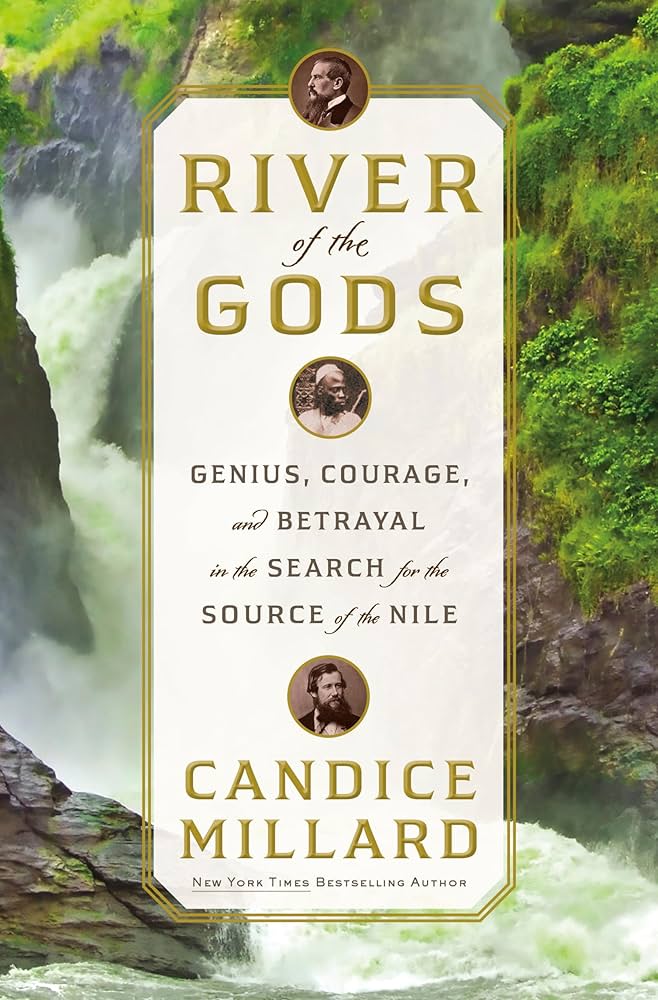
In the prologue to River of the Gods, Candice Millard tells us how the arrival of the Rosetta Stone in England in 1801 triggered a keen interest in Egypt and Africa and the treasures of the ancient world. The Royal Geographical Society, which sponsored exploration of these relatively unknown lands and rivers, thought the best way to learn about this part of the world was not to sail up the Nile—which had been tried without much success—but to travel inland from Africa’s east coast and search for the White Nile’s headwaters. This called for sailing to Zanzibar and there buying supplies and finding guides and workers to support long, arduous, and dangerous journeys, directed by little more than tales of snow-capped mountains and vague reports of large bodies of water somewhere.
Millard tells the story of three of these expeditions. The findings of the trips were tentative and controversial for years until, finally, Lake Victoria (Nyanza) was confidently declared to be the source of the Nile. And that is nice to know.
But the real pleasure of the book comes from Millard’s talent as a storyteller. Although quotation marks are everywhere, and there are fifty pages of notes and bibliography at the end, the story flows like a novel with fascinating, flawed characters, high stakes, and a sense of being there with the characters.
As one reader in our group pointed out, the subtitle is a key to the “real” story. River of the Gods: Genius, Courage, and Betrayal in the Search for the Source of the Nile. The real story is about the darker, the brighter, and the more ambivalent sides of humanity as shown through three very complex and diverse men and one fascinating woman. We come to care about and forgive these brave, striving people, despite their flaws.
There’s Richard Burton, only technically an Englishman, with dark hair and black eyes and long canine teeth, expelled by his own design from Oxford. An adventuresome traveler fascinated by other cultures, a linguist speaking many languages and dialects. A writer, poet, and translator (especially of erotica). A supremely confident man.
There’s John Speke, English aristocrat to the bone, a skilled hunter with a longing to explore and map. A brave, determined, would-be leader who struggles in Burton’s shadow.
There’s Sidi Mubarak Bombay, kidnapped as a child, sold in the infamous slave markets of Zanzibar, and taken to India. Eventually, as a free man, he returns to Africa and serves as a guide on all three of the expeditions. He goes on to become one of the most respected guides in Africa and, by the time he dies, is said to have travelled six thousand miles across the continent and back, mainly on foot.
And there’s Isabel Arundell, eventually Burton’s wife. Chafing under Victorian constraints on women, she writes, “I wish I were a man. If I were, I would be Richard Burton. But as I am a woman, I would be Richard Burton’s wife.”
The story begins with a breath-holding scene as Hajj pilgrims paw through Richard Burton’s possessions. An Englishman in disguise in Mecca, he watches, knowing that “A blunder, a hasty action, a misjudged word, a prayer or bow, not strictly the right shibboleth, and my bones would have whitened the desert sand.”
Because he is such a talented and adventuresome man, the Royal Geographic Society chooses him to lead the first expedition into the interior, with Speke second in command and Bombay as a guide. The challenges of the expedition form the characters, test them, pull them apart, throw them back together, foster friendship and loyalty, nurture jealousy and resentment, breed pettiness and revenge. And finally, on the eve of an important debate about the true source of the Nile—the Nianga or the Tanganika—causes the untimely death of one of them.
The story is so vividly told that the reader can (almost) feel the torment of a beetle trapped in one’s ear, of having a javelin pierce through one’s jaw, of convalescing for many months from hunger, exhaustion, and disease. The sheer courage of the characters to undertake long expeditions to who-knows-exactly-where is a celebration of the human spirit.
A wonderful, engaging book about complicated people living in interesting times. Readable and discussable.
— Sharelle Moranville
 Books, Brews & Banter