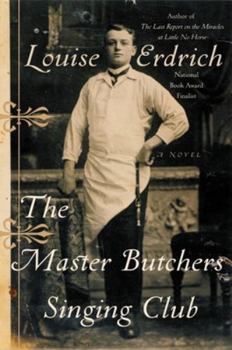
The Master Butchers Singing Club is a mouthful of a title. But read closely, and you’ll see how the role of songs is critical to the book’s message. This is a book about a community in which music is a connector, bringing together people who have grown up in the town, but nevertheless are outsiders, immigrants who are building businesses and relationships, and native Americans who live nearby yet worlds apart.
The traumas of two world wars and of Wounded Knee, of family loss and community estrangement permeate the ground. Songs heal. Songs of patriotism, of war, of love and belonging pervade the book as this engaging cast of characters seeks belonging and a sense of home, not always sure where that is.
The book starts after WWI, as Fidelis Waldvogel leaves Germany for the United States, planning to take a train to Seattle, paying his way selling sausages. He runs out of money in Argus, North Dakota, and ends up making a life there. When his can afford it, he brings his wife Eva and her son Franz to join him. Fidelis and Eva run a successful butcher’s shop and he leads the men’s singing group, which includes Roy, the town drunk, a competing butcher, the sheriff, a doctor, and poor Porky Chavers whose singing might have gotten him killed.
While the men are singing, the women are talking. Eva, by now the mother of four sons, nurtures Delphine, who grew up a motherless misfit in the town, but left for a brief stint as a table in a balancing act with Cyprian, her gay unmarried husband with whom she shares a strong emotional bond. Delphine is close friends with Clarisse, the town undertaker, who is shunned by men because of her occupation. Hock, the sheriff, thinks he’s a prize because he wants her no matter what. The “no matter what” wasn’t what he was expecting. Franz’s girlfriend Mazarine lives in poverty, which makes her the butt of jokes until Delphine helps her with a new wardrobe. And Step and a Half keeps walking and watching, helping from the sidelines.
Fidelis and Eva’s sons are vital to the story as World War II looms and Franz learns to fly, marries Mazarine, and heads to Europe to be a hero. Markus becomes bookish and leans on Delphine to fill the void left by his mother’s death, either trapping Delphine or offering her sanctuary—Delphine’s not too sure. And the twins, Emil and Erich, move back to Germany with their stern aunt, Tante, becoming Hitler youths ready to fight their American brothers.
Then there’s the mystery of the bodies in Roy’s basement—and the beads embedded in an odd sealant that kept the cellar door shut. What was Roy’s role in their deaths? Was Clarisse involved? How did the beads get there? And why won’t the sheriff move on and acknowledge it was a tragic accident?
Erdrich explains some of this, but not all. She leaves crumbs for us to find in careful reading. But she isn’t there to answer all our questions, or to leave all plot points neatly tied up. That’s neither real life nor a good book, and she masterfully gives as both.
— Pat Prijatel
 Books, Brews & Banter