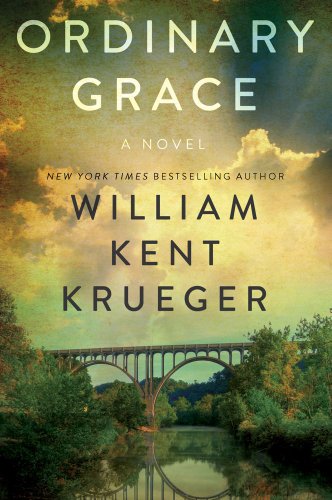
William Kent Krueger’s novel Ordinary Grace won the Edgar Award for Best Novel, the Anthony Award, and The Barry Award for 2013. Krueger has also written a series of mystery stories set in Minnesota based on sheriff/detective Cork O’Connor.
Ordinary Grace is a coming of age-story set in 1961 New Bremen, Minnesota. The story is narrated by Frank Drum as an adult forty years later. He recounts the events and challenges of that summer when everything he, as a thirteen year old, thought he knew of the world he was living in, was falling apart. We feel, see, hear and think as the thirteen year old in this story. It feels as if the town and characters were very real in their human experiences and emotions. The tone of this story is written with a quiet melancholy air.
Based in the small town of New Bremen, Minnesota, 13 year-old Frank, his brother Jake, and sister Ariel live with their parents Nathan, a Methodist minister and his wife Ruth. The story begins with the death of Bobby Cole, a child with golden hair and thick glasses killed on the railroad tracks. In that summer, the town saw five deaths, one of them was a member of the Drum family. Frank’s innocent summer transforms into a dark journey into adulthood.
The family members and the community deal with the deaths in many ways: goodness, joy, kindness, cruelty, anger and grace. The book raises questions of racism, war, mental illness, forgiveness, despair, faith and redemption. Often in the face of despair, Nathan spoke quiet humble words of faith to the community helping us, as the reader, to begin to understand the awful grace of God.
The action, characters, picturesque writing and the setting all enhance the story. The writing allows you to feel the depth of despair, the joy of life and ordinary grace of God.
One question raised in the novel is, “Why does God let bad things happen to good people?” Ordinary Grace is a journey of that question.
But it is Jake who offers us the most profound understanding of ordinary grace. “And that was it. A grace so ordinary that there was no reason at all to remember it. Yet I have never across the forty years since it was spoken forgotten a single word.” At the end of the novel, we glimpse in understanding the quote of what is ordinary grace.
— Deb Krueger
 Books, Brews & Banter