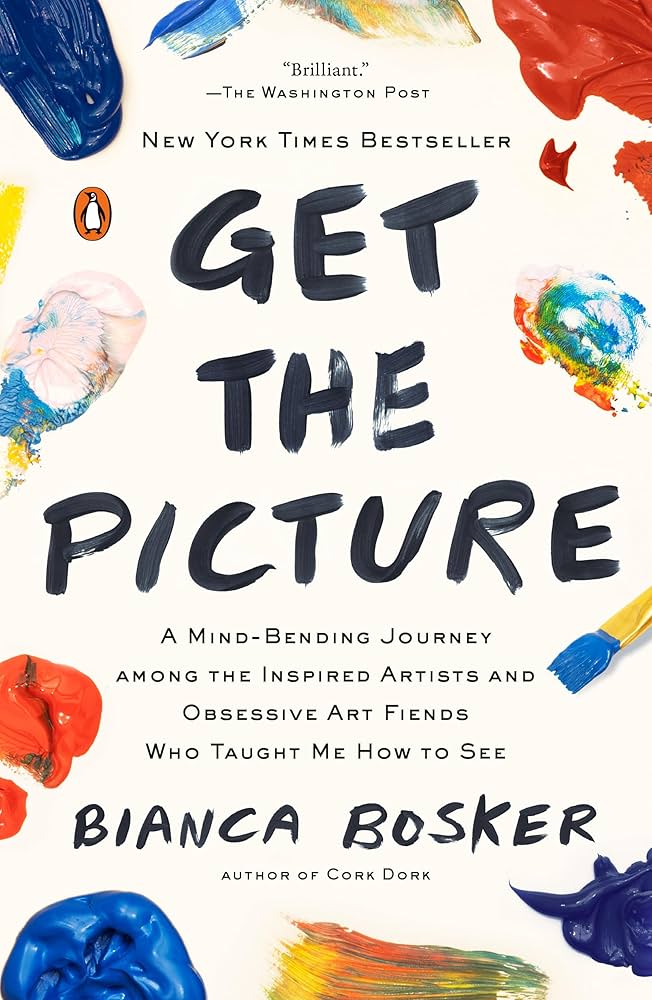
Bianca Bosker looked at art in her New York neighborhood and wondered what others saw.
Trying to figure out what paintings and sculptures made it into galleries and museums, she spent nearly two years working in the New York art world, trying to learn what and who makes art important right now. Because she was a journalist, getting even a menial job in this world was difficult; she was blocked by gallery owners who saw her as a potential enemy capable of distorting their work to the world. It’s an insular, paranoid world where reputations are fragile yet essential.
In Get the Picture, Bosker shares what she learned as a gallery art assistant, an artist’s apprentice and as a guard at the Guggenheim Museum. The subtitle demonstrates the book’s breadth: A Mind-Bending Journey Among the Inspired Artists and Obsessive Art Fiends Who Taught Me How to See.
Bosker developed close relationships with some of the top players in the art game, doing menial work, such as stretching canvasses and painting walls, to prove her commitment in an exhausting journey of multiple 12-hour days ending in late-night art openings and parties. Through this immersion, she learned that contemporary art often is judged by context rather than content, its meaning coming from its story. Not only who made it, but why and where, and who owns it. Art for grandma’s condo has less value than that purchased by influential collectors—even if it looks the same to us.
In fact, galleries representing “important” art are often hidden away from the annoying public. They don’t want us to bother them. The wrong buyer can spoil the story and reduce the work’s value. And it can be ruinous for an artist when her work sells at auction for many times its original selling price. While that might seem a good thing, none of that money goes to the artist, and the result of the inflation can be a deflation of the artist’s reputation. It looks like collectors see no future in holding onto the art and are dumping it for whatever they can get—which can be 100s of times the original price. Plus, being too popular cheapens the importance of the piece.
It’s a confusing world in which work that is “too pretty” is denied admittance because it is seen as simplistic and lacking in meaning, although meaning shifts so much it’s hard to keep up. The idea of an intuitive relationship with art is often seen as naïve. The art needs to earn its standing not just by being a cut above, but also by being less accessible than other works.
At the Guggenheim Museum, Bosker spent hours doing nothing but staring at art. And she learned her way of finding meaning—through immersion, waiting for the details, the meaning, the beauty to inevitably emerge. The way most of us go to art exhibits, she learned, is wrong. We dutifully look at each painting, read its description, then go on to the next. Pros, by comparison, enter the room, find the piece that captures their eye immediately, go to it, and do a deep dive. Not just for a few minutes, but for 10, 20 or more. Forget the description and let the art speak for itself. Some art instructors, in fact, require students to look at the same piece over and over throughout a semester, sometimes every class session, spending hours on one work. Each time they look, they see something different.
But there’s another reason to avoid reading the descriptions of art in galleries and museums—they are written in “International Art English,” a batch of fancy words that most of us don’t understand—and aren’t supposed to. As an example, Bosker quotes a news release for a show that will “summon forces of indexicality and iconicity from the aspirations, alibis and abuses of sovereignty.” You betcha.
So, what is art? For enjoyment, it’s up to us—what engages us and gives us joy. For profit, it’s up to the collectors and investors—what ends up in museums and art warehouses and sells for six figures or more.
Bosker introduced us to several artists that might be fun to follow, especially Erin O’Keefe and Julie Curtiss. And even though Jack Barrett took up far too much space in the book and came off as a person we need not ever meet, she nevertheless recommends his gallery in Tribeca, a block from the DIMIN gallery, whose owner, Rob Dimin and former partner Elizabeth Denny are committed to helping new artists. As for Amanda Allfire and her face-sitting art—the less said the better.
— Pat Prijatel
 Books, Brews & Banter