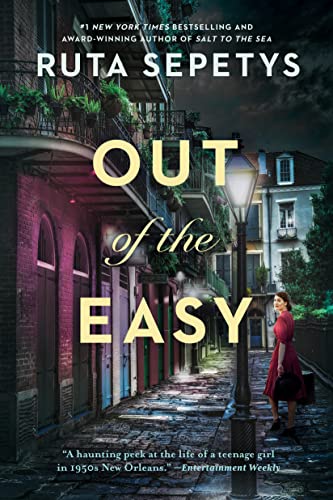
“My mother’s a prostitute.” Well, there’s an opening line for you! So begins 17-year-old Josie’s story set in 1950 New Orleans. This is a page-turner, a story of the southern gentility that covers over the decadent underbelly of “The Big Easy.” And a young girl’s desire to get out. There’s a murder mystery, dreams and dashed hopes, survival in tough circumstances. But this book is also about love and about family.
Josie’s family isn’t like yours or mine. Her father is unknown to her, but she fantasizes about who he might be. Her mother is well known to her, but is incapable of nurturing her, capable of great cruelty and actually betrays her time after time. Her family is Willie, the madam of the brothel where her mother works; Cokie, the driver of Willie’s car and a devoted believer in Josie; Charlie, an author and bookstore owner who has suffered an assault that has left him diminished and in need of care; Patrick, Charlie’s son, who runs the bookstore where Josie works. There are others, too, who surround this smart, worldly-wise teenager and keep watch over her, frequently without her knowledge.
The story centers on Josie’s chance meeting with Charlotte, in New Orleans to visit her cousin. Charlotte is a freshman at Smith College. She and Josie form an immediate bond that leads to Josie’s determination to go to Smith and get “out of the Easy.” She’s smart enough, sure; she’s got the grades. But her “extra-curriculars” are not exactly what are featured on most college applications. She cleans at the brothel in the mornings and works at the bookstore, where her “family” has created an apartment for her where she has lived alone since she was eleven.
Josie’s relationship with Willie is charming, if not your normal “mother”-daughter one. Take this exchange, for instance. This is the morning routine, after Josie has cleaned up after the previous night. She takes Willie her morning coffee, made just so, along with a report:
“So what do you have,” she asked.
I picked up the pail. “Well, first, this huge thing.” I pulled an enormous red shoe out of the bucket.
Willie nodded. “From Kansas City. He paid two bills to dress up in stockings and dance with the girls.”
“And he left a shoe?” I asked.
“No the other one’s under the settee in the parlor. I keep them up in the attic for guys like him. Wipe them off and put them back up there. What else?”
I pulled a twenty dollar bill out of the pail. “In Dora’s toilet tank.”
Willie rolled her eyes.
I produced a silver cigarette lighter from the pail. “On Sweety’s bedside table.”
“Well done. It belongs to an Uptown attorney. What a horse’s ass. Thinks he’s so smart. Doesn’t know the difference between piss and perfume. I’ll have fun returning that to him. Maybe I’ll drop by his house at dinnertime.”
“And this,” I said. “I found it in the upstairs hallway.” I help up a bullet.
Willie put out her hand.
“Did you have one of the bankers here last night?” I asked.
“This isn’t from a banker’s gun,” said Willie. “It’s for a .38.”
“How do you know?”
Willie reached under her pillow and pulled out a gun. With a flick of her wrist she opened the cylinder, slid the bullet in the chamber, and snapped the cylinder back in place. “That’s how I know.”
Willie can be gruff, but she’s very well aware of the gem that Josie is and, as we learn, will do almost anything to protect her.
Josie’s growing desires to be admitted to Smith, to somehow find the money to pay the tuition, room and board, and to avoid Cincinnati, her mother’s murderous boyfriend, consume her and drive the plot. And a compelling plot it is.
I’m not the only member of the book club who couldn’t put this book down. We’ll be reading more of Ruta Sepetys in coming months!
— Jeanie Smith
 Books, Brews & Banter