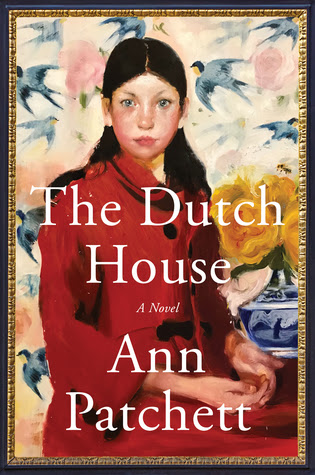
The Dutch House, by Ann Patchett

Patchett is a connoisseur of imperfect characters who are compelling mixes of the saintly, the clueless, the wise and loving, the selfish and manipulative—characters the reader can’t help but care about because they are just so human.

In The Dutch House, Patchett uses the grand VanHoebeek’s mansion that came on the market after World War II as the spine of the multi-generational story. When Cyril Conroy buys the Dutch house (with all the VanHoebeek’s personal possessions and three servants included) as a surprise for his wife Elna, it is a cruel gift to the quiet, would-be nun. 

The changes brought about by moving into the Dutch house eventually send Elna fleeing to Bombay to work with Mother Teresa (who is actually in Calcutta). After she leaves, the Conroy children, Maeve and Danny, are in the capable, loving hands of the housekeeper, the cook, and the nanny, Fiona (aka Fluffy), who is a warm, humorous presence from before the beginning of the story through the end, three generations later.

Danny, as the narrator, shows us life in the Dutch house. After their mother, who has been disappearing for increasingly long spells, seems perhaps not to be coming back ever, he and Maeve wonder if she is dead. Probably, their dad tells them. She probably died in India. Information which is neither comforting nor edifying. 

Then young and attractive Andrea begins to come and go in the Dutch house. The children are left on their own to figure out what this means. Maeve becomes suddenly and seriously ill with diabetes. Despite all this, young Danny still feels secure and loved by the servants and especially his sister, who has taken on a quasi-motherly role.  

When their dad marries Andrea, she brings two little girls, Norma and Bright, into the Dutch House. Maeve and Danny come to love the little girls, but Andrea—in a vein of casual cruelty, gives Maeve’s room to Norma when Maeve goes off to college. And when Cyril dies of a heart attack shortly after Maeve graduates, Andrea calls Maeve and says of Danny: “Come and get him.” Thus Danny and Maeve are summarily banished from the Dutch house and Norma and Bright.  Equally shocking, Maeve and Danny discover Andrea now owns everything: the Dutch house and all of Cyril’s real estate and investments. Danny and Maeve are left with Maeve’s car and a foundation established for the education of Cyril and Andrea’s four children. 

Thus begins Danny and Maeve’s period of watching the Dutch house and plotting. In Maeve’s car, they take up posts, smoking and talking, with Maeve planning ways for Danny to use up the foundation money by the longest, most costly education imaginable. And from this revenge plot, Danny eventually and unwittingly becomes a doctor, when all he wants to do is get a little money together so he can start investing in real estate and follow in his dad’s footsteps. 

Danny’s girlfriend, Celeste, in training to be the best doctor’s wife ever, discovers she has married a landlord instead of a doctor—repeating Elna’s pattern of discovering her husband was not who she thought he was. And Danny ironically repeats family history too by surprising Celeste with a beautifully restored brownstone in Manhattan not at all to her taste.

Over the years, through various bits of information, Danny and Maeve gradually come to understand their mother is still alive, living and doing good works among the homeless in the city. Danny struggles with how to feel about this, but Maeve embraces the woman she still calls Mommy.  

Near the end of the story, Elna convinces her children, as only she could, to go with her to visit the Dutch House.  This causes a tectonic shift among the characters. Now demented, Andrea is enormously comforted by Danny, who she believes is Cyril returned to her. Ever compassionate (except perhaps to her young children) Elna moves back into the Dutch house (unchanged all these years) and works with Norma (who actually did want to become a doctor) as Andrea’s caretakers. Maeve, who feels abandoned by her mother once again, dies of what is surely meant to be taken as a broken heart.  

As the story ends, Danny and Norma become siblings of sorts (“a half-sister from a second marriage,” as Danny cautiously puts it). Elna begins to disappear among the poor again. Danny finally gives up his rage at his mother and replaces it with “familiarity.” Danny and Celeste divorce. Fluffy visits the Dutch House now and then and sleeps in her old room above the garage. And May—Maeve’s namesake—gains fame and fortune as an actress and ultimately buys the Dutch house and brings back parties reminiscent of the VanHoebeek era. And the portrait of Maeve, originally painted to stare down the VanHoebeck’s portraits hanging across the room, looks to all the world like May. There’s a sense of rightness about this ending. Finally, the Dutch house has come into its own as the Conroy house. 

The Dutch House is a rich and conversation-provoking story showing us the human condition in fascinating particulars.

— Sharelle Moranville
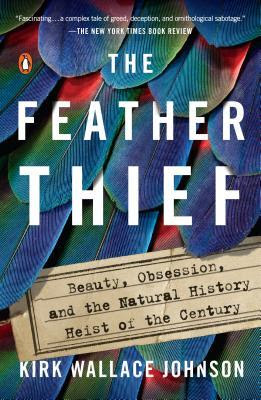
The Feather Thief: Beauty, Obsession and the Natural History Heist of the Century, by Kirk Wallace Johnson

Is this book autobiography?  Memoir?  Is it the story of a quest for the answers to an absorbing crime story with an uncertain ending?  Is it scientific history?  Answer: All of the above!  In weaving together these several strands, this non-fiction tale led to provocative discussion. 

Kirk Wallace Johnson opens his tale autobiographically:  He’s suffering from PTSD in the aftermath of the war in Iraq.  His current work, seeking to resettle Iraqi interpreters in the US, meets with limited success and constant frustration.  To relieve his depression, he takes up fly-fishing.  From his guide, he learns about fly-tying, the creation of beautiful works of art that are ostensibly for use as hooks to attract salmon.  In reality, these salmon flies are almost never actually used to fish.  They are bought and sold and hoarded as the works of art they are.  Trouble is, however, that the “best” require the use of rare and expensive bird feathers, many from extinct or near-extinct birds. 

As the author enters the world of the fly-tiers, he starts to hear of a theft from the British Museum’s ornithological collection held at the Tring Museum outside London.  This theft was accomplished by a young man, barely out of his teens, named Edwin Rist.  To explain not only the lure of the beautiful bird feathers that drew Rist to the heist, but also the scientific value of the birds taken, the author discovers the work of naturalist Alfred Russell Wallace, who in the middle years of the 19th century, traversed the Malay Archipelago where he gathered and catalogued over 125,000 specimens of rare birds.  His meticulous efforts to tag the date and location of each skin, as the bird carcasses are called, led him independently from Charles Darwin to arrive at the theory of evolution via natural selection.  

But what of Edwin Rist?  Rist is an American young man studying flute at the Royal Conservatory in London, hoping to be selected to play with a major European orchestra when his studies are completed.  He is also an up-and-coming expert fly-tier, featured in the fly-tying world’s website as “the future of fly-tying.”  He needs money to purchase the exotic bird feathers to use in tying his flies.  His visit to the Tring museum awakens him to the possibilities of securing a supply of rare feathers for his own fly-tying and of a steady source of income from feather sales to other fly-tiers.  

The subtitle speaks of obsession and there are many to examine in this book.  There is, first, the scientific obsession of Alfred Russell Wallace, the collector of the specimens, who from his lower-class origins sought academic recognition that was at the time only granted to upper class Britons.  There is Edwin Rist’s obsession with tying classic fishing flies that motivates the theft.  And there is the author’s own obsession with the crime and with recovering feathers for the museum, an obsession that has therapeutic value in alleviating his PTSD symptoms.   

Fly-tying with exotic feathers has exerted an obsessive pull on anglers and on pure hobbyists, with an upsurge of interest in the late 20th century.  With that enthusiasm comes the obsessions that fuel an underground market in rare and often illegal feathers.  Edwin Rist fell into this obsession as a young teenager.  He was later arrested and tried for the theft, was found guilty but lightly punished with a short period of probation after pleading incapacity due to Asperger’s syndrome.  

Many of our discussions were prompted by the judicial treatment of the case.  Could the system do justice to all the interests of society?  The police were essentially done when Rist was identified and tried.  The prosecutor and judge felt limited by prior decisions on the Asperger defense.  The museum’s interest waned when the specimens that were recovered were missing their sourcing tags or had been cut into marketable parts.  The general silence of the “feather underground” made it more difficult to track the fate of the specimens.  What do we think should have been a just punishment or a restorative action imposed on Edwin Rist?  And could he have pulled this off alone?  

Where does the value of the specimens to the scientific community collide with the value of the birds as objects of true beauty that the public might want to see?  Fly-tiers ask:  “Why does the Museum need so many examples of the same bird anyway?”

The Feather Thief is a good read, provocatively posing questions to which different readers might well derive different answers.

Jeanie and Bill Smith


Virgil Wander, Leif Enger

This quiet, gentle story is remarkable for the artistry of it words, the realistically oddball characters, and its touch of Northwoods magic realism. The main character, Virgil Wander, almost drowns when his car slides off the road and into Lake Superior. The accident damages his brain and, as a result, he quietly and gradually reinvents himself, leaving behind his hesitant, staid self—the “former occupant” of his apartment, clothes, and life. In his place is a man willing to take a few risks.

Comparing his flight into the lake with his new life, he says:

“A person never knows what is next—I don’t anyway. The surface of everything is thinner than we know. A person can fall right through, without any warning at all.” 

Virgil owns a down-on-its-luck movie theatre, the Empress, and is also Greenstone’s city clerk. (When he explains this latter job, he addresses the reader directly asking, “Did you think I made a living at the Empress?” It’s a delightfully engaging moment.)

After his plunge into the lake, Virgil has a unique mental quirk: He cannot remember adjectives. But no matter, Enger demonstrates the power of all parts of speech, in quote-worthy paragraph after paragraph, as Virgil creates a new life from the leftovers of his old one. The language alone makes the book a wonder to read.

For example, when Virgil first meets the mystical Rune, he describes how the old man smoked his pipe: “The smoke ghosted straight up and hung there undecided.” Who needs fancy adjectives when you can create an image so economically and so powerfully?

And when Virgil finds the ominous Adam Leer burning clothes behind his house, he again evokes the smoke-in-need-of-direction image, this time using an adjective in a way that makes the reader wonder why other writers haven’t used this description: “Tendrils of tea-colored smoke uncurled to explore the immediate region.”

Some lines are laugh-out-loud funny, as when Virgil observes, “The evidence of my life lay before me, and I was unconvinced.” 

Virgil, who narrates the book, introduces us to his community in the bad luck town of Greenstone, Minnesota, north of Duluth. Residents have landed there by chance, as Virgil did, lured by a lake view and cheap real estate; others were born there, as was the mysterious and sinister Leer; and then there’s the elfin Rune, who shows up on the shore of Lake Superior flying kites. 

But these are no ordinary kites—they’re so mystical that people passing by stop and wait their turns to fly the giant dog, or the bike with wheels that turn, a burning fireplace, or even an anvil. Rune is in town looking for stories of his son Alec, whom he never met, and who flew out over Lake Superior one day in a tiny old plane, never to return. Nadine, Alec’s widow, takes over his neon sign business, creating pieces of art she sells nationally; Virgil loves her from afar, assuming he has no chance with her, until he does. When the two finally connect, he observes, “She kept looking away then back to me, as though at a nice surprise. This was maybe best of all. I never once expected to be someone’s nice surprise.” 

Two fatherless boys, Bjorn and Galen, help pull Virgil toward himself and away from the previous tenant, aided by Ann and Jerry, married but not really, who are trying to move beyond the margins of their lives.  Then there’s a giant sturgeon, a bomb, a festival called Hard Luck Days, and a cameo by Bob Dylan, who wrote a song about Greenstone, but Virgil can’t remember which one. And a priceless set of old movie reels Virgil refers to as imps in a jar, and which get the Empress a new roof.

Like the kites, the characters’ lives move with slow precision and eventually reach a conclusion that ties the story lines and loose strings together. A few bits are left hanging (What actually did happen to Leer?) and some are tied up with a bit of sadness (Jerry’s luck gets harder, although he might have left the city better off).

Toward the end of the book, the community comes together for Virgil, who does not expect it, and he says, poignantly, “Your tribe is always bigger than you think.” 

At the very end, in Rune’s city of Tromsø, Norway, Nadine and Virgil face an unknown future, but with a fresh outlook that mirrors the theme of the book: “We all dream of finding but what’s wrong with looking? When the sun rises we’ll know what to do.”

—Pat Prijatel