Glass Houses, by Louise Penny

For the thirteenth time, Louise Penny has written a number-one best selling mystery novel. And once again, Superintendent Armand Gamache (now promoted to Chief Superintendent of the Sûreté du Quebec) plays the leading role.  But this time Penny’s plot weaves two seemingly un-related stories together into an intricate mystery full of twists and turns, juicy details and humor. It’s a great read.  And, like all Penny’s Gamache mysteries, it is beautifully written.

The book opens on a steamy July day in an uncomfortably hot Montreal courtroom. Surprisingly, Gamache is the one on the stand.  We see a whole different side of his character as we watch and listen to his testimony about drug trafficking.  We learn that he is the courageous, behind-the-scenes leader of a secret, one-man very dangerous war against drugs.  It’s a war that could cost—or save—hundreds of lives. Including Gamache’s.

The second, seemingly un-related, story begins three months later on a cold, rainy November day in Three Pines with the sudden, mysterious appearance of a masked, cloaked figure.  He stands unmoving for hours, then days, on the Village Green thorough rain and sleet, staring at someone or something in the village.

Villagers come to believe that the figure is a Cobrador, a debt collector. According to history, they act as a conscience for someone who has committed a terrible crime.Villagers are curious, but soon become wary.  Gamache suspects the creature has a “dark purpose.” But he can do nothing but watch and wait for days, as his fears continue to mount. Then the creature vanishes as quickly and quietly as it arrived.  But the villagers’ relief quickly turned to fear when a body is discovered. And another murder mystery begins.

Penny toggles between the two stories, between the courtroom in Montreal and the village of Three Pines, putting her readers inside Gamache’s head as he slowly and meticulously unravels the mysteries.  She weaves an intricate plot, taking readers scene by tantalizing scene to the truth that finally solves the mystery.

— by Gail Stilwill
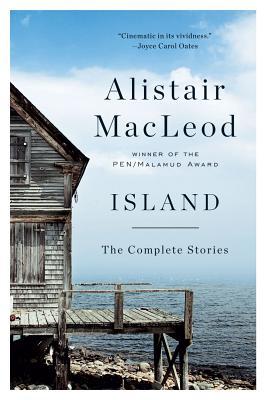
Island: The Complete Stories, by Alistair MacLeod

The words of the narrator in “The Closing Down of Summer”:

“[I]n the introduction to the literature text that my eldest daughter brings home from university it states that ‘the private experience, if articulated with skill, may communicate an appeal that is universal beyond the limitations of time or landscape.’ I have read that over several times and thought about its meaning in relation to myself. . . . I would like somehow to show and tell the nature of my work and perhaps some of my entombed feelings to those that I would love, if they would care to listen.”

And what follows is the narrator’s explanation of leaving university and the reading of literature to embrace the life of a deep shaft miner, traveling the world, abandoning his family at the end of each summer in a caravan of big cars full of large, strong, brave men, and going to places like Haiti, Chile, the Congo. Bolivia, Guatemala, Mexico, Jamaica. Drinking moonshine as they drive non-stop, hard through the night.

MacLeod is brilliant in showing and telling the nature of their dangerous work and the fullness of their hearts in their isolation from the rest of the world. We can feel their physicality and courage. We can know them.

Like the narrator in “The Closing Down of Summer,” MacLeod wants us to understand and care and know about his corner of the world, his people, his roots. So he writes about the people who came to Cape Breton as part of The Clearances (the forced migration of people from the Highlands and western islands of Scotland in the mid-to-late 18th Century). Most of his stories are set on Cape Breton, where the old Gaelic language, music, and myths are still part of life.

MacLeod uses his amazing skills as a describer to make us feel how beautiful and compelling, but inhospitable and dangerous, Cape Breton is. How proud people are to be miners, fishermen, and farmers. How arduous such work is on the body and spirit. What pride the people take in their work.

There are sixteen stories in Island, the first published when MacLeod was thirty-one, the last when he was sixty-three. And the tenor of the stories, as they progress from 1968 to 1999 generally embrace the aging of the human spirit and psyche.

Characters in the earlier stories are more innocent and aspirational (boys like Jesse in “The Golden Gift of Grey” who drifts into the pool hall, and like James in “The Vastness of the Dark” who believes leaving home will be simple).  With the middle stories like “The Closing Down of Summer,” narrators are in their prime, but mindful of the cycle of life. And with the last stories like “Vision,” “Island,” and “Clearances,” there’s disillusion, madness, German tourists, and pit bulls.

Stories are populated by children, young people, men, women, old people–and, of almost equal importance, by cattle, horses, sheep, dogs, and chickens.  The breeding of people and the breeding of animals is serious business in this world.

Most of the stories have a male narrator – thus the collection overall has a masculine perspective. In many ways, the stories are a study of masculinity. But we see women. And they are strong. The fierce mother in “The Boat” and the woman with the coral combs in “In the Fall.” The resolute grandmother in “The Road to Rankin’s Point.” The brave, lonely, ultimately mad woman in “Island.”

The skill of MacLeod’s writing makes Cape Breton and its people real. We know them. And by knowing them, we know ourselves. We know that life is ultimately a story of loss, but that loss can be faced with kinship, love, and courage.

My favorite anecdote about MacLeod is that when a writing student asked him how long a good story should be, MacLeod answered, “Just make your story as long as a piece of string, and it will work out just fine.”

And it does.

—Sharelle Moranville

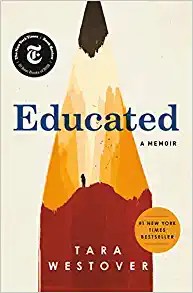
Educated, by Tara Westover

Educated is a multi-dimensional memoir in which Tara Westover traces her voyage from an isolated and troubling childhood to the highest levels of academia.  She grew up in a religiously conservative Mormon family in remote surroundings in the Idaho mountains.  The family outlook is more than conservative – as Westover describes it, the ethic is survivalist, isolationist, and distrustful of outside influences, even those from mainstream Mormon sources.  Telling are her father’s extensive preparations for Y2K and his ultimate disappointment when those preparations were proved unnecessary. The isolation grew, such that the older children attended community schools for a few years, but Tara never attended school, and her home schooling included little beyond the Bible and the Book of Mormon.    

The dominant themes of her youth are dangerous work in the family junkyard and controlling and abusive behavior by an older brother.  The picture is more nuanced, however, as she was exposed to outside forces in several ways. One set of grandparents lived in town and provided some contact with the larger world.  She developed a singing talent and participated in church music and community theater.  She occasionally held jobs in town and developed some trusting friendships with other young people.  An older brother went to Brigham Young University and ultimately opened an awareness of that avenue to Tara.    

These conflicting forces built Westover’s growing awareness of her talents and opportunities.  This section of the memoir left some of our group unsatisfied; some readers would have liked more description, for instance, of how she prepared herself for college admission without the benefit (or burden?) of any formal scholastic training.  Other themes were just as important as academic preparation, however. Westover covers how leaving for college allowed her to deal with mental instability and abusive relationships, her own sense of integrity, and the values of family relationships compared to academic work.  Ultimately that is unfinished work and she is still wrestling with being part of family without being trapped by it.  She deals very honestly with the reality that some of her observations and memories differ substantially from those of other members of the family.    

Our group had an interesting discussion of memoir writing.  Westover writes from the perspective of the age of about thirty. This gives her an advantage of proximity to the events she writes about, but limits the perspective that may come with more distance and maturity.  We expect that the bulk of Westover’s professional and personal development still lies ahead of her and might lead to new reflections of her forming experiences. The etymology of “educated” suggests a drawing out.  Usually this implies drawing lessons from the past or work of others or drawing the best out of oneself.  This tale also evokes Westover drawing herself away from the complexities of her birth family into the world of higher academia as she studies at Cambridge and Harvard.  As education should never end, we await what will fuel Westover’s future memoirs.   

— Bill Smith