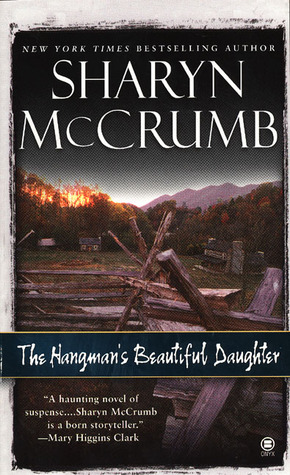
The Hangman is a rock formation in Wake County, a rural community in the mountains of eastern Tennessee. In this charming natural setting, Sharyn McCrumb creates the second book in her Appalachian ballad series, a mystery surrounding the murder of four members of one rural family. She introduces us to a loose-knit community of independent yet interdependent locals who live along a carcinogenic river full of toxins from a paper plant and in hills once covered by chestnut trees that were all killed by a blight decades before.
This is a story about humans and nature, trials and resilience, destruction and resurrection, change and adaptation.
But who is the Hangman’s Beautiful Daughter?
Could it be Nora Bonesteel, the woman who lives on the top of Ashe Mountain, who knows her neighbors’ news before they do because she has The Sight? No, not Nora. She is an incomparable character, but the description “beautiful daughter” falls a little short of incapsulating her rare personality and her inimitable power.
Or maybe it’s Laura Bruce, who ends up taking over her husband’s ministerial duties when he is sent to the Gulf War? No, she is a bit of an angel of mercy, rescuing kids of all ages from floods and fires and human suffering. But, again, “beautiful daughter” doesn\’t capture her. She’s more the mother.
How about Maggie Underhill, one of the two surviving children of the slain family? No, Maggie is an important character, but not a main force in the book. Sadly, like her mother, she tends to be a follower until, at the end, her life depends on forging her own way.
None of these women feels right as the Hangman’s child. If not them, though, who?
The clue to that puzzle is in McCrumb’s love of folklore and folk music, which she weaves throughout this and her other ballad novels, and in the music of a band that shares her Scottish roots. In 1967, 25 years before this book was published, the Incredible String Band, self-described as a “Scottish psychedelic folk group,” released an album titled Hangman’s Beautiful Daughter. At the time, singer Mike Heron explained the title: “The hangman is death and the beautiful daughter is what comes after.”
Death does permeate this novel, yet the book ends up being about life. About what comes after. This is not a grim read, but a loving, hopeful one.
McCrumb introduces bits of history and geography that add depth and intrigue to her tale. She explains that, while people in the nearby cities fought on the Confederate side during the Civil War, those in the mountains supported the Union. They had their land, their sustenance, and they wanted to keep it and to be left alone. Yet they got embroiled in the war and in what came after.
As a side story, McCrumb introduces Tavy and Taw, childhood friends, now retired, who are embroiled in a fight with the paper mill. Tavy has been diagnosed with incurable cancer that the doctor ties to the toxic river on which he has spent his life fishing. Turns out the Tavy and Taw are also the names of two rivers in Cornwall, which some locals say are enchanted.
Plus there’s Laura’s baby and Nora’s prediction and the sheriff’s fixation on Naomi Judd and her retirement from music because of hepatitis. In the end, the community pulls together, survivors helping survivors. Thanks to the generosity of his dispatcher, the sheriff sits in bliss watching Naomi in concert.
The book was written in 1992 and the themes of environmental degradation have only gotten worse. But Sheriff Arrowood would be happy to know that Naomi has gotten much better.
— Pat Prijatel, with thanks to Jeanie Smith for asking the original question, “Who is the hangman’s beautiful daughter?” and to Annie Waskom for her research on 1960s psychedelic folk bands and rivers in Cornwall.

 Books, Brews & Banter