(Warning: contains spoilers)
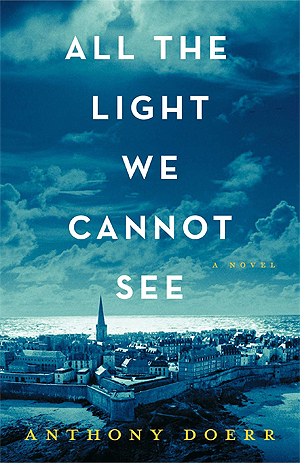
Anthony Doerr’s 2014 novel All the Light We Cannot See is a story of survival, courage, sacrifice, suffering, family, friendship, love, and hope. It’s set in France and Germany during WW II. How many thousands of novels does that thumbnail description fit? (Jaded publishers and others in the business are starting to think of such novels as just another WW II book, which might account for some of the tepid reviews the novel got before it circulated through the wider reading community.)
All the Light We Cannot See is one of the richest, most readable, discussable, and likeable WW II novels ever. Yes. Likeable. A narrative of war and suffering and death becomes a hopeful hymn about family, kindness, potential, magic, love, and mystery.
Doerr brilliantly shows us the specifics in the general: the character so unique and real that the reader can become the character. And thus we can truly cloak ourselves in the potential for individual goodness in the storm of a world gone mad. We learn and are comforted by how we might behave in a similar situation.
In the final analysis, the story belongs to Marie-Laure, the little blind girl with the father who keeps thousands of keys for the National Museum of Natural History and is a gifted woodcarver. In both Paris and Saint-Malo he carves tiny, clever models of their neighborhoods, which Marie-Laure must memorize with her fingertips. Then by counting grates, benches, streets, and tapping her other senses for cues, she must show him she can navigate their neighborhood. He also teaches her to use her cleverness to unlock tiny objects to find the treasures inside. To this reviewer, those incredible miniatures, made in such a rush by a father for his vulnerable six-year old girl as the Germans draw near, are the most unforgettable takeaways of the novel.
And as her world is going up in conflagration, Marie-Laure’s fingertips race across the braille dots to open another world, the world of Twenty Thousand Leagues Beneath the Sea, which she broadcasts as the bombs fall. Marie-Laure, with her blindness, has a huge capacity for the world and human experience.
Then there is Werner, a German boy, whose snowy white hair is almost as much a character marker as Marie-Laure’s blindness. He is an undersized orphan trying to look after his sister and others in the industrial area of Zollverein, Germany. Werner has a preternatural gift for mathematics and radios and, as a result, is spared going into the mines, but is scooped up into the German army where he becomes a radio operator.
Marie-Laure and Werner cross paths when the Allies begin bombing the holdout of Saint-Malo in early August, 1944. During the most intense part of the circular, reiterative narrative, Werner is trapped in the basement of the Hotel of Bees because of a bomb hit. Marie-Laure is trapped not far away in the attic of her uncle’s house with the cursed jewel, The Sea of Flames, in her possession. A mad, dying Nazi stalks the downstairs desperate to get at the jewel, which he believes will save his life. Thankfully, Doerr lets a long, comforting resolution play out as we see what happens to the survivors of the bombing of Saint-Malo. We see the survivors intermittently as they go about life-after-the-war until 2014 (the novel’s pub date).
So vicariously was I participating in this novel, if I should go to Paris this year (fat chance), I would keep an eye out for an elderly blind lady who seems to know where she is going. And I do believe some evil potential, buffeted and stained to look like ordinary sea rock, is always being swished around on the ocean floor waiting to be found and polished.
Doerr expands the literal plot line (this-happens-then-this-happens-then-this-happens) with a richness of inversions, paradoxes, oxymorons, juxtapositions, repetitions, symbols, and motifs that invite the reader to go beyond the storyline. For example:
- Clearly, a mollusk is not just a mollusk. And what’s with all those birds?
- Before two of the most heart-breaking events of the narrative (the rape and Werner’s death), why are there quasi-Eucharistic events?
- Why is the fabulous diamond, The Sea of Flames, given such an oxymoronic name?
- How can we not see light?
- Why is Twenty Thousand Leagues Beneath the Sea the message of comfort to all who hear Marie-Laure’s last broadcast? (On the surface, it would seem to be an inversion of the usual message of hope.)
- Why can the story be read pretty effectively backwards?
Doerr’s story has become an earwig. Certain images, characters, events, and themes will always remain in my head. More than any novel I’ve read in years, I felt that I was buried with Werner below the Hotel of Bees. I was in the cold orphanage attic with him when, as a boy, he listened to a faraway voice talking about the nature of light on the radio. I was as hungry as Marie-Laure contemplating opening the last unlabeled can of food in the attic.
As an adult who has read a gazillion novels, I’ve largely lost my childhood ability to be carried away into another world by a story. So thank you, Anthony Doerr, for letting me do that again.
—Sharelle Moranville


 Books, Brews & Banter