Author Kent Haruf

The other morning over coffee and The New York Times, my husband said, “Did you read Kent Haruf died?”  I hadn’t, but I wasn’t surprised.  I understood his most recent novel, Benediction, was given that title for a reason.

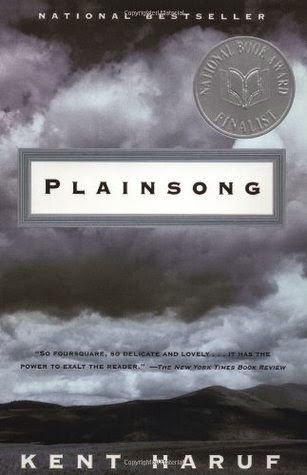
He is one of the few prolific writers of whom I can say that I’ve read all his books.  And I’m sorry there will be no more. But I’d love to read at least one again (Plainsong would be my preference) and discuss it with the BB&Bers.  (Also, it would address Ken’s lament that we’ve been reading a disproportionate number of women authors lately. ) 🙂

Plainsong was a finalist for the 1999 National Book Award.  In it, as in all his novels, the style is unadorned; he lets his characters show themselves on the page by what they do and say; we have to get to the bottom of things on our own by observing their behaviors and thinking about them. He is very much a writer of place: of small town and rural Colorado. The characters are exactly life sized. They are ordinary people:  elderly bachelor brothers on a cattle ranch; a pregnant teenager; a lonely and well-intentioned high school teacher; a single-parent dad; two little boys whose mother suffers from depression.  It’s in their response to each other that Haruf shows us grace in the most unlikely places.

Even if it doesn’t make it onto our official reading list, I highly recommend it to you fiction lovers. And if you read it, I’d like to hear your impressions.

Sharelle Moranville

A Fine Balance, by Rohinton Mistry

If one had visited urban India circa 1975 for even a month, the careful reading of A Fine Balance would be more credible than that of an armchair traveler. This novel is not for the faint of heart, as it deals realistically with the sadistic and depraved sides of human nature. Mistry brings a mesmerizing style and a heartening since of humor, but, no laughter.   

This work also reveals a compassionate and caring side of human nature and an honest desire to connect with people, especially the four main characters:   

Dina is a young, independently spirited widow who is a skilled seems just an entrepreneur;  

Ishvar is generous and kind to everyone, and constantly encouraging his nephew, Omprakash (Om) to loosen up and fly right;  

Maneck is a college student who cannot cease dwelling on his idyllic past.   

The foregoing characters’ lives meet and eventually mingle and boost one another to a light-hearted and most easy-going state. The first three characters rise above their past and present predicaments, and, with their innate or learned good attitudes, do you go forward.   

As this novel is complex in its style, it is meant to be read twice.

Laurie Jones

You Don’t Look Like Anyone I Know, by Heather Sellers

St. Timothy’s Books, Brew and Banter book club has just finished reading a fascinating book by Heather Sellers entitled You Don’t Look Like Anyone I Know.  The story is a memoir and concentrates on this author’s coming to an understanding of a condition she has known as “face blindness.”  The official term for this condition is prosopagnosia; what it means is that she is unable to put together any memories of people’s faces.  Yes, she sees their eyes, noses, mouths (that’s vision), but cannot put them together in memorable forms (perception).  She recognizes some people by hairstyle, the way they carry themselves or walk, the style of dress they usually wear.  But others – even her own husband – she frequently does not recognize.

What makes the book fascinating is that she does not really understand that she has this condition until she is in her late 30’s, when she is also coming to grips with the fact that her mother is a paranoid schizophrenic.  Her father is an alcoholic who has significant problems of his own.  To say that this woman comes from a dysfunctional background is to understate her childhood.

Written in a style where the author moves back and forth between the present and the past, we see Ms. Sellers’ childhood and adolescence remembered from her perspective at close to 40 years old.  We feel her pain at shuttling back and forth between living with one parent and then another; her disappointment when neither of her parents will complete college scholarship financial information forms; her heartache at her lack of friends because other kids see her as stuck up when she doesn’t recognize them.  And yet, she never stops loving her parents and trying to understand them. The story is ultimately one of the power of love and forgiveness to bring redemption and acceptance to troubled relationships.

We enjoyed this book a great deal and would recommend it highly.  The book is well written and makes reading on and on a pleasure, even, and maybe particularly, in the parts where she is finally able to find medical help that explains prosopagnosia.

—Jeanie Smith