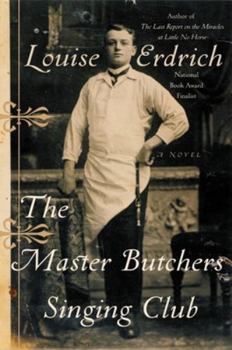
The Master Butchers Singing Club, by Louise Erdrich

The Master Butchers Singing Club is a mouthful of a title. But read closely, and you’ll see how the role of songs is critical to the book’s message. This is a book about a community in which music is a connector, bringing together people who have grown up in the town, but nevertheless are outsiders, immigrants who are building businesses and relationships, and native Americans who live nearby yet worlds apart.

The traumas of two world wars and of Wounded Knee, of family loss and community estrangement permeate the ground. Songs heal. Songs of patriotism, of war, of love and belonging pervade the book as this engaging cast of characters seeks belonging and a sense of home, not always sure where that is.

The book starts after WWI, as Fidelis Waldvogel leaves Germany for the United States, planning to take a train to Seattle, paying his way selling sausages. He runs out of money in Argus, North Dakota, and ends up making a life there. When his can afford it, he brings his wife Eva and her son Franz to join him. Fidelis and Eva run a successful butcher’s shop and he leads the men’s singing group, which includes Roy, the town drunk, a competing butcher, the sheriff, a doctor, and poor Porky Chavers whose singing might have gotten him killed.  

While the men are singing, the women are talking. Eva, by now the mother of four sons, nurtures Delphine, who grew up a motherless misfit in the town, but left for a brief stint as a table in a balancing act with Cyprian, her gay unmarried husband with whom she shares a strong emotional bond. Delphine is close friends with Clarisse, the town undertaker, who is shunned by men because of her occupation. Hock, the sheriff, thinks he’s a prize because he wants her no matter what. The “no matter what” wasn’t what he was expecting. Franz’s girlfriend Mazarine lives in poverty, which makes her the butt of jokes until Delphine helps her with a new wardrobe. And Step and a Half keeps walking and watching, helping from the sidelines.

Fidelis and Eva’s sons are vital to the story as World War II looms and Franz learns to fly, marries Mazarine, and heads to Europe to be a hero. Markus becomes bookish and leans on Delphine to fill the void left by his mother’s death, either trapping Delphine or offering her sanctuary—Delphine’s not too sure. And the twins, Emil and Erich, move back to Germany with their stern aunt, Tante, becoming Hitler youths ready to fight their American brothers.

Then there’s the mystery of the bodies in Roy’s basement—and the beads embedded in an odd sealant that kept the cellar door shut. What was Roy’s role in their deaths? Was Clarisse involved? How did the beads get there? And why won’t the sheriff move on and acknowledge it was a tragic accident?

Erdrich explains some of this, but not all. She leaves crumbs for us to find in careful reading. But she isn’t there to answer all our questions, or to leave all plot points neatly tied up. That’s neither real life nor a good book, and she masterfully gives as both.

— Pat Prijatel

The One-in-a Million Boy, by Monica Wood

Ona is 104 when she first meets the boy, who comes on Saturdays to work for her as part of a Boy Scout project. He fills her birdfeeders and does odd jobs around her house. She is impressed that he always shows up and does what he says he’s going to do. But then he disappears.

Three weeks later, his father, Quinn, comes over to help finish the boy’s job. He offers no explanation for the boy’s absence. He has seven more weeks of work to do for Ona, which he does competently but distractedly at first. But Ona charms him with card tricks, animal cracker treats, and honesty; the two develop a relationship that fills a need neither have had the courage to face before.

Quinn never tells Ona the boy has died; she learns through a newspaper story. The boy got up very early one morning, went on a bike ride, and his heart gave out because of long QT syndrome. But the boy, who is never named, remains ever present in this beguiling story of belonging; of memories lost then regained; and of people picking up the broken pieces of their lives and gluing them together with one another into a messy but marvelous collage.

The boy is 11, small for his age, and has no friends. He’s anxious, and counts actions, plans, and thoughts off on his fingers in groups of ten to calm himself. He is obsessed with The Guinness Book of World Records. His mother, Belle, knows he’s not like most other boys, and has sought treatment for him. Rather than seeing him as odd and labeling him as having a disorder, she sees him as one-in-a-million. The reader might conclude that he has OCD, but author Monica Wood presents him not as a diagnosis, but as a treasure.

Quinn, who is in his 40s, has made a living as a roving guitarist, always with his eye toward his big break. Several years before, he’d provided guitar backup one magical evening to musician David Crosby, who had said, “Look at this guy!” while Quinn played. He was sure Crosby saw him as a rare talent. But working through the boy’s death helps Quinn see more clearly and he realizes that he completely misunderstood Crosby‘s comment. It was a starry night, and Crosby had said, “Look at the sky!” He was in awe of nature, not Quinn. Finally, Quinn can face that he is a good, not great, guitarist and he needs to face reality and grow up.

Belle shows the grief Quinn can never face. Quinn and Belle have been married twice—they truly appear to love one another—but Quinn is just not up to marriage and fatherhood. Music is more vital to him. He has been an absent father, and Belle has had to shoulder the responsibility of raising the boy. Only after the boy dies does Quinn realize he loved him.

Throughout the book, Ona tells the story of her life through a series of interviews with the boy. When the boy learns how old she is, he begins his quest to get her into The Guinness Book of World Records. But she is not old enough, plus she doesn’t have the documents to prove her age. This sets off a quest in which Ona faces her own life while Quinn grows into his.  Bit by bit, words from her native Lithuanian start coming to her, vestiges of long-buried memories of a brother, her two sons who died, and a third son who is now in his 80s. And she unearths the truth of people who loved her, disappointed her, and betrayed her.

Wood tells us the story with one exquisite scene after another falling together precisely and often unexpectedly. She breaks the narrative throughout with parts of the boy’s interview with Ona and with random snippets from The Guinness Book of World Records, both presented in lists of ten. His presence is especially palpable in these interruptions, which also serve as connections. When the boy gets to Part 10 of the interview and realizes he has more story to tell, he simply calls it “also Part Ten.”

Included in the lists of world feats: largest gathering of clowns (850); harriest family (the Gomez family of Mexico, with 98 percent body hair); fastest time nonelectric window opened by a dog (11.34 seconds); and heaviest bus pulled by hair (17,359 pounds).

Throughout the interviews, the boy searches for ways to get Ona into the Guinness book. Ona calls him “my steadfast little fellow” for his efforts.  Maybe she could be the oldest person to fly in an airplane? he asks. Ona scoffs—prematurely, as it turns out. Or she could be the oldest person who still drives, a record currently held by “Fred Hale.109. Country of USA.” Ona has a car but no license, although she nevertheless drives to the store weekly. The boy sets out to help her pass her driving test. He doesn’t finish, but Quinn does.

Also making appearances are a Christian boy band and their hard-driving manager Sylvie, who offers Quinn a chance for a different life and another way of belonging; Ted Ledbetter, the upstanding Scout leader who woos Belle, gives her comfort and offers Quinn a glimpse into  a responsible relationship; Ona’s first husband who wrote a song she considered a failure, but which the boy band loves and which shows he loved her; and Quinn’s local band, which consists of manager-level childhood friends who envy him while he envies them.

The ending is heartbreaking—and uplifting. While Quinn thought he and the boy never connected, the boy saw him as the one person who could bring beauty and music back into Ona’s life. And he was right, although it happened differently than he expected.  His loss is tragic, but he remains alive in these beautiful, lost characters who discover themselves through one another, and create a makeshift family because of him.

He was one in a million. Maybe that should get him into The Guinness Book of World Records.

— Pat Prijatel

Neighbors and Other Stories, by Diane Oliver

Diane Oliver died in a motorcycle accident at age 22 in 1966. At the time she was a graduate student at the Iowa Writers’ workshop at the University of Iowa. Today reviewers laud this phenomenal black author, a master of the short story, with their highest praise for the economy of her prose, the empathy and insight she demonstrates in her character development and the intimate glimpses of life in the Jim Crow south. The stories are gems of compelling insight far beyond the tumultuous media coverage of the civil rights era. Critics’ reviews are in response to the 2024 collection and publication of fourteen of her stories in a volume titled Neighbors. Only four of her stories were published in her lifetime, none in main stream media.

A particularly remarkable feature of Oliver’s brilliance as a writer is her ability to show rather than tell – to reveal the story line with phrases and details that communicate much more effectively than direct narrative in informing the reader. In the title-based story “Neighbors” for example, Oliver begins revealing the core of the narrative in the third paragraph when Ellie stands up to look over the shoulder of a man reading the newspaper to see if she can read the headline. Immediately the reader suspects the story is about something momentous, but what? “Traffic Jam” finds maid Libby icing Christmas cookies, putting a ham in the oven and soup on the stove for her wealthy white employer’s lunch while she worries about her children scavenging for apples for lunch or alternatively eating cold boiled potatoes, because they have no other food – a powerful, heart breaking contrast.        

Throughout the collection a number of common themes are woven into the fabric of the narratives. Her main characters – mainly strong black women – are all aspirational – some, striving for a better world to raise their families as in “Neighbors” where parents are agonizing over whether to send their young son the next morning to integrate a neighborhood grade school. In “Health Services” the mother is focused on a better day-to-day existence for her children by trying desperately to access health care in the face of bureaucratic inhumanity and dire poverty. In “Key to the City” the mother insists on moving her children to Chicago, keeping up the charade that their father will meet them at the depot. She’s confident there’s got to be a better life in the big city even without his support.

In a twist on the theme of aspiration, the main character in the “Closet at the Top of the Stairs” is a young woman who has been sent by her father to integrate a southern women’s college. She is exhausted and on the verge of a mental breakdown due to the unchecked civil rights activism of her father, who has turned her into what feels like an “Experiment.”

Aspiration does indeed have a downside too as in “The Visitor” where socialite and doctor’s wife Alice faces the lies and games of the artificial life she aspired to and now inhabits. Also achieving marriage to a doctor, Meg in “Spiders Cry Without Tears” realizes she is simply an interchangeable object to her husband rather than a unique human being when he gifts her with his former wife’s fur stole, just back from the furriers, as if it were a special present from him.

Oliver’s use of bright colors often serves to emphasize the bleakness of a situation. In “The Closet at the Top of the Stairs,” mentally unstable Winifred has a pink plaid hatbox, and, in a seeming effort to cling to her childhood and her family, a menagerie of stuffed animals including a yellow bunny, a green duck and a pink dog with orange eyes which she carefully wraps in plastic every night. Emphasizing her efforts to fit in even as she spirals mentally, Winifred has her parents send her a white rain coat – what everyone is wearing – to replace the blue one she brought to college. The yellow ribbon the mother in “Key to the City” is carefully ironing for her daughter who cherishes it and wants to wear it to church, vividly contrasts the dire situation of a family stranded in Chicago with a paucity of festive normality.  In “Traffic Jam” the fact that the car the father has bought instead of food for his family is blue, his wife’s favorite color when they were courting, provides the reader with a very clear understanding that this man is not focused on the reality of his starving children.

Adding to the compelling nature of these spare and exceptional stories, is the irony of many of the titles.  “Mint Julips Not Served Here” focuses on a family who has fled to the woods to live a primitive life, where visitors are met with firearms, in order to protect their young son who no longer speaks after having been brutally bullied. As the reader soon learns, there is no “Key to the City” in that story, rather desperation and fear when the reality of the abandonment by the father sinks in. There is also no health service in “Health Service,” only denial of service and disregard for health.  “Traffic Jam” has two disrupting “jams  – Libby’s employer is constantly in her way and irritatingly nosy as Libby works in the kitchen, and her clueless husband “jams” up her life by buying an obviously unneeded car.

Book club members were moved by the exceptional skill of Diane Oliver as a short story writer and by  the intimacy of these insightful stories of an era they all lived through. They wished she had lived to develop her talent even beyond the high standard of Neighbors. The only adverse comments were about “Frozen Voices,” the experimental story which most found difficult to follow, although some made some sense of by reading it as poetry. Without question, everyone did agree “Neighbors” needs no editing.   

— Sue Martin