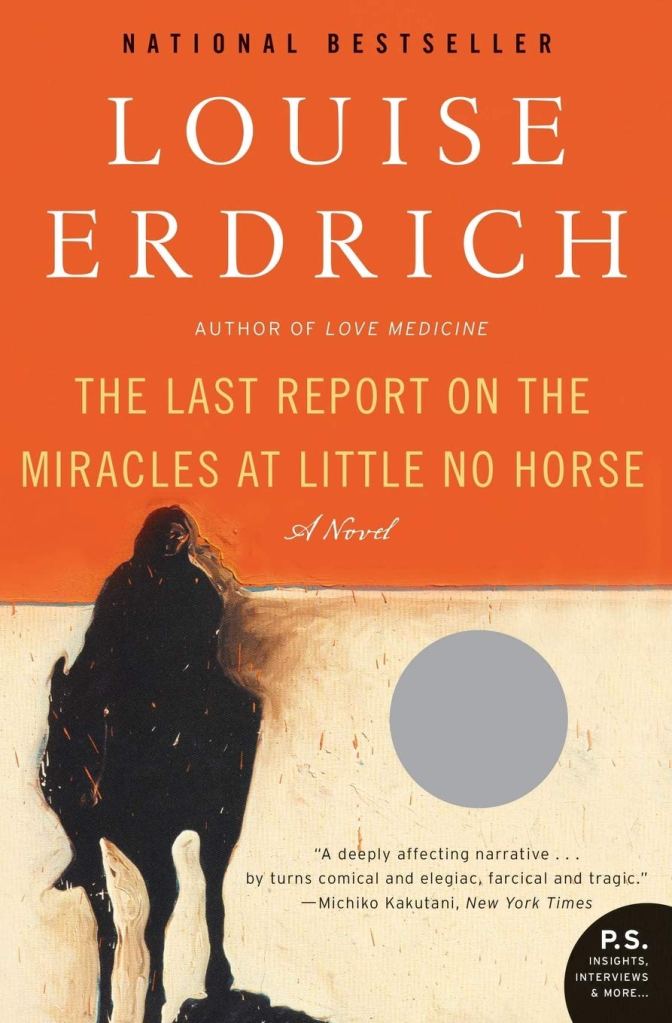
The Last Report of the Miracles at Little No Horse, by Louise Erdrich

Biblical in nature and scope, The Last Report is replete with floods, snakes, sin, and forgiveness. Father Damien Modeste has lovingly served the Ojibwe settlement of Little No Horse for eight decades, forming his life around their needs. He may well be a saint. But he’s also a woman. Behind his priestly garb he’s actually Agnes, who transformed herself into a Catholic priest after living a full life as a Catholic nun, farm wife, and general adventurer, with random interactions with outlaws, floods, dead cows, and Chopin.

The epic tale of Agnes’s early life requires a total suspension of disbelief as she faces one passion after another, often losing herself in Chopin to such a degree that she ends up ecstatic and naked on the piano bench. This, not surprisingly, gets her kicked out of the convent. She finds love with a German farmer who dies defending her but leaves her his prosperous farm. Then Agnes gets caught in a disastrous flood, which sends her down the river in her wispy white nightdress, hanging on to her grand piano. When she lands, she finds a dead priest hanging in a tree, so she takes his dry clothes and his identity.

As one does.

This novel follows Agnes until she is over 100 and deeply entrenched in being Father Damien, while maintaining vestiges of her real, feminine self. She wraps her breasts tightly to hide her feminine identity and learns the rules of being a man, as she defines early in the book:

1.Make requests in the form of orders.
2. Give compliments in the form of concessions.
3. Ask questions in the form of statements.
4. Exercise to enhance the muscles of the neck?
5. Admire women’s handiwork with copious amazement.
6. Stride, swing arms, stop abruptly, stroke chin.
7. Sharpen razor daily.
8. Advance no explanations.
9. Accept no explanations.
10. Hum an occasional resolute march. 

Despite her subterfuge, the Ojibwe know she’s a woman and are just fine with her pretending to be a man, although they don’t understand the necessity.

In one delightful section, Nanapush, an elder Agnes has learned to admire and love, questions her during a game of chess. He knows Agnes wants to keep her femininity a secret, so Nanapush chooses to address her during an especially tricky move because, quite simply, he wants to win the game:

“What are you?” he said to Damien, who was deep in a meditation over his bishop’s trajectory.
“A priest,” said Father Damien.
“A man priest or a woman priest?”

Agnes panics until she realizes Nanapush is really only curious.

“I am a priest,” she whispered, hoarsely, fierce.
“Why,” said Nanapush kindly, as though Father Damien hadn’t answered, to put the question to rest, “Are you pretending to be a man priest?”

Why, indeed? Because the Catholic church doesn’t allow women to be priests and, throughout the book, when asked who she really is, Agnes consistently answers: “I am a priest.” A lover asks it, a papal investigator asks it, Agnes asks it of herself. Why: Because I am a priest.

The book encourages comparisons with other classics, from Death Comes for the Archibishop, by Willa Cather,to Tom Jones by Henry Fielding, with a little Faulker and Shakespeare thrown in, plus a bit of the Bible.

Erdrich’s reprises her most memorable Ojibwa characters—Fleur and her daughter Lulu, plus the Nanapushes, Kashpaws and the Puyats—which she introduced in previous novels (Love Medicine, Four Souls, Tracks). The book stands on its own, although it makes you want to read more to get the backstory on these people working hard to live a life of truth.

Chapter 18, La Mooz, Or the Death of Nanapush, is a classic, worth reading by itself. Perhaps more than once. And the sections on Mary Kashpaw, from the very beginning (her aggressively terrible coffee) to the end and her final, silent care for Agnes/Damien, are heart-rending yet beautiful, a picture of true love.

What’s the miracle? There are many: the people, the land, the priest.

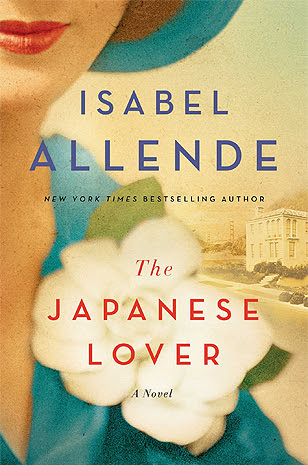
The Japanese Lover, by Isabel Allende

Isabel Allende’s novels often take place during a time of war and its aftermath when characters are forced to tap unknown reservoirs of strength and find creative, unorthodox ways of forming families to protect the vulnerable.  

Her novels are invariably well plotted and often include a thread of magical realism. And they tend to be beautifully written—though in The Japanese Lover, likely the translation does not do justice to the original manuscript.

The time of war in this novel is World War II, with the concentration camps in Germany and the Japanese internment camps in America. And the long tail on the war likely made places like Moldova (where Irina’s story begins) a place to leave. 

Early in the war, young Alma, with her Jewish parentage, is sent from Poland to live with the wealthy Belasco family in San Francisco. In her loneliness, she is befriended and comforted by her older cousin, Nathaniel Belasco. And she is utterly captivated by young Ichimei Fukuda, the Japanese gardener’s son, whose family is one of many sent to an internment camp.  

As the years pass after the war, Ichimei’s life takes its own path, and Alma grows up and marries her cousin Nathaniel and has a son with him. And the son grows up and has a son, Seth, who grows up to be one of the main chroniclers of his grandmother’s life—including the undying love story between her and gentle Ichimei. 

In the time present of the story, Alma is elderly and Seth is trying to complete a history of the wealthy and well-known Belasco family before his grandmother dies. Of great puzzlement to Seth is why, “early in 2010 his grandmother’s personality underwent a complete change in the space of two hours. Although she had been a successful artist and someone who always fulfilled her obligations, she suddenly cut herself off from the world, family, and friends, shutting herself away in an old people’s home that was beneath her and deciding, in her daughter-on-law Doris’s opinion, to dress like a Tibetan refugee.” 

The overall movement of the novel is to discover why. Why does she do his sudden, outrageous, and inexplicable thing? What happened to cause such a dramatic turn? 

Seth and Irina (a young woman who works at the old people’s home and hides a huge secret of her own) come together to love and support Alma, and to find out why she made such a dramatic change.  

To tell the story, the narration begins with a few steps forward in the characters’ lives, reaches back in time to reveal something important, takes a few more steps forward, reaches back in time to reveal something else important. Over and over again—until the reader finally and satisfyingly understands why Alma’s whole life changed in the space of two hours.   

Allende, through Alma, as seen by Irina—who is a kind of acolyte in the complicated ritual of dying—presents an evocative, compelling picture of aging unto death. Yes, aging is troublesome. It involves unrelenting loss. And it is inevitable. But Alma moves toward it with passion, discipline, imagination, and a touch of whimsey. Her soothing ritual of long weekends away with Ichimei help her linger on the bridge between life and death with her true love. 

The Japanese Lover feels singular in the way it depicts growing old and dying as a heady distillation of life. — Sharelle Moranville

Hamnet: A Novel of the Plague, by Maggie O’Farrell

As the author tells us in her opening Historical Note: “In the 1580s, a couple living on Henley Street, Stratford, had three children: Susanna, then Hamnet and Judith, who were twins.  The boy, Hamnet, died in 1596, aged eleven.  Four years or so later, the father wrote a play called Hamlet.”  And in her closing Author’s Note, O’Farrell writes, “This is a work of fiction, inspired by the short life of a boy who died in Stratford, Warwickshsire, in the summer of 1596.”  

But the book is so very much more.  The story is not much about this boy, Hamnet, nor about his father, who is never named in the book, only referred to, first, as “the boy,” and later “the Latin tutor,” or “the husband.”  This is a story of Agnes, Hamnet’s mother, Shakespeare’s wife.  It is about her strangeness among women of her time; about her knowledge of the medicinal properties of plants; about her fierce love for her husband and her family; about her ability to sense what is wrong under the guise of the normal; about her ability to manipulate the patriarchal system to make happen what is best for the people around her. 

The flyleaf on the book jacket describes Agnes as “a wild creature who walks her family’s land with a falcon on her glove and is known throughout the countryside for her unusual gifts as a healer, understanding plants and potions better than she does people.”  I would disagree – While her gifts as a healer and in understanding plants and potions are undeniable, I would argue that she has a profound understanding of herself and the people with whom she lives. 

At every turn, we see a woman so in touch with herself and with her community that she is able to defy community mores and truly be her own true self. 

This is a beautifully written work, full of such descriptions of sixteenth century English life that we can feel and smell and almost touch the streets, the houses, the farms.  But again, so much more.  These relative simply sentences capture better than anything I have ever read the reality of labor:  “She feels another pain coming, driving towards her, getting closer, like thunder over a landscape.  She turns, she crouches, she pants through it, as she knows she must, holding tight to a tree root.  Even in the throes of it, when it has her in its clutches, when it drives everything from her mind but the narrow focus of when it might end, she recognises that it is getting stronger.  It means business, this pain.  It will not leave her be.  Soon it will not let her rest or gather herself.  It means to force her out of herself, to turn what is inside outside.”  

And surely, the grief that comes with the death of her son is so magnificently written that we too are overcome. 

I wish I had the words to recommend this book as highly as I’d like to.  Alas, I don’t.  But it is among the best books I have ever read, a book that holds you so tightly that you don’t want to put it down, much less begin reading another.  It is a gem.

Jeanie Smith