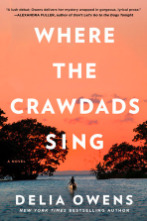
This is an intriguing murder mystery, woven through the painfully beautiful story of Kya, a young girl abandoned and left to survive on her own in the marshes of North Carolina.
Kya is no stranger to the beautiful but treacherous marshes. Deserted when she was just six years old, eventually “Marsh Girl” learns to survive, thrive and find solace in the beauty of the nature all around her.
Kya, lives in a shack with her dirt-poor family “squeezed together like penned rabbits”: a caring but worn down and helpless mother, a cruel, abusive father and four older siblings. One by one they desert Kya, saving themselves from the frequent, vicious beatings of their father, who is the last to desert her. Her mothers’ leaving is the most heart-breaking and frightening for Kya. “Ma” leaves, letting the door slam with finality behind her. No good-by. Not even a wave to her 6-year-old daughter. Finally, Kya is truly alone, except for the beautiful sea gulls who swoop and dive in to eat the grits she tosses to them each evening.
She becomes a wild child, living completely on her own in the marshes with the seagulls, snow geese, doves and crows as her only companions. She takes herself to school, but stays for just one day because of the cruel mocking from her classmates. So most of what she knows she learned from the creatures with whom she shares the swap. Nature nurtured, tutored, fed and protected her when no one else would.
She grew up navigating the family’s motorboat through the marshes and is able to dock near the small general store where she can buy simple supplies, mostly grits, which she cooks with scrambled eggs, cornbread, biscuits and sometimes beans just like her mother fixed.
Kya grows older and develops into a tall, skinny, tanned teenager with hair as black and “thick as crow wings.” She begins to long for companionship, and thinks “If anyone would understand loneliness the moon would.” She becomes increasingly aware of the older boys she sees in town. And they begin to notice her, especially
Chase Andrews, the handsome only son of wealthy parents. She also becomes good friends with another young man,Tate. Tate loves and becomes protective of her, especially as he sees the questionable attention Chase pays to Kya. Tate tells Kya that his father taught him that “A real man is one who cries without shame, reads poetry with his heart, feels opera in his soul and does what is necessary to defend a woman.” Kya opens herself to Chase and Tate and to a new life.
And then…the story develops into a murder mystery and a very unpredictable ending. As my fellow St. Timothy’s Book Club readers and I discussed this book (which we all loved) – we agreed NOT to discuss the ending until all members had finished the book. It’s that unpredictable and that well done. So I certainly can’t disclose, or even hint at it, to you, Blog readers. I’ll just say it’s definitely worth the wait.
Crawdads is a wonderful, very well-told story with beautiful language and gentle descriptions of nature woven throughout. And there is wonderful poetry that appears, often when least expectedly. You might want to pay attention to it. It’s beautiful, well-written and more important than you might expect.
A word about the author, Delia Owens. She is a wildlife scientist who has coauthored three international best-selling, award-winning nonfiction books about her life as a wildlife scientist in Africa. She is much admired and respected for her extensive writing about nature. She holds a BS in Zoology from the University of Georgia and a PhD in Animal Behavior for the University of California at Davis. This is her first fiction book. We hope it is not her last.
About the title “Where the Crawdads Sing”- Kya said her Ma used to encourage her to explore the marsh. “Go as far as you can, way out yonder where the crawdads sing.” Google couldn’t help me learn if crawdads really do sing. But I did learn that they are like small, very tasty lobsters. Maybe it’s better if they don’t sing. Could ruin our appetite for lobsters.
—Gail Stilwill
 Books, Brews & Banter