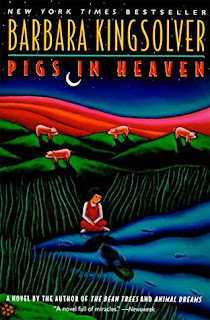
The Bean Trees, by Barbara Kingsolver

I knew I was going to get some good chuckles out of the book when I read the opening paragraph of Bean Trees:

“I have been afraid of putting air in a tire ever since I saw a tractor tire blow up and throw Newt Hardbine’s father over the top of the Standard Oil sign. I’m not lying. He got stuck up there. He wasn’t killed, but lost his hearing and in many other ways was not the same afterwards.” 

And I kept chuckling throughout the book. It’s funny but it also is a good story, really a series of good stories from beginning to end. The stories are intriguing, clever and wise.  Barbara Kingsolver has written a number of books but this is her first.  The “heroine,” Taylor Greer is a determined, spirited, and very likable young woman.  She has two goals in life: To move away from her home in rural Kentucky and not to get pregnant.  She heads off on her getaway adventure in her newly-purchased 1955 Volkswagen bug which, besides being unreliable mechanically, has no windows. No starter either, so it has to be push-started, preferably on a hill. She stuffs all the money she has into one pocket of her jeans and heads off.  

Taylor grew up poor, but she is resourceful. Her plan is to drive west and never look back until her car stops running, then settle wherever that takes her. She lands on the outskirts of Tucson, Arizona on a Cherokee Indian reservation. She manages to drive her wobbling car off the highway and find a much-needed auto repair shop with the interesting name of “Jesus is Lord Used Tires.” Somewhere along the way, her trip takes a very unexpected turn. A woman places a small child wrapped in a large pink blanket into Taylor’s car, insisting that she must “Take this baby.” Taylor is too stunned to refuse and so becomes the instant mother of a three-year-old Native American Cherokee girl, a round-eyed child with a “cereal bowl haircut.” The child’s tiny hands grab and hold tightly onto everything she can reach, especially her new mother’s long braid. She also realizes that the child has been horribly physically and sexually abused. Perhaps because Turtle needs security as the result of the fear and pain she has suffered, her tiny little hands grab and hold tightly onto everything she can reach, especially her new mother’s long braid.  So Taylor names her little girl “Turtle” after mud turtles who also hold tightly to everything they can grab. 

Turtle becomes fascinated with beans, especially the purple beans from Wisteria trees and loves to collect and plant the beans, then dig them up. The little girl is also fascinated with horticultural magazines and books, anything that pictures vegetables and plants. Her quick mind helps her memorize the names and types of vegetables. In Tucson, Taylor meets and becomes good friends with Lou Ann Ruiz, whose husband has lost a leg in an accident. Lou Ann also has a child and the two women agree to move in together with their families.  From there on the book is filled with the sometimes touching and always humorous lives of the two women, their families and the events and everyday miracles in their lives. The Bean Trees is witty and wise and funny – a good read from start to finish.  I did not want it to end.

Gail Stilwill

Death Comes for the Archbishop

Considered by critics to be Cather’s best work, Death Comes for the Archbishop is a full-color portrait of the southwestern United States, especially New Mexico, and its people in the second half of the 19th century. As she has done in other books, Cather catches a culture on the cusp of huge change—the “new” world pushes against the “old,” indigenous religions fight to maintain their beliefs while integrating with Catholicism, the strength and beauty of nature begins to face those who want to control it. The Americans are pitted against the French, the Spanish, the Indians, the Mexicans, although it is not clear who, in this context, actually is an American.
 
At the center of the story are two French missionaries, Jean Marie Latour and his good friend and assistant Joseph Vaillant. Their lives mirror the men on whom they are based: Latour on the first bishop of New Mexico, Jean-Baptiste Lamy and Vaillant on the first bishop of Colorado, Joseph Projectus Machebeuf.
 
Latour is sophisticated, thoughtful, and cool. Vaillant, who is a few steps beyond homely, is warm and engaging, enthusiastic about raising funds for missions and, ultimately, for the bishop’s dream: the cathedral. The two men are yin and yang, each showing strengths that combat the other’s weaknesses. Vaillant helps Latour establish himself in a land in which priests have been settled for hundreds of years, although those priests have been on their own, with no oversight from Rome, and they’ve created their own rules, or lack of them. They flagrantly take advantage of the local people and grow ostentatiously wealthy while living a life of pleasure, marrying, having children, and building a bit of a family business. Latour carefully and slowly forces the errant priests out of their parishes, and Vaillant is there to care for the parishioners, wherever or however he finds them.

The book is episodic, less like a novel and more like a series of short stories tied together by the missionaries and some continuing characters. Kit Carson plays a prominent role and, through him, Cather shows this country’s relationship with its earliest settlers, the Indians. Carson is married to an Indian and, in most cases, he acts like their friend. Yet, when the U.S. government wants to find a hideout where the Navajos stay safe, Carson leads the troops right there, causing the death of more than 100, and leading to the death of their way of life. Cather offers a poignant overview of that way of life:
 

They seemed to have none of the European\’s desire to “master” nature, to arrange and re-create. They spent their ingenuity in the other direction; in accommodating themselves to the scene in which they found themselves. This was not so much from indolence, the Bishop thought, as from an inherited caution and respect. It was as if the great country were asleep, and they wished to carry on their lives without awakening it; or as if the spirits of earth and air and water were things not to antagonize and arouse. 

Perhaps the biggest contrast Cather creates is between the first chapter and the rest of the book. In that initial chapter, she introduces us to “three Cardinals and a missionary Bishop from America,” in an opulent villa overlooking Rome. The four men are fed exceptionally well and drink fine champagne, which feeds the Cardinals’ already overblown egos. They are committed to sending more missionaries to America but are not interested in the least in learning just what America is or who its people are and assume Indians all live in wigwams. Their evening ends over brandy and a sunset. These cardinals wouldn’t last a half hour in the territory to which they are sending missionaries, nor would their arrogant attitudes achieve many converts.
 
Characters throughout the book are compelling, real, and beautifully flawed, but the exquisite scenery is the real star, and Cather captures that with breathtaking clarity; the book is full of a love of the land and with descriptions that take the fine hand of a master.  Perhaps her most-quoted description:

The sky was as full of motion and change as the desert beneath it was monotonous and still, — and there was so much sky, more than at sea, more than anywhere else in the world. The plain was there, under one’s feet, but what one saw when one looked about was that brilliant blue world of stinging air and moving cloud. Even the mountains were mere anthills under it. Elsewhere the sky is the roof of the world; but here the earth was the floor of the sky. The landscape one longed for when one was away, the thing all about one, the world one actually lived in, was the sky, the sky.

Death finally comes for the archbishop, after he has lived a long and full life. When one of his friends shows his obvious grief and wants to heal him from what looks and sounds like pneumonia, Latour simply says, ‘I shall not die of a cold, my son. I shall die of having lived.”
Pat Prijatel

The Hate U Give, by Angie Thomas

I am in awe of Angie Thomas’s accomplishment with this book. It has a moral without being moralistic and a message that creeps into your consciousness through believable, likable, and courageous characters, a complex and compelling storyline, and a city you can almost hear and smell, even though we have no idea where it actually is. 
This is a book about the importance of speaking out, despite the very real risks it presents. It’s also about community, with interconnected themes of belonging and loyalty woven with race, police brutality, and black identity.
That’s a lot to pack in, but Thomas does it so elegantly the reader falls in love with these amazing people facing a decision: Can they go on as usual or is it time to challenge the power structure? In this case, that structure includes the police department and district attorney on the one hand and a drug lord and his minions on the other. Caught between these two, which do you align with? What happens when the answer is “neither”?
At the center of the story is Starr, a smart and perceptive Black teenager who sees her childhood friend Khalil killed by a police officer after a traffic stop for a bad brake light. She struggles with her responsibility to Khalil, her community, family, and ultimately to herself. She’s terrified of telling the truth, which implicates both the officer and the drug kings, but she finally realizes she has no choice.
Starr straddles two different communities with different cultures and language. In the neighborhood, she is the grocer’s daughter, who sometimes works in his store. At her school in a ritzy white neighborhood, she is only as cool as she needs to be. She’s in that school because her parents know she will not get the education and opportunities she needs and deserves if she stays in the local school. She’s not a total fit in either place.
She has to leave parts of her behind when she goes to school—her language, her stories, and certainly the fact that she was in the car when Khalil was killed. If the white kids know too much, she fears, they’ll see her as a ghetto kid and dismiss her. Eventually, loyalty to her community and trust from her white friends help her speak out.
Thomas began this book when she was an undergraduate in creative writing at Belhaven University in Jackson, Mississippi. She says she chose to write it as a young adult novel to make it more accessible and relatable—and she succeeded.
The book was inspired by the Black Lives Matter movement, and the title comes from rapper Tupac Shakir’s THUG LIFE philosophy (and tatoo), an acronym for The Hate U Give Little Infants F*cks Everybody. Shakir says, “What you feed us as seeds, grows and blows up in your face.” When you force kids to live in a community that offers few opportunities besides drug dealing, you allow children to grow up broken and angry.  But those are our kids, even if they don’t look or act like us—or we like them—and their world is connected to ours. Nothing happens in a vacuum. Ideally, we would be motivated to help black children get the same benefits as white because that is simply part of a just society. But THUG LIFE reminds us that, no matter our motivation, our inaction will come back to hurt us all.
Pat Prijatel