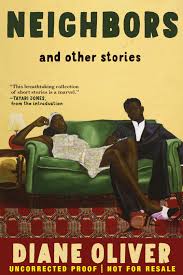
Neighbors and Other Stories, by Diane Oliver

Diane Oliver died in a motorcycle accident at age 22 in 1966. At the time she was a graduate student at the Iowa Writers’ workshop at the University of Iowa. Today reviewers laud this phenomenal black author, a master of the short story, with their highest praise for the economy of her prose, the empathy and insight she demonstrates in her character development and the intimate glimpses of life in the Jim Crow south. The stories are gems of compelling insight far beyond the tumultuous media coverage of the civil rights era. Critics’ reviews are in response to the 2024 collection and publication of fourteen of her stories in a volume titled Neighbors. Only four of her stories were published in her lifetime, none in main stream media.

A particularly remarkable feature of Oliver’s brilliance as a writer is her ability to show rather than tell – to reveal the story line with phrases and details that communicate much more effectively than direct narrative in informing the reader. In the title-based story “Neighbors” for example, Oliver begins revealing the core of the narrative in the third paragraph when Ellie stands up to look over the shoulder of a man reading the newspaper to see if she can read the headline. Immediately the reader suspects the story is about something momentous, but what? “Traffic Jam” finds maid Libby icing Christmas cookies, putting a ham in the oven and soup on the stove for her wealthy white employer’s lunch while she worries about her children scavenging for apples for lunch or alternatively eating cold boiled potatoes, because they have no other food – a powerful, heart breaking contrast.        

Throughout the collection a number of common themes are woven into the fabric of the narratives. Her main characters – mainly strong black women – are all aspirational – some, striving for a better world to raise their families as in “Neighbors” where parents are agonizing over whether to send their young son the next morning to integrate a neighborhood grade school. In “Health Services” the mother is focused on a better day-to-day existence for her children by trying desperately to access health care in the face of bureaucratic inhumanity and dire poverty. In “Key to the City” the mother insists on moving her children to Chicago, keeping up the charade that their father will meet them at the depot. She’s confident there’s got to be a better life in the big city even without his support.

In a twist on the theme of aspiration, the main character in the “Closet at the Top of the Stairs” is a young woman who has been sent by her father to integrate a southern women’s college. She is exhausted and on the verge of a mental breakdown due to the unchecked civil rights activism of her father, who has turned her into what feels like an “Experiment.”

Aspiration does indeed have a downside too as in “The Visitor” where socialite and doctor’s wife Alice faces the lies and games of the artificial life she aspired to and now inhabits. Also achieving marriage to a doctor, Meg in “Spiders Cry Without Tears” realizes she is simply an interchangeable object to her husband rather than a unique human being when he gifts her with his former wife’s fur stole, just back from the furriers, as if it were a special present from him.

Oliver’s use of bright colors often serves to emphasize the bleakness of a situation. In “The Closet at the Top of the Stairs,” mentally unstable Winifred has a pink plaid hatbox, and, in a seeming effort to cling to her childhood and her family, a menagerie of stuffed animals including a yellow bunny, a green duck and a pink dog with orange eyes which she carefully wraps in plastic every night. Emphasizing her efforts to fit in even as she spirals mentally, Winifred has her parents send her a white rain coat – what everyone is wearing – to replace the blue one she brought to college. The yellow ribbon the mother in “Key to the City” is carefully ironing for her daughter who cherishes it and wants to wear it to church, vividly contrasts the dire situation of a family stranded in Chicago with a paucity of festive normality.  In “Traffic Jam” the fact that the car the father has bought instead of food for his family is blue, his wife’s favorite color when they were courting, provides the reader with a very clear understanding that this man is not focused on the reality of his starving children.

Adding to the compelling nature of these spare and exceptional stories, is the irony of many of the titles.  “Mint Julips Not Served Here” focuses on a family who has fled to the woods to live a primitive life, where visitors are met with firearms, in order to protect their young son who no longer speaks after having been brutally bullied. As the reader soon learns, there is no “Key to the City” in that story, rather desperation and fear when the reality of the abandonment by the father sinks in. There is also no health service in “Health Service,” only denial of service and disregard for health.  “Traffic Jam” has two disrupting “jams  – Libby’s employer is constantly in her way and irritatingly nosy as Libby works in the kitchen, and her clueless husband “jams” up her life by buying an obviously unneeded car.

Book club members were moved by the exceptional skill of Diane Oliver as a short story writer and by  the intimacy of these insightful stories of an era they all lived through. They wished she had lived to develop her talent even beyond the high standard of Neighbors. The only adverse comments were about “Frozen Voices,” the experimental story which most found difficult to follow, although some made some sense of by reading it as poetry. Without question, everyone did agree “Neighbors” needs no editing.   

— Sue Martin

A Thousand Acres, by Jane Smiley

What lurks beneath the surface? This question rears up in every chapter of A Thousand Acres, Jane Smiley’s searing reimagining of Shakespeare’s King Lear. Updated to 1979 and moved to a thousand-acre farm in northern Iowa, the story starts with Larry, the family patriarch and a king among the farmers in Zebulon County, abruptly deciding to divide his land among his three daughters. Just as Cordelia did in the original play, the youngest daughter, Caroline, expresses doubt about the wisdom of this move and is summarily disinherited. Left to manage the farm are our narrator Ginny and her sister Rose, along with their husbands, the dutiful and hardworking Ty and the onetime musician turned reluctant farmer Pete. 

Smiley’s writing brilliantly captures the beauty of the tranquil landscape and the stoic nature of the farmers who tend it. “A thousand acres. It was that simple….But if I look past the buzzing machine monotonously unzipping the crusted soil, at the field itself and the fields around it, I remember that the seemingly stationary fields are always flowing toward one farmer and away from another. The lesson my father might say they prove is that a man gets what he deserves by creating his own good luck.”

This is a familiar backdrop to our group of readers. We see the rolling fields of corn and neatly planted rows of soy beans Smiley describes daily as we drive even a few minutes outside the city. As the story unfolds, however, we become aware of the poison flowing through the fertile soil. Smiley describes monoculture, use of pesticides and artificial fertilizers, the practice of planting to the very edge of fields with no borders to capture and filter toxic runoff, and large hog confinements – all standard farming practices today that were just starting to appear in 1979.

And just like the land they tend, the stoic, upstanding members of the Cook family hide the poison that flows under the surface of their family dynamic. Bit by bit, Smiley pulls back the facades that hide the true nature of their relationships and interactions over the years, which are yet more toxic than the pesticides and fertilizers that form the foundation of their livelihood.

Just as Shakespeare did in King Lear, Smiley introduces side characters who complicate established relationships and drive the plot forward to its tragic end. Unlike Shakespeare, however, she gives sisters Ginny and Rose a voice and a backstory that make us wonder whether Lear’s coldhearted Goneril and scheming Regan might have had motivations we never saw. Smiley ultimately leaves us with a blistering family portrait and their beautifully-narrated, heartbreaking inability to avoid their own tragic demise. 

— Marcy Luft and Jeanie Smith

James, by Percival Everett

Percival Everett’s novel, James, which recently won the 2025 Pulitzer for fiction, is a reimagining of Mark Twain’s Adventures of Huckelberry Finn told through the sensibility of the slave Jim.

Everett introduces the story with pages from the notebook of Daniel Decatur Emmett, a 19th Century composer who formed the first black minstrel troupe. Some of these songs, like “Old Dan Tucker” and “Turkey in the Straw,” were disconcertingly familiar to our group because we had learned them as children and sang them with innocent ignorance.

Everett rips away that band-aid of ignorance with Jim’s opening reflection:

Those little bastards were hiding out there in the tall grass. The moon was not quite full, but bright, and it was behind them, so I could see them plain as day . . . Lighting bugs flashed against the black canvas. I waited at Miss Watson’s kitchen door . . . Waiting is a big part of a slave’s life, waiting and waiting to wait some more. Waiting for demands. Waiting for food. Waiting for the end of days. Waiting for the just and deserved Christian reward at the end of it all.

Waiting for someone to get raped or beaten or burned alive or sold away from their family.

The little bastards, of course, are Huck and Tom conspiring to play some kind of demeaning joke on Jim the slave, a grown man who understands he must show white folks what they need to see: a docile darky, happy under the massa’s thumb. So Jim obligingly calls out to Huck and Tom, “Who dat dere in da dark lak dat?” and introduces the fascinating construct that builds the irony that drives the story: the slaves are not the dumb, insensitive, superstitious, sub-human creatures the white folks need them to be. Among themselves, they speak in cultured voices with rich vocabularies, read the great thinkers, and parse the subtle difference between dramatic and proleptic irony. In the slave quarters, they drill the children in situational translations. How, for instance, to tell a white lady her house is on fire. Not by yelling, “Fire, fire!” because that is too direct, but by exclaiming, “Lawdy, missum, looky dere!” because whites must be the ones to name the trouble.

Miss Watson soon names the trouble that launches the story when she is overheard declaring her intention to sell Jim away from his wife and daughter, and Jim decides he must run—though he knows the horror of what can happen to a runaway slave. At the same time, Huck stages his own murder and runs to avoid the blows of his abusive father. When the Jim and Huck coincidentally end up together on Jackson Island, their river adventure begins. Sometimes they are together, and sometimes they are separated. They are always growing in their understanding of the world and their places in it, in their understanding of their connection to each other. They grapple with what it means to be black or white or slave or free.

The story is narrated by Jim in his “real” voice, and the tension from the irony of who this person really is, versus who white people believe he is, builds an intimacy with the reader that makes the pages fly by, sometimes showing foolishness, sometimes tenderness, sometimes the omnipresent violence of a slave’s world. Rape so common it’s almost banal, a slave hanged for stealing a pencil, a slave burned alive, a wife and young daughter sold to a slave breeding farm.

At the beginning of this gripping story, Jim is understandably reactive and runs away from the threat of being sold. But as the story develops, he becomes determinedly proactive. This turning occurs at the midpoint when he is caught up in Daniel Emmett’s racist minstrel show. He is sold as a slave, bought as a tenor. He becomes a black man who must be made blacker with shoe polish so people will believe he is white.

The wrenching irony of all this finally twists Jim from reactor into protagonist. He steals the journal with Daniel Emmett’s songs and the beautiful blank pages beyond them and runs like only a slave can run: this time, toward his wife and child to somehow save them. Eventually getting a pencil stub, he begins to write, which becomes a metaphor for his emerging fully into his own and daring to reveal his true self to the white world on the final page of a truly brilliant novel.

“Are any of you named Nigger Jim?”
I pointed to each of us.
“Sadie, Lizzie, Morris, Buck.”
“And who are you?”
“I am James.
“James what?”
“Just James.”

Before James became the book everybody was reading and raving about, few of the people in our group were familiar with Percival Everett’s work. Now we are eager to read more.

— Sharelle Moranville