Beloved by Toni Morrison


Toni Morrison says she intended her Pulitzer-Prize-winning novel Beloved to be disorienting. And she succeeded.  She throws readers into the internal chaos faced by former slaves, who live in a constant state of grief, anxiety, and determination. This book is the ultimate definition of showing rather than telling. As we read, our minds try to make sense of a story that is non-linear to the extreme, that is usually unclear and unexplained. But Morrison wants us to experience, at least to a small degree, what it felt like to be a slave.

“Freeing yourself was one thing, claiming ownership of that freed self was another,” says the main character, Sethe, late in the book.

The details of what happens in the book can be difficult to determine empirically, especially for people who want all the pieces of a puzzle to fit. In Beloved, Morrison leaves us with pieces we have to imagine ourselves. This is a sensual book, not a logical one.

The story begins with Sethe living at 124 Bluestone Road, on the outskirts of Cincinnati. She’d escaped the Sweet Home plantation in Kentucky with her two boys and the baby she was still nursing. She’d sent her children ahead and had a fourth baby on her way to Ohio, helped by a young white woman named Amy Denver; she named the baby Denver, after the mysterious woman.  With the help of another former slave, Stamp Paid, she made it to 124, where her mother-in-law Baby Suggs lived as a free woman, bought by her son Halle, Sethe’s husband.

Sethe has a month of freedom before Schoolteacher, who took over Sweet Home, finds her. In terror and rage, she kills her baby to keep her from slavery, slitting the child’s throat. She is briefly jailed and then returns to 124, which is now overcome with the spirit of the dead baby. She has only enough money for the word “Beloved” to be placed on the baby’s gravestone–not enough to add “Dearly.”

The first line gives a solid clue about where we’re going: “124 was spiteful. Full of a baby’s venom.”

The house is a character in this complex work, a haven, a protector, but also a prison and a keeper of secrets. Baby Suggs has since died and Sethe and teenage Denver live in the house alone. The two boys have run away, pushed out by the house’s violent spirit. Sethe works in town, cooking at a restaurant.

Paul D., who was a slave at Sweet Home with Sethe, shows up early on. He feels the mood of the house and calls it evil. “Not evil, “Sethe says, “Just sad.” Denver disagrees, saying the ghost “is not evil, but not sad either.” What is it? “Rebuked. Lonely and rebuked,” Denver says.

Paul D. may or may not be the catalyst for the arrival of a young woman who calls herself Beloved, who emerges out of the river shortly after Paul D. shows up. It’s more than 20 years since Sethe escaped the plantation, where, as slaves, both faced horrors neither can forget, or live with.

Who is Beloved? Is she actually the spirit of Sethe’s murdered child, come back to seek revenge? The clues are there—she’s the right age, she speaks with a raspy voice because she had died of a slit throat, her feet are like a baby’s, and she behaves like a toddler—an angry, spiteful one.

To Sethe and Denver, who have lived with Beloved’s ghost, it’s a given that the young woman who showed up on their porch one summer day is the baby who died in the shed behind their house.

But to Paul D., Beloved is a threat to his happiness with Sethe, whom he has loved for decades.  And she’s a vestige of what he left behind. But Sethe’s strong feelings worry him. It’s not safe:

Risky, thought Paul D, very risky. For a used-to-be-slave woman to love anything that much was dangerous, especially if it was her children she had settled on to love. The best thing, he knew, was to love just a little bit, so when they broke its back, or shoved it in a croaker sack, well, maybe you’d have a little love left over for the next one.”  

Beloved’s control over Sethe builds until it nearly kills her. Denver, originally under Beloved’s spell, sees her as a danger and an aberration and finally leaves the house and goes to town, seeking help. She finds a community to support her, especially the women who come to 124, singing and praying in an attempt to rid 124 of the ghost. When the women see Beloved, they “surprise themselves by feeling no fear.” Mr. Bodwin, basically a good guy and protector of slaves, drives up. But he’s white, and Sethe thinks he’s coming after her “best thing,” her child, Beloved. This sets her into another rage. This time, Denver and the women constrain her.

Beloved disappears and a boy says he saw a woman walking into the river with fish for hair. Are we to make sense of this? We can try, but whatever it means, Beloved is gone.

Later, Sethe tells Paul D. that Beloved was her “best thing.”

“No,” Paul D. replies. “You your best thing, Sethe. You are.”

— Pat Prijatel


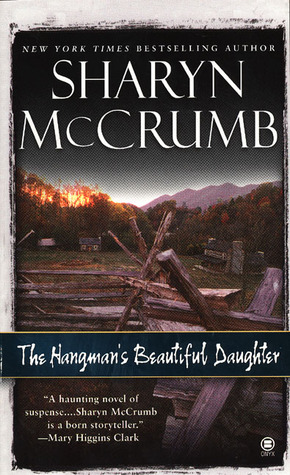
The Hangman’s Beautiful Daughter, by Sharyn McCrumb

The Hangman is a rock formation in Wake County, a rural community in the mountains of eastern Tennessee. In this charming natural setting, Sharyn McCrumb creates the second book in her Appalachian ballad series, a mystery surrounding the murder of four members of one rural family. She introduces us to a loose-knit community of independent yet interdependent locals who live along a carcinogenic river full of toxins from a paper plant and in hills once covered by chestnut trees that were all killed by a blight decades before.

This is a story about humans and nature, trials and resilience, destruction and resurrection, change and adaptation.

But who is the Hangman’s Beautiful Daughter?
Could it be Nora Bonesteel, the woman who lives on the top of Ashe Mountain, who knows her neighbors’ news before they do because she has The Sight? No, not Nora. She is an incomparable character, but the description “beautiful daughter” falls a little short of incapsulating her rare personality and her inimitable power.

Or maybe it’s Laura Bruce, who ends up taking over her husband’s ministerial duties when he is sent to the Gulf War? No, she is a bit of an angel of mercy, rescuing kids of all ages from floods and fires and human suffering. But, again, “beautiful daughter” doesn\’t capture her. She’s more the mother.

How about Maggie Underhill, one of the two surviving children of the slain family? No, Maggie is an important character, but not a main force in the book. Sadly, like her mother, she tends to be a follower until, at the end, her life depends on forging her own way.

None of these women feels right as the Hangman’s child. If not them, though, who?

The clue to that puzzle is in McCrumb’s love of folklore and folk music, which she weaves throughout this and her other ballad novels, and in the music of a band that shares her Scottish roots. In 1967, 25 years before this book was published, the Incredible String Band, self-described as a “Scottish psychedelic folk group,” released an album titled Hangman’s Beautiful Daughter. At the time, singer Mike Heron explained the title: “The hangman is death and the beautiful daughter is what comes after.”

Death does permeate this novel, yet the book ends up being about life. About what comes after. This is not a grim read, but a loving, hopeful one.

McCrumb introduces bits of history and geography that add depth and intrigue to her tale. She explains that, while people in the nearby cities fought on the Confederate side during the Civil War, those in the mountains supported the Union. They had their land, their sustenance, and they wanted to keep it and to be left alone. Yet they got embroiled in the war and in what came after.

As a side story, McCrumb introduces Tavy and Taw, childhood friends, now retired, who are embroiled in a fight with the paper mill. Tavy has been diagnosed with incurable cancer that the doctor ties to the toxic river on which he has spent his life fishing. Turns out the Tavy and Taw are also the names of two rivers in Cornwall, which some locals say are enchanted.

Plus there’s Laura’s baby and Nora’s prediction and the sheriff’s fixation on Naomi Judd and her retirement from music because of hepatitis. In the end, the community pulls together, survivors helping survivors. Thanks to the generosity of his dispatcher, the sheriff sits in bliss watching Naomi in concert.

The book was written in 1992 and the themes of environmental degradation have only gotten worse. But Sheriff Arrowood would be happy to know that Naomi has gotten much better.

— Pat Prijatel, with thanks to Jeanie Smith for asking the original question, “Who is the hangman’s beautiful daughter?” and to Annie Waskom for her research on 1960s psychedelic folk bands and rivers in Cornwall.

The Language of Flowers, by Vanessa Diffenbaugh

In an author interview at the end of The Language of Flowers, Vanessa Diffenbaugh says of her inspiration for the novel, “I’d been a foster parent for many years, and I felt it was an experience that had not been described well or often…. With Victoria, I wanted to create a character that people could connect with on an emotional level—at her best and at her worst—which I hoped would give readers a deeper understanding of the challenges of growing up in foster care.” As someone who worked for seven years with kids in foster care, some of whom aged out like Victoria, and as someone who was briefly a foster parent, I think Diffenbaugh does a terrific job.
We meet Victoria on her way to her “last chance” placement with Elizabeth. “I pressed my forehead against the window and watched the dusty summer hills roll past. Meredith’s car smelled like cigarette smoke, and there was mold on the strap of the seat belt from something some other child had been allowed to eat. I was nine years old. I sat in the backseat of the car in my nightgown, my cropped hair a tangled mess. It was not the way Meredith had wanted it. She’d purchased a dress for the occasion, a flowing, pale blue shift with embroidery and lace. But I had refused to wear it.”
Diffenbaugh’s language as she tells Victoria’s story is full of this kind of rich sensory detail that puts the reader in the backseat with Victoria when she shows us the mold on the strap of the seat belt. And that one tiny, dirty, carefully observed detail suggests larger truths about the foster care system. For that trip to her “last chance” Victoria is still in her nightgown. Because we all feel vulnerable in our nightgowns, we take Victoria’s vulnerability into our own sensibilities.
Victoria is a very specific girl; she’s not a type, and that’s where the charm and intelligence of the story lies. She is memorable. She speaks the language of flowers. She burns down the vineyard and lies to the judge. Against all odds, she becomes a successful business person with her language of flowers. She lives in weird places. The scene where she wraps her baby in moss to give to Grant is such a wonderful, fresh, memorable scene. As is her almost Homeric battle with Hazel to get nursing routine under control. I will never forget Victoria, just as will never forget Dellarobbia in Flight Behavior. 
Yet Diffenbaugh also achieves her goals of giving readers an understanding, generally, of the hardship of growing up in foster care. Victoria’s anger (which is really a mask for terror), her ravenous hunger (a sign of her emotional emptiness), her inability to learn in a normal school setting are normal behaviors of foster kids. The kids are usually terrified, emotionally drained, and unable to concentrate. Victoria makes these generalities specific in the most compelling way. 
We say goodbye to Victoria when she’s a mother and a small business owner and on the cusp of beginning a new and hopeful life with Grant, Hazel, and Elizabeth. And the journey from hello to goodbye is steered by the language of flowers. Victoria finds that language clear and unambiguous—Hazel means reconciliation; moss means maternal love; purple hyacinth means please forgive me. And where there is ambiguity, Victoria sorts it out, nails it down, and records it on two cards. One for her; one for Grant. The language of flowers, which Elizabeth introduces her to, connects Victoria to Elizabeth, Grant, Hazel, and her customers. And that’s where her hope lies at the end of the story. —Sharelle Moranville