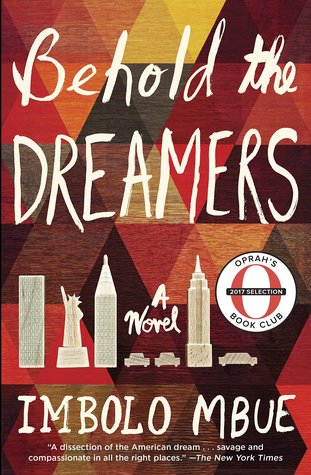
Behold the Dreamers, by Imbolo Mbue


Imbolo Mbue, herself an immigrant from Cameroon, has written a story focusing on two couples, one an immigrant family from Cameroon and the other, their upscale employers in New York City.  Mbue starts her story in the fall of 2007 and weaves a tale that combines the difficult decisions that many immigrants must face with the looming financial crisis.

As the book opens, Jende Jonga has just been hired as a chauffeur by Clark Edwards, a top executive for Lehman Brothers. This job enables Jende to bring his wife, Neni, and their 6-year-old son to New York, where Neni finds temporary work for Edwards’ wife, Cindy, at their summer home in the Hamptons.

All, of course, does not go smoothly.  Jende does not have his green card and has been assured by his “cousin,” acting as his immigration lawyer, that it is only a matter of time.  Together they craft an exaggerated story to document Jende’s claim of dire danger to himself – from Neni’s family in Cameroon — that will, hopefully, convince the immigration authorities to grant him asylum status.  In the meantime, Neni uncovers and documents Cindy’s drinking problem.

At the collapse of Lehman Brothers, Jende loses his job and with it, the Jongas’ ability to pay the rent on their modest apartment.  The financial squeeze leads Neni to take steps of her own that come as a surprise both to the reader and to Jende.

Throughout, Mbue shines her light on how these marriages work, and don’t work. Cultural differences play an important part, as we watch the Jongas through the lens of a strongly patriarchal background against the Edwards in a modern America where Cindy finds herself as a very wealthy stay-at-home mother/professional volunteer not quite in step with the times. Patterns of communication and non-communication, honesty and deceit, and saving face are woven together to craft a compelling story.

The ending was both disappointing to me and, strangely at the same time, inevitable. But however I was feeling at the time I read the conclusion of this book, I found the whole book eminently readable and insightful. Mbue has a strong voice and her characters are well drawn and true to human form, with their flaws and strengths, their compassion for one another and their casual disregard.  I cared about these people. And, for me, that’s one mark of a good novel.

— Jeanie Smith
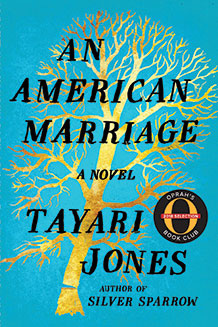
An American Marriage, by Tayari Jones


Celestial and Roy have been married a little over a year when he is falsely accused of rape and sentenced to 12 years in prison. They’re both smart, educated, ambitious, highly focused, and African-American. He’s a marketing pro, she’s an artist. He’s her muse, she’s his inspiration.

In An American Marriage, Tayari Jones follows the couple through Roy’s incarceration, building up layers of background stories to question just what marriage is and how being American, especially African-American, defines it.

We learn about both sets of parents and their jagged paths toward one another, and we begin to understand how and why Celestial and Roy chose one another. Andre, who has loved Celestial since they were babies, is always a bit on the sidelines, adoring her even while introducing her to Roy and celebrating their marriage.

Eventually we meet Roy’s “Biological”—the ne’er-do-well drifter to whom he is biologically related, even though the man he calls Big Roy has always been his real father. Jones deftly shows us that there is more than one way to be a father.

Why do people choose who they marry? What draws people together and why do some marriages last and some not? Do we choose the partners we want or those we need? Does that matter?

This is a story of affluent Americans who face challenges typical of many couples, but who also have the issue of race as a threat in the shadows. Roy is clearly innocent, yet it takes his lawyer five years to work past the bigoted local justice system to get him cleared. Then he returns to find what home now looks like, to deal with a brittle spirit that has endured evils he never knew existed, and a life without the mother he adored.

Celestial has moved on and, in her defense, she asks Roy, “Would you have waited for me for five years?”

“This wouldn’t have happened to you,” Roy replies. She is, after all, not a black man. But what Roy doesn’t understand is the way in which being a woman has forced Celestial into a style of thinking and acting that confines her at the same time it defines her creative spirit. She is also broken.

Ultimately, they both find a level of comfort and, perhaps, end up where they should have been in the first place.

Celestial and Roy are alternately charming and annoying, selfish yet giving. An American Marriage offers plenty of questions but no easy answers. It’s worth reading twice—once to get the story, once to get the characters.

—Pat Prijatel 

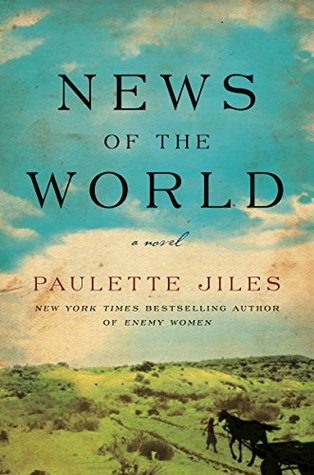
News of the World, by Paulette Jiles

In today’s world, we get our “news of the world” instantly, and literally, at the touch of our fingers—on computers, iPads, iPhones, TVs, car radios, and if you still read them, newspapers.

But a century before all that sophisticated, fun and sometimes overwhelming communications technology worked its way into our modern world, citizens were hungry for news of their states and of the world.

Enter Captain Jefferson Kidd, a grizzled elderly widower who has lived through three wars and  fought in two of them. He made his living in Texas as a printer until he lost his business during the War Between the States.  In 1870, at the age of 71, the Captain finds a new way to make a living and enjoy the freedom of the road. He travels from town to town and state to state, giving live readings from newspapers to audiences who are hungry for news of the world and who are willing to pay 20 cents to have him read it to them.

He enjoys his rootless, solitary existence. Then in Wichita Falls, he is offered a $50 gold piece to deliver a fiesty, 9-year-old orphan girl to her family. Four years earlier, a band of Kiowa raiders killed her parents and sister, but spared the little girl and raised her as one of their own. She was recently rescued by the U.S. Army. Now the grizzled old man and the lost little girl both have to learn to take care of each other and find their place in the world. Joanna tries to escape every way and every chance she gets, including throwing her shoes away. But slowly they begin to form a bond during their 400-mile journey, and begin to trust each other.

Jiles is a wonderful writer, telling an imaginative story. Her descriptions make both characters and their environment alive and believable. I loved every creative twist and turn of this book and couldn’t wait to see what happened to the Captain and Johanna.

— Gail Stilwill