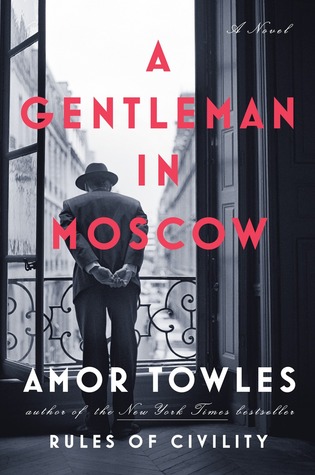
A Gentleman in Moscow By Amor Towles

By the end of this novel, I admired the amount of information packed into this title.  

First, it places us in Moscow, a place somewhat mysterious to most of us, and immerses us in layers of Russian history from the end of the Czarist days, through the revolution, through the tenures of Lenin and Stalin, and into the infighting over the next period of leadership. Towles recreates the period effectively through details of furniture, books, menus, and meetings.  

Second, the title draws our focus onto the gentleman, Count Alexander Rostov. We grow to admire how he uses the more admirable traits of the old aristocracy to adapt to his lengthy house arrest in the fading glamor of the Hotel Metropol, which is richly developed as a setting. We come to know its layout, décor, and personalities.  Rostov maintains possessions and habits when they conform to his higher goals; he avoids letting ideology prevent him from cultivating friendships among many levels of the hotel’s staff and guests. His “gentleman’s” traits allow him to act as a mentor to two remarkable young girls. Without his established character, some of these relationships might seem improbable. But though these relationships, he seems remarkably to be engaged in society though physically limited to the hotel.  

Of course there is action in the novel, but its languid pacing echoes the decades of Rostov’s arrest and suits his expansive and reflective nature. He is allowed to express a philosophical digression from time to time. We always suspect the house arrest must come to an end, but that ending is brilliantly tight and pulls together a number of crumbs that have been left along the reader’s path – some carefully constructed by Rostov and others provided by opportunity but cleverly exploited. We are amazed how he contrives Sofia’s escape from Soviet Russia and his own escape from the Metropol, and we are left to speculate on his future. A surprising number of details are left for us to surmise, but I’d like to think that we are urged to emulate the gentleman and not ask too many unimportant questions and instead focus on the important ones. 

—Bill Smith

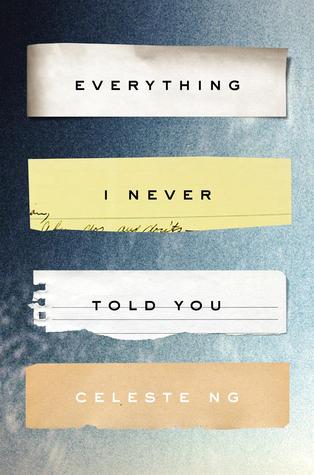
Everything I Never Told You by Celeste Ng

Everything I Never Told You is the story of a Chinese-American family and how they try so hard to do well and do good. But first one thing goes wrong and then another and then another, and to protect themselves and each other, they amass secrets that can’t be sustained.

Lovely Lydia, with her silky black Asian hair and her beautiful blue Caucasian eyes is the heart of the story. And we know from the first sentence that Lydia is dead.

Lydia is dead because her grandmother was left without a man in a time and place where a woman was supposed to be a home ec teacher (or nurse or secretary) and have a man. Lydia is dead because her dad is Asian and feels like a misfit in 1977’s Ohio. Lydia is dead because her mother, rebelling against her mother, disappears from the family, leaving them in mortal terror for months.

Lydia is dead because, like most young children, she assumes she is the cause of the family’s misery. She has surely been bad, or at least lacking, and driven their mother away. And so she makes a deal: if her mom comes home, she (Lydia) will be perfect. She will say yes to everything asked of her.

When her mother returns, Lydia accepts the burden of being the perfect child to save the family. Her loving siblings (and the characters in this story really do love each other) know she is faking so many things, but don’t dare tell because they too feel Lydia is the glue that holds the family together with her Chinese hair and American eyes.

Near the end of the story, when too many pressures are building on Lydia (when she is failing not only physics but drivers ed, and she is terrified of her brother Nath’s going away to college), she is forced into an epiphany:

[S]he had been afraid so long, she had forgotten what it was like not to be – afraid that one day, her mother would disappear again, that her father would crumble, that their whole family would collapse once more. . . . Anything her mother wanted, she had promised. As long as she would stay. She had been so afraid.

She connects this fear with the time in childhood she almost drowned and her brother saved her.

His fingers caught hers and right then she had stopped being afraid.

Kick your legs. I’ve got you. Kick.

It had been the same ever since. Don’t let me sink, she had thought as she reached for his hand, and he had promised to not when he took it. This moment, Lydia thought. This is where it all went wrong.

It was not too late. There on the dock, Lydia made a new set of promises, this time to herself. She will begin again. She will tell her mother: enough. She will take down the posters and put away the books. If she fails physics, if she never becomes a doctor, it will be all right. . . . And Nath. She will tell him that it’s all right for him to leave. That she will be fine. . . . And as she made this last promise, Lydia understood what to do. How to start everything over again, from the beginning . . . What she must do to seal her promises . . . Gently she lowered herself into the rowboat and loosed the rope.

The ending is painful but truthful. Families are nurturing; families are damaging. And not everyone survives the damage.

But the ending is also hopeful. The family slowly, gently rebuilds itself without the keystone of Lydia. Years later, when Nath is in space he stares down at the silent blue marble of the earth and thinks of his sister, as he will at every important moment of his life. He doesn’t know this yet, but he senses it deep down at his core. So much will happen, he thinks, that I would want to tell you.

Ng writes with a distinctive technique of exaggerating characters and events – pushing out curves farther than they naturally go, chipping usually smooth edges, and sharpening points almost to invisibility.

For example: James, a slightly-built Chinese man, teaches a college course on the American cowboy. Marilyn, his student, kisses him on the first day of class and beds him not long after. Later, she abandons her family without a word. Lydia has chatty phone conversations with non-existent friends. Loving, insightful little Hanna is so inconsequential they sometimes forget to set a place for her at the dinner table.

These are extreme, stylized images. Like burrs that cling, they won’t be forgotten anytime soon. Ng walks a fine balance with this technique. The distortions have to be strong to claim a lasting hold in the reader’s mind, yet believable enough to be realistic. Otherwise, the reader won’t identify with the characters or care what happens to them.

The book’s cover anticipates this stylized realism. The title, Everything I Never Told You, is handwritten – seemingly with a dried-out brush dipped in ink, or with an iffy-nibbed pen. The writing suggests the person holding the brush or pen is determined to finally tell the true story, as ragged and uneven and tender and unique as it necessarily is. And that we’ll probably remember it.

—Sharelle Moranville

The Songcatcher, by Sharyn McCrumb


“And  where she’s been and what she’s seen, 
     no living soul may know, 
And when she’s come back home, 
     she will be changed—oh!”
The Rowan Stave” Ballad

Lark McCourry is a popular folk singer whose tours regularly take her across the country.  But her roots and strong family ties are in the small town in the mountains of North Carolina where she grew up and learned to love folk music, especially ballads— and most especially The Rowan Stave ballad.  Lark moved from the mountains to the big cities to build her singing career.  But she continues to be haunted by the memory of the The Rowan Stave ballad.  She knows the song has been in her family for generations and finally feels compelled to leave her singing tour and travel back to the mountains to begin her journey to find it and restore a piece of her family’s past.  Her quest leads her to her estranged father, now a lonely and angry old man living alone, and dying, in the North Carolina mountains.

She also meets Nora Bonesteel, a wise mountain woman who talks to both the living and the dead, and who may be able to help with Lark’s search.  Nora believes that old, lost songs are a touchstone to the past, and so is eager to help Lark.

Songcatcher is the story of Lark’s journey.  But it also is the story of the lyrical, haunting ballad that has woven its way through generations, across oceans and mountains, from Scotland and Ireland and England to the hill country of North Carolina.

The first settlers in the North Carolina mountains brought the folk songs they’d sung in their homeland with them to their new home and sung them to their children, then to their grandchildren and great grandchildren.

The ballad was first heard in 1759 by a nine-year-old boy after he was kidnapped from the shores of his home in Scotland and taken aboard an English ship as a slave.  His name was Malcolm McCourry and during his 10 years on the ship, of all the songs he heard sung or played by his captors, “The Rowan Stave” ballad was the one he liked best.  The “strange and terrible” story in the ballad haunted him and also reminded him of home. He learned it by heart and for many years taught it to others he met on his travels.

Malcom’s other remembrance of home was the small white pebble, the “magic rock,” his mother gave him when he was just a toddler to keep him safe from drowning, a fear she’d had since a “wise woman” terrified her with a prophesy when Malcolm was born that “The sea will take him.”  He kept the small rock safe during all the years he traveled.

But when he lost his “magic” rock, he was afraid to sail without its protection.  So he jumped ship and settled in Morristown, New Jersey because he liked the “little village.”  The song went with him when he apprenticed with an attorney, became an attorney himself, and married Rachel, the daughter of the attorney who had befriended him.  It was with him when he fought bravely in the American Revolutionary War, and came home suffering from serious wounds and exhaustion.  He sang the song to his wife, then to his young son, Zebulon.

Tragically Malcolms son, Zebulon, was left an orphan after both Malcolm and Rachel died of Typhoid Fever, leaving their baby son to be raised by an uncle on his farm. Young Zeb enjoyed entertaining visitors to his village with ballads he’d learned, especially his favorite, “The Rowan Stave.”

As time went on, the ballad was shared with sons and siblings, with children and grandchildren, then continued to weave its way through generations, becoming a part of McCourry family history.

But as families grew and spread from the mountains to the and farms and small towns across the country, this ballad and other ballads and old songs— beautiful songs telling wonderful stories— began to be forgotten, replaced by new songs played in music halls and concert houses.  But the old songs were not lost to those who settled in the North Carolina mountains.  They had brought the music with them in their heads. Music was an important and constant part of their lives. And there were no concert houses or music halls in the mountains to introduce the new and different music to them.

As we follow Lark’s journey to find the ballad and her family’s legacy we learn the colorful, intriguing stories of other McCourry family members and how their lives impact each other.

Author McCrumb is a master storyteller knitting the fascinating stories of the McCourry family together with the history of The Rowan Stave ballad and other songs carried across oceans and mountains. It’s a book that held my interest and imagination from beginning to end!

P.S.  In her notes, author Sharyn McCrumb shares with us the surprising and wonderful fact that Malcolm McCourry is the author’s “four-times great grandfather.”

—Gail Stilwill