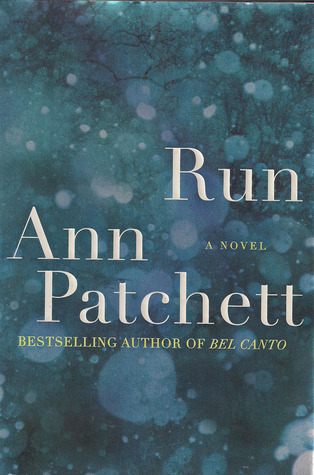
Run, by Ann Patchett

When I first read Run, I dismissed it as being mediocre, especially by Ann Patchett’s standards. But then I kept thinking about it. About the scenes Patchett builds and the characters she creates. When our book club decided to read it, we found much to love about it, much to question, and much to learn. Patchett’s standards are, after all, pretty high.

This is a book about how families work and how they don’t, about whether we love biological children more or less than adopted. It’s about family deception: It starts with a story about a statue of the Virgin Mary that was carved to look like Bernadette’s Irish grandmother. It is a flat-out lie—the statue was stolen by her grandfather during a drunken night out—but the family chooses to believe the lie even though they fully know the the truth. The lie, of course, is much lovelier. The mysterious mother figure, Tennessee, is not entirely who she says she is. Father Sullivan is not a saint, and his nephew Sullivan’s recent past is a little more murky than he suggests. Doyle tries to manipulate them all and Tip and Teddy do their best to become who they want to be, more or less, although their father’s shadow is large and controlling.

Patchett has been criticized for implicit racism in the book—the white family is the ideal, the Black is flawed, and all Black people can run fast. But Kenya is a delightfully authentic little girl and she would clearly choose to be with her mother, in her dark little apartment, surrounded by the love she has always known rather than in the bright and airy Doyle home. Ultimately, she has no choice, and she becomes the family heiress, who inherits the magic statue. The fact that she looks nothing like that version of the Blessed Virgin doesn’t even enter into Bernard’s decision. So I see a lot of color blindness here, but I can see how that in itself presents a rosy happy-ever-after ending that shrugs off the harsh realities of living with a skin tone a tad too dark to be Irish. — Pat Prijatel

All the Light We Cannot See, by Anthony Doerr

(Warning: contains spoilers)

Anthony Doerr’s 2014 novel All the Light We Cannot See is a story of survival, courage, sacrifice, suffering, family, friendship, love, and hope. It’s set in France and Germany during WW II. How many thousands of novels does that thumbnail description fit? (Jaded publishers and others in the business are starting to think of such novels as just another WW II book, which might account for some of the tepid reviews the novel got before it circulated through the wider reading community.)

All the Light We Cannot See is one of the richest, most readable, discussable, and likeable WW II novels ever. Yes. Likeable. A narrative of war and suffering and death becomes a hopeful hymn about family, kindness, potential, magic, love, and mystery.

Doerr brilliantly shows us the specifics in the general: the character so unique and real that the reader can become the character. And thus we can truly cloak ourselves in the potential for individual goodness in the storm of a world gone mad. We learn and are comforted by how we might behave in a similar situation.    

In the final analysis, the story belongs to Marie-Laure, the little blind girl with the father who keeps thousands of keys for the National Museum of Natural History and is a gifted woodcarver. In both Paris and Saint-Malo he carves tiny, clever models of their neighborhoods, which Marie-Laure must memorize with her fingertips. Then by counting grates, benches, streets, and tapping her other senses for cues, she must show him she can navigate their neighborhood. He also teaches her to use her cleverness to unlock tiny objects to find the treasures inside. To this reviewer, those incredible miniatures, made in such a rush by a father for his vulnerable six-year old girl as the Germans draw near, are the most unforgettable takeaways of the novel.

And as her world is going up in conflagration, Marie-Laure’s fingertips race across the braille dots to open another world, the world of Twenty Thousand Leagues Beneath the Sea, which she broadcasts as the bombs fall. Marie-Laure, with her blindness, has a huge capacity for the world and human experience.    

Then there is Werner, a German boy, whose snowy white hair is almost as much a character marker as Marie-Laure’s blindness. He is an undersized orphan trying to look after his sister and others in the industrial area of Zollverein, Germany. Werner has a preternatural gift for mathematics and radios and, as a result, is spared going into the mines, but is scooped up into the German army where he becomes a radio operator.    

Marie-Laure and Werner cross paths when the Allies begin bombing the holdout of Saint-Malo in early August, 1944. During the most intense part of the circular, reiterative narrative, Werner is trapped in the basement of the Hotel of Bees because of a bomb hit. Marie-Laure is trapped not far away in the attic of her uncle’s house with the cursed jewel, The Sea of Flames, in her possession. A mad, dying Nazi stalks the downstairs desperate to get at the jewel, which he believes will save his life.     Thankfully, Doerr lets a long, comforting resolution play out as we see what happens to the survivors of the bombing of Saint-Malo. We see the survivors intermittently as they go about life-after-the-war until 2014 (the novel’s pub date).

So vicariously was I participating in this novel, if I should go to Paris this year (fat chance), I would keep an eye out for an elderly blind lady who seems to know where she is going. And I do believe some evil potential, buffeted and stained to look like ordinary sea rock, is always being swished around on the ocean floor waiting to be found and polished.    

Doerr expands the literal plot line (this-happens-then-this-happens-then-this-happens) with a richness of inversions, paradoxes, oxymorons, juxtapositions, repetitions, symbols, and motifs that invite the reader to go beyond the storyline. For example:

  • Clearly, a mollusk is not just a mollusk. And what’s with all those birds?
  • Before two of the most heart-breaking events of the narrative (the rape and Werner’s death), why are there quasi-Eucharistic events?
  • Why is the fabulous diamond, The Sea of Flames, given such an oxymoronic name?
  • How can we not see light?
  • Why is Twenty Thousand Leagues Beneath the Sea the message of comfort to all who hear Marie-Laure’s last broadcast? (On the surface, it would seem to be an inversion of the usual message of hope.)
  • Why can the story be read pretty effectively backwards?

Doerr’s story has become an earwig. Certain images, characters, events, and themes will always remain in my head. More than any novel I’ve read in years, I felt that I was buried with Werner below the Hotel of Bees. I was in the cold orphanage attic with him when, as a boy, he listened to a faraway voice talking about the nature of light on the radio. I was as hungry as Marie-Laure contemplating opening the last unlabeled can of food in the attic.    

As an adult who has read a gazillion novels, I’ve largely lost my childhood ability to be carried away into another world by a story. So thank you, Anthony Doerr, for letting me do that again.

Sharelle Moranville

Breathing Lessons, by Anne Tyler

Some members of our group found the main character of this book, Maggie Moran, irritating. Others found her endearing. Sort of like real life. And that’s the beauty of Anne Tyler’s novels: They are about the lives we actually live—the mundane, the everyday, the irritating, and the endearing.  

I have loved the Maggie character since I first met her when the book came out in 1989. I loved her as played by Joanna Woodward in the Breathing Lessons movie in 1994. And I loved her when I reread this book in 2016.

Yes, Maggie and other characters in Tyler’s books skew toward odd duck territory, but as I lose myself in their stories, I begin thinking they have more of a handle on things than I do.

And then there’s Ira, Maggie’s husband. Some members of our group thought he was a long-suffering saint for putting up with Maggie. I found him passive aggressive and judgy in 1989 and even more so in 2016. His saving grace was that he was played as kind and compassionate by James Garner in the movie, so obviously Garner—and my feller BBBers—saw something I didn\’t.

Breathing Lessons was awarded the Pulitzer Prize for fiction in 1989, was a finalist for the 1988 National Book Award, and was Time Magazine’s Book of the Year. Two previous books by Anne Tyler were Pulitzer finalists: The Accidental Tourist in 1986 and Dinner at the Homesick Restaurant in 1983.

Like most Tyler novels, Breathing Lessons is character-driven. It’s one day in the lives of Maggie and Ira, who drive to the funeral of Maggie’s best friend’s husband, and then stop to visit their granddaughter, Leroy (pronounced LA roy), who lives with her mother, Fiona, Maggie and Ira’s former daughter-in-law.

It’s one bizarre day, including some laugh-out-loud moments at the funeral, during which friends are asked to sing the love songs they first sung at the dead man’s marriage 28 years ago. Maggie barely remembers the words so she and a friend work out the verses on a coupon Maggie has in her purse. The friend gives the coupon back and, later, Maggie tries to use it when buying groceries, but the clerk reads the love-struck lyrics and, with a red face, hands it back, mortified. There\’s a hilariously clumsy sex scene, a visit with a waitress at a roadside diner who quickly becomes Maggie\’s friend, and a vignette with Otis, a man who Maggie and Ira help with a tire problem. But Maggie made up the tire issue to goad Otis because he was driving too slowly, but then she realized he was a sweet and somewhat brittle old man, so she made Ira stop and the tried to help him and ultimately drove him home, and…. Anyway, you get the point about Anne Tyler\’s characters and the worlds they inhabit.

Through flashbacks and dialogue, we learn about Maggie and Ira’s unlikely and unpromising courtship and Fiona’s marriage to the their son, Jessie, a classic screw-up—just ask his dad. We see Fiona and Maggie bond through childbirth classes, complete with breathing lessons, and we see the young marriage dissolve through immaturity and a series of miscommunications, with all characters playing pivotal roles in the chaos. And we see Fiona flee the family—and the city—multiple times, to try to make some sort of sensible life for herself and her daughter.

This is the story of a marriage, of how people change when they become a couple, about the sacrifices they make for one another and the mixed blessings those sacrifices bring.

Learning how to navigate a marriage, Tyler implies in her title, is like learning to breathe, and every day is a lesson. —Pat Prijatel