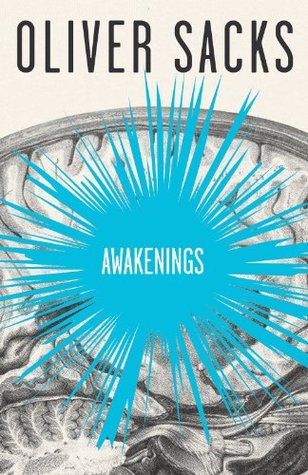
Awakenings, Oliver Sacks

Once when I was working in the garden, a bee plummeted out of the blue and dove into the heart of a hollyhock and stayed in there a long time, maintaining a little motion and humming, gorging. Eventually, he crawled out, sat a spell, and lifted off heavily. He literally couldn’t fly straight. After a couple of lazy loops and bemused U-turns he disappeared over the hedge.

That’s a fair description of what can happen to readers of Oliver Sacks’ Awakenings, a book about the catatonic, post-encephalitic patients Dr. Sacks treated at Mt. Carmel hospital when he went there as a young neurologist in 1966. We readers dive in because both author and book are so widely acclaimed (ten other well-received books and countless articles and lectures from Sacks; a movie and various stage plays from the book.)

Like the bee, we find lots to feed on: several prefaces and forewords as the book has gone through different editions. A twenty-five-page prologue. And then the heart: The compelling stories of twenty patients who awoke from their long sleep (brought on by encephalitis) after being administered L-Dopa (one of the very early psychotropic meds). In this section, there are surely as many lines of footnotes as of body. And they aren’t necessarily boring footnotes that the reader wants to skip.

Then there is a forty-page riff, in a section called Perspectives, on how illness fits into Western culture, history, philosophy, and literature. And a thirty-five-page epilogue to the 1982 edition and a brief postscript to the 1990 edition. Plus eighty pages of appendices (an interesting series of essays/papers that has an “Oh, and everything else interesting on the subject . . .” feel to it). Followed by a glossary (useful for medical terms), a bibliography, and an index.

In the middle of the book is an inset of haunting photographs of Mt. Carmel patients caught in catatonic sleep and their poignant awakenings. There are also clips from the media: Sleepy Sickness Spreading: Fatal Cases: Hunt for Elusive Germ: 20,000 Cases Last Year: Epidemic Worst In Britain and Italy: Record Death Toll.

That’s why the reader comes out sated. A little over-fed. Stunned. Sacks was (he died this year) a brilliant neurologist and a deeply compassionate physician. He had the imagination and audacity to experiment with new chemistry and awaken catatonic patients; he had the sorrow of watching them eventually regress and suffer and die.

Perhaps one reason Sacks has been so embraced as a person, physician, and writer is that he felt the humanity of illness. In the section called Perspectives, he writes “Diseases have a character of their own, but they also partake of our character; we have a character of our own, but we also partake of the world’s character: character is monadic or microcosmic, worlds within worlds within worlds, worlds which express worlds. The disease-the man-the world go together and cannot be considered separately as things-in-themselves.”

In our current specialized, assembly line, code-for-payment medical industrial complex, who can help but feel nostalgia for that humanity?  

Sharelle Moranville


A Thief of Time, by Tony Hillerman

Tony Hillerman creates a sense of place so strong and compelling you forget this is a mystery and just get caught up in the land, its people, and its history. More mystical than mystery, A Thief of Time is named for the criminals who steal Native American artifacts—in this case, Anasazi and Navajo pots—and sell them for exorbitant amounts. Those people, according to Navajo culture, are stealing their ancestors’ history.

In the book, an anthropologist who has found a treasure trove of artifacts disappears, and the Navajo Tribal Police are charged with finding her. It’s a compelling story, largely because of the cast of full-bodied characters, including two tribal policemen, several anthropologists, a random assortment of petty thieves, an influential Mormon leader with a sad secret, a New York museum curator, and a wealthy Manhattan pot collector.

Lieutenant Joe Leaphorn leads the search; this theoretically is one of his last cases, having given his notice of resignation after his beloved wife Emma died. The young Jim Chee joins him, trying to balance his police work with his unsuccessful attempts to become a Navajo shaman. Both are beautifully crafted characters whose frustration with one another is matched with a common love for their religion and traditions.

As well-woven as a Navajo rug, the story centers on the remarkable Chaco Canyon and the surrounding area of New Mexico, Colorado, and Arizona. It won the Macavity Award for Best Mystery Novel (1989) and was a nominee for the Anthony Award for Best Novel (1989) and the Edgar Award for Best Novel (1989).

It’s the eighth of 18 books Hillerman created featuring Leaphorn and Chee. His daughter Anne completed an additional two. PBS produced TV movies of three of them—A Thief of Time, Skinwalkers, and Coyote Flats—that are available through PBS or on Netflix.

—Pat Prijatel

The Year We Left Home, by Jean Thompson

Reading Jean Thompson’s novel is much like paging through a family photo album that says “The Year We Left Home” on the cover. Inside, each photo is neatly labeled:

Ryan, January 1973, Iowa
Ryan, April 1973, Iowa
Chip, July 1976, Seattle

Each photograph focuses on one character, but the whole Peerson clan comes and goes in the background of the photos. We get to a look at everybody multiple times over thirty years. We see them at weddings, funerals, family vacations, conventions, trips to visit the sick and dying, farm auctions, business dinners, Al-Anon meetings, moving day.

At the beginning, Ryan is eager to leave home. He doesn’t want to be Norwegian; he doesn’t want to be a tall, bony Peerson. Yet when Norm and Martha, two tall bony Norwegians like himself, only old, claim the dance floor at the wedding reception, Ryan has an intimation of what he is leaving.  As he watches the elderly couple dance, “It was like the perfect heart of the snow globe, and Ryan guessed rightly that he would remember the moment forever.”

At the end of the story, Matthew and Jimmy, of the next generation, are getting ready to leave home. And Torrie – brilliant, beautiful, ambitious, creative Torrie – has finally, thirty years later, managed to leave home.

The most compelling “leaving home” photos are of Torrie and Audrey. In the early family photos, Torrie is just a leggy kid in the background of other people’s pictures. But then we come to the photo of her (Torrie, November 1979, Iowa).  She’s in the foreground with Martha’s funeral happening in the background. Torrie has acquired big, big dreams. She is going the fastest on her way out of this place. She literally guns her car to get away from the headlights of her dad’s car behind her.

And on the next page of the photo album is a picture of her mother (Audrey, June 1989, Iowa). In this photo, Audrey is trying to take care of an adult Torrie.  “Her beautiful, willful daughter had been stolen away and replaced by this changeling creature, a furious and oversize baby who had to be taught all over again how to eat with a knife and fork, toilet herself, tie her shoelaces.” Some days Torrie will not put on clothes and turns on all the stove burners. Torrie looks through the family photo albums and puzzles because pictures of her stop appearing. She demands her mother get her a camera. Soon Torrie begins to wander around the declining small town photographing things and people. We’re told that Torrie’s photos looked less like Torrie looking at the world, and more like the world looking back at Torrie. Audrey, for all the years of grotesque motherhood forced on her when the nest was supposed to empty, feels abandoned.

The great strength of this novel is the way it reveals characters. We see them in selfies (if selfies had been invented then), we see them in formal poses the way they want to be seen, we see them caught off guard, we see them through the eyes of other characters.  We see them in their own photography. We know them well at the end and recognize them as ourselves.

Thompson explores many of themes in this novel: maturation, alienation, memory, change, family, tradition love, betrayal, marriage, parenthood, heritage, creativity, and home above all.

Leaving home turns out to be a life long endeavor. Thompson’s characters leave home over and over. And every time they return home, it looks different. As do they.

As do we.

— Sharelle Moranville