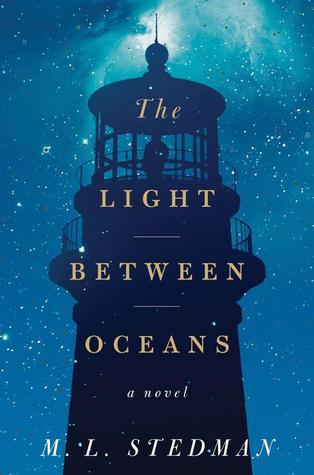
The Light Between Oceans by M.L. Stedman

Tom Sherborne, World War II Veteran and Medal of Honor recipient, wants only to forget the war and live a quiet, isolated life.  So when he gets the job of lighthouse keeper on Janus Rock, a tiny island a half-day\’s boat ride from the coast of mainland Australia, seems a perfect fit.  The supply boat comes only four times a year and shore leave might be granted every other year at best. 
Tom\’s only companion is his young, loving and vivacious wife, Isabel.  They are very much in love and very happy with each other and their life on the island.  They hope for children, but after several years, two miscarriages and a stillborn birth, they reluctantly give up hope. Tom watches sadly as his young wife suffers from grief.  Then, miraculously it seems, a rowboat washes on shore.  Aboard are a dead man and a tiny living baby girl. 
Tom feels strongly that they should report the dead man and the baby, but Isabel begs him to keep the child.  Against his better judgment he gives in, beginning a cycle of happiness, guilt and fear for them both.  They bury the unidentified man and try to push aside the fact that the baby likely has grieving parents somewhere and that they are breaking the law by not reporting their find. 
They fall completely in love with the little girl, who they name Lucy, and build their lives around her.  For two years they are a happy family.  Lucy thrives and is developing into a bright and happy child.  Isabel and Tom love parenting her, but Tom is increasingly troubled and guilt-ridden about not reporting finding Lucy and the dead man.  Then shore leave is granted and the family of three returns to the small town where they are reminded that there are other people in the world and that their decision has almost certainly ruined the life of one of them.

The book is unique—a bit of a mystery and a love story with unpredictable plot twists.  The setting on the beautiful, isolated coast of Australia is a perfect backdrop for this wonderfully written story about good, loving people and decisions that can lead only to tragedy.—Gail Stilwill

Flight Behavior, by Barbara Kingsolver

This book is titled Flight Behavior for good reason. It opens with a 27-year-old Applachian woman, Dellarobia Turnbow, poised to take flight from her shotgun marriage to a man she does not love and no longer respects and from the responsibility of two young children, and her mundane life of near poverty. On her way to begin an

affair with a younger man, she runs up the mountain above her family’s farm and straight into an astounding phenomenon that changes everything for her.

She stumbles into the forest alight with millions of beautiful orange Monarch butterflies covering nearly every inch of the ground, tree trunks and branches. Dellarobia is filled with awe and wonderment and interprets the sight as a sign from God that she must go back to her life and try to make her marriage work.

As word spreads about the butterflies, the local religious community, then the international media, consider the sight miraculous. But when a Harvard-educated scientist whose life work is studying butterflies arrives and sets up a lab on the Turnbow farm, he is certain that the migratory patterns of these Monarch butterflies has been disrupted by the effects of climate change. On their annual flight to the warmer climate of Mexico, something caused them to land in the less-friendly climate of the Tennesee, forest putting their survival at risk.

Dellarobia originally had planned to improve her life by attending college. But an unplanned pregnancy had disrupted those plans and landed her – like the butterflies— in a very different and uncomfortable environment. As she gets involved in the scientific study taking place in her own back yard, she begins to see that she and her children can attain a better and more meaningful life.

Kingsolver tells a fascinating, gripping story and tells it beautifully. But her book also conveys an urgent social message about climate change.

—by Gail Stilwill

How The Light Gets In, by Louise Penny

The sleepy, scenic village of Three Pines, just hours from Montreal, seems like an unlikely setting for murder and intrigue. But the tiny, secluded village has seen its share of both.

The town square is ringed with older, well kept homes, a theater, and combination library and cozy, welcoming bistro, which is a gathering place for villagers. The book’s unforgettable, main characters are friends and frequent bistro visitors who come in from the cold Canadian winter to enjoy hot coffee, or wine, excellent food and lively discussions around the large stone fireplace.

Ruth is a grumpy, outspoken retired, award-winning poet whose constant companion is a duck. Chief Inspector Armand Gamache of the Montreal Police Department and his wife recently joined the group since moving to Three Pines. Myrna the bookstore owner, mothers quirky but sweet bistro owners Gabriel and Olivier. She is worried about her missing friend, Constance. The elderly Constance carefully guards the secret that she is the last survivor of the famous Ouellette quintriplets, whose birth and early life caused an international media frenzy for years. And no one has ever seen the inside of Constance’s home until the morning she is found murdered and they discover that she has used the walls of her home as canvases for her strange, beautiful paintings.

The Inspector begins discovering connections between Constance’s murder, the unexplained nearby murder of a young woman, and corruption and evil-doing in his own police department. The secrets go deeper and become more intertwined, threatening Inspector Gamache, the police department and the village itself. Penny skillfully twists and turns her plot and her characters, tugging the reader into the lives of the villagers and the intrigue surrounding them.

How the Light Gets In is nine in a series of 10 Inspector Gamache books by Louise Penny. All are set in the village of Three Pines.

—by Gail Stilwill