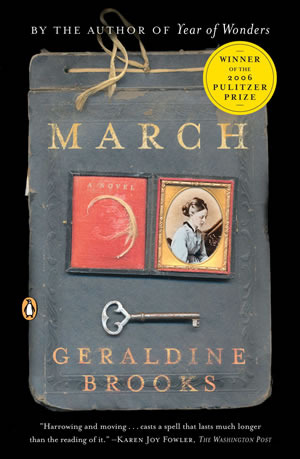
March, by Geraldine Brooks

Anyone who has read Louisa Mae Alcott’s Little Women will likely remember the vague, background figure of the father of the four little women.  For most of that book, he was far from home fighting the Civil War. In this Pulitzer Prize winning novel, Geraldine Books brings him to life, calling him only “March,” the family’s last name.

She paints March as a strong believer in the Union cause, but he is too idealistic and totally unprepared for the horrors of the war he is about to become involved in. The story follows March as he leaves behind his family and heads off to join the Union troops as a Chaplin.

But before leaving, and without consulting his wife, Marmee, he gives nearly all of the family’s fortune away to support the losing cause of John Brown, leaving his family to live on the very edge of poverty, barely surviving and only with the reluctant help of the family’s Aunt March.

Behind the lines of the battlefield, March comes face to face with violence, suffering, and the unexpected cruelty and racism of both Northerners and Southerners.  His faith in himself and in his religious and political convictions are mightily tested. But his letters to his family are intentionally evasive and cheerful, never revealing the challenges and discouragement he faces daily.  March becomes attached to a field hospital where he is faced with violence and horrible suffering which he is powerless to prevent.

He re-unites with Grace, a beautiful, well-educated Black nurse who he met years ago while working as a peddler, selling his wares to various Connecticut plantations.  When his sexual indiscretion with Grace becomes known, March is sent to a plantation where recently freed slaves are able to earn money.  But while he struggles with his duties as a Chaplin, he becomes seriously ill from the horrors he has experienced, his guilt and total disillusionment. Marmee is sent for and eventually is able to bring him home from the Washington hospital, a sick, broken man, and an invalid.  His belief in himself is shattered.  He is a changed man.

Then we learn the behind-the-scenes story of Marmee, the strong, outspoken and loving mother who kept her family together during their wartime struggles. She is both enraged and deeply hurt when she learns of March’s indiscretion. His actions have driven a wedge between Marmee and March. Marmee is again left to struggle with keeping her family together and nursing her invalid husband.

— by Gail Stilwill.

Mudbound, by Hillary Jordan


Winner of the Bellwether Prize, awarded to a first literary novel that promotes social justice.

Two men return to the Jim Crow world of the Mississippi Delta from World War II; one is black, one is white. Both have lived a life far freer than the one they now face. Ronsel Jackson is the son of sharecroppers, and Jamie McAllan is the brother of the owner of Mudbound, the cotton farm that ties the two men and their families together.

It’s a miserable place, the owner’s house little more than a shack, the people mired both in mud and a system of rules that keeps everybody—blacks, whites, men, women— in their narrowly defined space. Ronstel’s father works a grueling schedule to maintain his status as a tenant farmer, which means he gets half of the crops he and his family harvests. When a storm kills his mule, he can no longer keep up and faces returning to sharecropper status, meaning he gets only 25 percent. So a mule is the difference between making a living wage and being forever indentured.

Ronstel’s mother Florence is a midwife who saves the lives of the farm owner\’s daughters and helps the wife, Laura McAllan, turn her hovel into something of a home.  Yet, her thanks is to be treated as less than, because she is black.

The nonchalant racism of the farm’s owners is chilling. Laura notes that, while she appreciates Florence’s help, she is careful not to let the help cross the invisible line between black and white. She uses Florence’s first name, but Florence must call her “Miz McAllan.” And Florence and her daughter Lilly can’t even use the family’s outside toilet—they have to use the woods behind it. (Hard to see that as anything but an improvement, but rules are rules.)

Laura’s husband Henry is so in love with his land that he ignores the real dangers in his family, primarily those caused by his father, Pappy, who is evil incarnate and the catalyst for the disastrous events that end the novel.

Author Hillary Jordan writes each chapter in the voice of one of the main characters, giving insight into their hopes, fears, and justifications. She does not let Pappy speak, perhaps because he does not survive—which we learn in the first chapter, so no spoiler there. It would have been a challenge to hear such a nasty character explain himself, though. Such is the nature of his personality, however, that we all enjoyed the book a bit more knowing he would not survive.

—Pat Prijatel

The Round House, by Louise Erdrich


Winner of the 2012 National Book Award for Fiction

Joe, 13, lives with his parents on the Ojibwa Indian reservation in a North Dakota.  When Joe\’s mother is brutally raped, the family is devastated and the investigation into the crime grinds to a halt when Joe\’s mother retreats into herself and refuses to talk about the event.

As he watches his mother\’s slow and agonizing recovery, Joe becomes even more determined to find the rapist and somehow bring him to justice. With the help of his two best friends and some unintended inspiration from a battle-scarred former-Marine-turned-Catholic-priest, they do learn the identity of the rapist.  

But the events that follow are both bittersweet and tragic and will change all of their lives forever.

The book is more than a good mystery.  It also paints a picture of a wonderful, close-knit family and  skillfully weaves an understanding of the Indian culture that is so much a part of the lives of the tribe. This is a wonderfully written story from start to finish. —by Gail Stilwill