Winner of the Bellwether Prize, awarded to a first literary novel that promotes social justice.
Two men return to the Jim Crow world of the Mississippi Delta from World War II; one is black, one is white. Both have lived a life far freer than the one they now face. Ronsel Jackson is the son of sharecroppers, and Jamie McAllan is the brother of the owner of Mudbound, the cotton farm that ties the two men and their families together.
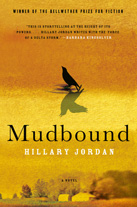 It’s a miserable place, the owner’s house little more than a shack, the people mired both in mud and a system of rules that keeps everybody—blacks, whites, men, women— in their narrowly defined space. Ronstel’s father works a grueling schedule to maintain his status as a tenant farmer, which means he gets half of the crops he and his family harvests. When a storm kills his mule, he can no longer keep up and faces returning to sharecropper status, meaning he gets only 25 percent. So a mule is the difference between making a living wage and being forever indentured.
Ronstel’s mother Florence is a midwife who saves the lives of the farm owner\’s daughters and helps the wife, Laura McAllan, turn her hovel into something of a home. Yet, her thanks is to be treated as less than, because she is black.
The nonchalant racism of the farm’s owners is chilling. Laura notes that, while she appreciates Florence’s help, she is careful not to let the help cross the invisible line between black and white. She uses Florence’s first name, but Florence must call her “Miz McAllan.” And Florence and her daughter Lilly can’t even use the family’s outside toilet—they have to use the woods behind it. (Hard to see that as anything but an improvement, but rules are rules.)
Laura’s husband Henry is so in love with his land that he ignores the real dangers in his family, primarily those caused by his father, Pappy, who is evil incarnate and the catalyst for the disastrous events that end the novel.
Author Hillary Jordan writes each chapter in the voice of one of the main characters, giving insight into their hopes, fears, and justifications. She does not let Pappy speak, perhaps because he does not survive—which we learn in the first chapter, so no spoiler there. It would have been a challenge to hear such a nasty character explain himself, though. Such is the nature of his personality, however, that we all enjoyed the book a bit more knowing he would not survive.
—Pat Prijatel

 Books, Brews & Banter