How to Read a Book, by Monica Wood

The cover of Monica Wood’s How to Read a Book is warm and inviting, especially to a lover of books and reading. It shows the exterior of a cozy bookstore from the sidewalk, beckoning readers to come on in. What follows is a highly engaging and uplifting story full of quirky and complex characters, difficult situations, emotional highs and lows, growth and redemption, and resilience. Is there a bookstore in the novel? Yes – but there’s so much more! 

There’s Harriett, a.k.a. “Bookie,” who runs a book club inside a women’s prison in Maine. She is dedicated to sharing the power of literature with every member of the group, helping them know their worth and express their feelings as they read aloud, react, discuss, write, and make connections to themselves and others. Wood does not sugar-coat their voices as they express powerlessness, rage, longing, resentment, distrust, love and more. We get to know each member of the group as they support one another through a very meager existence.  

But if the cover of the book showed a prison, it would not suggest that one of the youngest inmates, 22-year-old-Violet, is suddenly freed at the beginning of the book. In fact, the bulk of the story is arguably hers as she tries to navigate life as an ex-con “on the outs” where she never had a chance to live independently before being locked up. We watch as she goes from a tense reunion with her sister to a chance meeting with Harriett (at the bookstore!) and another fraught reunion with Frank, the husband of the woman she killed in the drunk driving accident that landed her in prison. Through much effort she lands a job for which she has “affinity,” a word that provides fledgling self-esteem, documenting research on talking parrots in a university lab – where the birds themselves are characters, as well as her ill-tempered, manipulative boss. 

Perhaps a bird would have made a good cover image, since the birds, too, were captives. And in addition to Violet’s work with the birds, the inmates give a gift of a small, knitted bird to Harriett as a token of their appreciation. She keeps it, though she’s been warned not to accept anything from them, and not without consequence. This repetition of birds seems symbolic, and yet a bird on the cover wouldn’t adequately represent Frank, a third major character who longs for a relationship with Harriett while feeling terrible about his true feelings around the death of his wife. No spoilers, but it’s not what you’d think. In addition, we get to see his rocky relationship with his daughter and his brilliance as a retired machinist-turned-handyman….at the bookstore. 

So, maybe the bookstore is the thing that ties everything together and is the best choice for the cover after all. As a member of our group observed, avid readers are drawn to books that have bookstores on the cover, and an avid reader would thoroughly enjoy this book. Also, its marketing had the intended effect. It looked like it would be an easy and enjoyable read, and it was, while still being intricately well-written.

As a bonus, our book club happens to include several people who have spent time volunteering at a women’s prison in Mitchellville, Iowa, as well as providing support to women who have recently been released. While there are some differences between the systems in Iowa and Maine, and it’s clear that some details were added to advance the story (such as Violet being outfitted with a fully stocked apartment upon her release – a lucky break that is very unlikely in reality), their general take was that the overall tone of the prison aspect of this book was spot-on. If any Iowa area readers are so inspired, check out Women at the Well for ways to get involved with helping women who are incarcerated and recently released.  

We were glad to have found and read this book, and glad that it left us feeling hopeful. It was also a good reminder of this: 

“The line between this and that, you and her, us and them. The line is thin.” 

— Julie Feirer

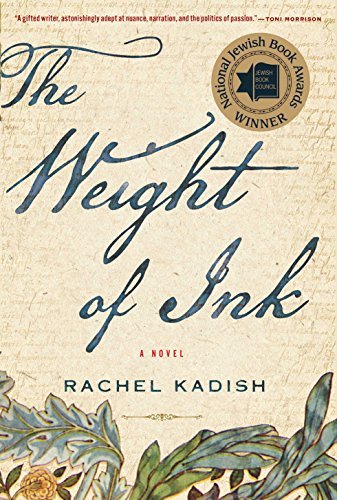
The Weight of Ink, by Rachel Kadish

Readers in search of good historical fiction may question whether they really want to learn about the everyday life and challenges of Jewish immigrants in London in the 17th century, but The Weight of Ink by Rachel Kadish quickly draws the reader into a compelling, atmospheric and skillfully written account of the period surrounding the Great Plague of 1665 alongside its impact and meaning to the professional and personal lives of two historical researchers in the 21st century.

In The Weight of Ink, the story moves back and forth, chapter by chapter, between the late 1660s and modern day London – between the household of Rabbi HaCoen Mendes who has followed his flock from Amsterdam, now, after Cromwell’s abdication, a somewhat more accepting place for Jews to practice their religion, and Helen Watt, professor and historical researcher who, at the end of her university career, is battling Parkinson’s disease and her brash, American assistant Aaron Levy.

Rabbi HaCoen Mendes is a survivor of the Inquisition, who was blinded as a concession for renouncing his faith, otherwise to die in agony on the rack. Also in the HaCoen Mendes household is Ester Valazquez, an Amsterdam orphan. She has a brilliant, open and inquisitive mind along with a strong aversion to the arid state of marriage.  Ester becomes the rabbi’s scribe by default, since she had been educated alongside her brothers, despite cultural norms against it. This work frees her from household drudgery, the only culturally acceptable alternative to marriage for a young woman.

Helen is a brilliant researcher and seemingly revered teacher, but she is lonely and emotionally repressed, having retreated from her first and only love and “…wasted her life fleeing from it ” (p. 452).  Aaron is obnoxious, arrogant and immature, but a highly intelligent graduate student whose dissertation on some minutia of Shakespeare’s Influence has stalled, likely irretrievably.  The personalities of these two accomplished researchers clash again and again until a seemingly terminal confrontation initiated by Aaron clears the air and marks the beginning of an unconventional friendship.   

But the main character of the narrative is a trove of old documents discovered during the 21st century renovation of the former Mendes, now historic HaLevy house. The narrative thereafter shuttles back and forth, chapter by chapter from one century to the other as Helen and Aaron decipher, analyze and puzzle over the documents. In alternate chapters the story of Ester, the originator of many of the documents as the rabbi’s scribe, is gradually revealed in fascinating detail, including vivid descriptions of life in London in the late 17th century.

Description is indeed the author’s strong point. Just one example – not long after Ester’s arrival in London, the rabbi sends her out into the city alone on an errand.  At first terrified by the jostling crowd,–“She was in a crush of English strangers and her breath came quick with fear – but their unfamiliar smells and rough fabrics and stout limbs carried her and the heat of their bodies warmed her” (p. 132) –and she soon comes to recognize a strong desire for life drives existence in London and in her – desire, strong enough to override the cultural conventions constricting her.  Ester’s craving for a life centered on books and ideas and how she addresses this life force through her work as a scribe is a major theme of the narrative and one shrouded in mystery.

Although The Weight of Ink would not be classified as a mystery, it reveals the secrets of the documents in a gradual way that nourishes suspense and propels the reader through the narrative. Two revelations near the end are especially surprising – one involving what momentarily seems like a contradiction of Ester’s desire for a life of the mind and the other that raises, but does not resolve, a mystery about her origins. This final jaw-dropping revelation also offers a profound gift to Aaron.

The book club enjoyed The Weight of Ink, and deemed it well written, especially the vivid descriptions, but the consensus was it would benefit from a thorough editing of its 559 pages.

— Sue Martin

The Waters, by Bonnie Jo Campbell

Bonnie Jo Campbell’s novel The Waters begins with “Once upon a time . . .” So we know to expect larger than life characters, clashes of good and evil, and a happily-ever-after ending. Yet The Waters is also a rural noir story, which means, in the author’s own words, it’s going to be “muddy and bloody,” with muck rattlers and rape, with the moral ambiguity of Wild Will Zook. And disgruntled men with lots of guns.

The story carries many themes: our relationship to the land and animals, religion versus spirituality, the meaning of family, math and logic versus intuition, aging, motherhood, reproductive rights, modern medicine versus folk medicine. But what drives the narrative is the division in the community. The men of Whiteheart are angry and discontent with Hermine (aka Herself), the matriarch of M’sauga Island, where no men are allowed and women do what they please. These men are suffering with problematic feet, bad backs, dark moods, and love problems. And Herself isn’t coming through with the cures the way she used to.

The men are troubled, sure their glory days are over. Once Whiteheart claimed its name from the delicate white-hearted celery grown by the effort of the whole community working harmoniously together. Now the land is row cropped and most of it is owned by the Clay family whose men are shadowed by hemophilia. Wild Will Zook has been banished. Wives are talking back, kids are disappointments, and Reverend Roy keeps telling them that to be a man is to suffer. Because they feel so beat down, they start shooting at stuff (animals, trees, machinery, M’sauga Island, Herself). In a memorable scene, they fell a beautiful old willow tree in an orgy of chain sawing—all the time keeping up an annoying Greek-chorus like commentary (aka whining) about the state of their world.

The only relief they get is when Rose Thorn (Herself’s youngest daughter) returns home, usually in the Spring. Rose Thorn doesn’t do anything to make them feel better because she’s a lazy woman. Yet, inevitably, when she’s around she can somehow “spin straw into gold and make people more interested in what might happen next.”

We meet Rose Thorn for the first time when the men discover her walking down the road, bedraggled and bleeding, secretly carrying a frail newborn in her backpack. The effect on the men is instant. They become considerate and loving. Interested. Hopeful.

The newborn in the backpack is Donkey, a child of rape, who comes of age in the story. On the island, she sleeps with either her grandmother or mother, sharing their dreams. She loves the swamp and the two donkeys just across the bridge. She crawls on her belly to meet the big m’sauga snake who she believes to be her sister. She turns to math and logic to try to understand a confusing world.

She is curious about the men and boys of Whiteheart and often slips away to observe them from behind the faded curtains of the house Wild Will built for Herself. But most of all, Donkey so wants Titus (who loves Rose Thorn passionately) to be her dad.

Titus, heir to the biggest farm in Whiteheart, has great passion for Rose Thorn, but he also loves practical, competent, Catholic, fertile Lorena, who can cut a pie into five perfectly even pieces (a source of wonderment to Donkey).

The climactic scene in the story, where the division in the community is finally resolved, is when the Greek chorus guys help Rose Thorn deliver her baby—Rose Moon, Titus’s child. This scene is hectic, funny, slapstick and very tender. When Titus finally shows up to carry Rose Thorn across the bridge, he is about to be bitten by the big m’sauga when Donkey tries to intervene and the snake bites her. And Herself falls in the water, only to be saved by Two Inch Tony.

As everyone is finally on the way to the hospital in Whiteheart, Donkey reflects on their dilemma.

If the Zook women continued living mysterious lives separate from the town, the men would continue watching them like prey from Boneset and making up stories about them, good and bad, calling them witches and angels. Burning fires and pissing Rosie into the snow. Standish might not shoot at them again, but someone else would; there was no end of men with guns.

So they abandon the island. Rose Thorn seeks medical care for her breast cancer, and eventually the women, Donkey, and baby Rose Moon move into Wild Will’s house. They accept the delicacies he leaves at the door, but they do not invite him in. He has become a kind of good ghost. He realizes that taking care of Rose Thorn in her pregnancy has “finally made a woman out of him, which is to say it has made him a better man.”

Titus has his epiphany too, when, having trapped and planned to kill the m’sauga, he instead submits to it and listens to the voice of God, which is not a man’s voice, telling him to take care of his kids.

Campbell’s writing is so marvelously detailed and specific that we see, hear, smell, taste, and touch the world of the waters. And because she uses an omniscient narrative voice, we can know everything about everybody—even what the crows think of all the human messing around down below.

Campbell invites us to roll our eyes, be creeped out, laugh, think about, but not judge, the world of the waters. And perhaps that’s the fairy dust sprinkled on Rose Thorn that lets her lift people’s spirits. She doesn’t judge them. Our group hadn’t read rural noir before, and it times it felt like a bit much, but that didn’t deter us from lively discussions.

— Sharelle Moranville