Author Kent Haruf

The other morning over coffee and The New York Times, my husband said, “Did you read Kent Haruf died?”  I hadn’t, but I wasn’t surprised.  I understood his most recent novel, Benediction, was given that title for a reason.

He is one of the few prolific writers of whom I can say that I’ve read all his books.  And I’m sorry there will be no more. But I’d love to read at least one again (Plainsong would be my preference) and discuss it with the BB&Bers.  (Also, it would address Ken’s lament that we’ve been reading a disproportionate number of women authors lately. ) 🙂

Plainsong was a finalist for the 1999 National Book Award.  In it, as in all his novels, the style is unadorned; he lets his characters show themselves on the page by what they do and say; we have to get to the bottom of things on our own by observing their behaviors and thinking about them. He is very much a writer of place: of small town and rural Colorado. The characters are exactly life sized. They are ordinary people:  elderly bachelor brothers on a cattle ranch; a pregnant teenager; a lonely and well-intentioned high school teacher; a single-parent dad; two little boys whose mother suffers from depression.  It’s in their response to each other that Haruf shows us grace in the most unlikely places.

Even if it doesn’t make it onto our official reading list, I highly recommend it to you fiction lovers. And if you read it, I’d like to hear your impressions.

Sharelle Moranville

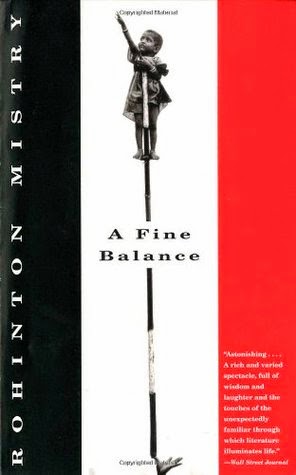
A Fine Balance, by Rohinton Mistry

If one had visited urban India circa 1975 for even a month, the careful reading of A Fine Balance would be more credible than that of an armchair traveler. This novel is not for the faint of heart, as it deals realistically with the sadistic and depraved sides of human nature. Mistry brings a mesmerizing style and a heartening since of humor, but, no laughter.   

This work also reveals a compassionate and caring side of human nature and an honest desire to connect with people, especially the four main characters:   

Dina is a young, independently spirited widow who is a skilled seems just an entrepreneur;  

Ishvar is generous and kind to everyone, and constantly encouraging his nephew, Omprakash (Om) to loosen up and fly right;  

Maneck is a college student who cannot cease dwelling on his idyllic past.   

The foregoing characters’ lives meet and eventually mingle and boost one another to a light-hearted and most easy-going state. The first three characters rise above their past and present predicaments, and, with their innate or learned good attitudes, do you go forward.   

As this novel is complex in its style, it is meant to be read twice.

Laurie Jones

Say You’re One of Them, by Uwem Akpan

Say You’re One of Them was the May read for Books, Brew, and Banter.  Written by Uwem Akpan, published in 2008, chosen as an Oprah’s Book Club Selection in 2009, it shows daily life in turbulent, war-torn, Africa.

In five short stories, all set in different parts of Africa, Akpan, an African Jesuit priest educated in America, shows us life through the eyes of African children. In “An Ex-mas Feast,” Akpan pours out Nairobian poverty on the page so vividly that it takes a reader’s breath away.  In “In My Parents’ Bedroom,” he shows us a loving, educated, enlightened Rwandan family ripped apart by tribalism.  In “Luxurious Hearses,” he narrates the ultimate sacrifice of a teenage boy to the bloodlust of people running for their lives in western Africa.

It’s a difficult book to read.  Because of the content, sometimes continuing to turn the pages is an effort.  And because Akpan sprinkles the stories generously with the mélange of languages spoken in Africa, parsing the meaning of what people are saying can be hard too.  But on those difficult-to-turn-and-understand pages, Akpan always splashes a generous measure of the best of humanity:  love, loyalty, responsibility, empathy, self-sacrifice, and faith.

In these stories of children’s lives, general themes emerge:  the variety of religions and languages in Africa, the power of faith, the role of the media, the relationship between men and women, the struggle of families to stay together, the driving force of the sex trade, the relentless force of tribalism, and always the plight of the children.

Deacon Jeanie Smith described the book as “beautifully written and utterly heartbreaking” – as the kind of book a person can’t just read.  Afterward, there’s the need to do something.

—Sharelle Moranville