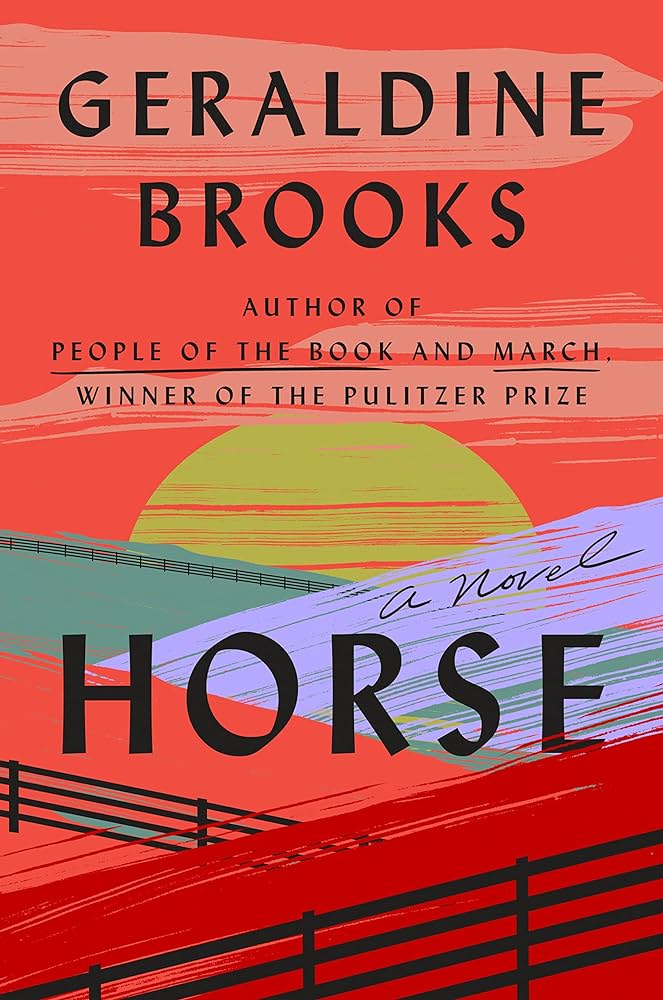
Horse, by Geraldine Brooks

Horse is a big, beautiful novel: The physical book, with its exuberant cover and elegant interior design; the story, told by five narrators, that sprawls over a hundred and seventy-five years. It’s a story about racehorses, slavery, the Civil War, race, racism, the connection between animals and people, art, history, museums, bone cleaning, skeletal articulation . . . The list is long.

Brooks explains in the backmatter that she first heard about the amazing racehorse and stud sire, Lexington, in 2010. She was seated at a luncheon by the person who had just handled the delivery of Lexington’s articulated skeleton to the Museum of the Horse in Kentucky. And she explains how her resulting research into horse racing in the mid-nineteenth century made her feel she couldn’t write about racehorses without writing about race. She also lists the characters in the novel who were real people and tells us a bit about them—for example, Black Jarrett’s owner, Dr. Warfield, who delivered Mary Todd Lincoln. Much of my enjoyment of the book comes from the clever and creative ways Brooks uses historical touchstones to unify and propel the two main stories.

The first story, that of Jarrett and Lexington, is told by Jarrett and Thomas J. Scott, the painter of racehorse portraits. Jarrett and the foal Darley (who becomes Lexington) are a matched pair until Lexington’s death. When they are separated by the whimsy of their owner, both suffer and are damaged. When they’re reunited, they heal. As a slave, Jarrett endures what he can’t change with canniness and dignity. But when the horses are threatened by Quantrill’s raiders, he reacts boldly and saves them and himself and a white man who once conspired against Jarrett and his father. Over the years, Thomas J. Scott, paints Lexington and Jarret for their owners, and he tries to befriend Jarrett. His intentions are good, but he always has a naïve understanding of what it really means to be owned.

Yet it’s his intuitive, beautiful portraits of Lexington, and the way the paintings pass from hand to hand, that unify the story—with one of them providing the much-needed bit of redemption in the second story, that of Theo and Jess. They are interesting young people in present day Georgetown. Theo is a Ph.D. candidate who believes art can change the world. Jess is an expert articulator of skeletons, and ultimately is invited to articulate Lexington’s bones, using Scott’s portraits for reference.

Their love story is touching, but complicated. They both have Australian roots. Theo is black, Jess is white. And they navigate racial shoals as most of us do–with good intentions, but a measure of ignorance and blundering awkwardness. Theo has encountered his share of racism playing polo in England, but he does not fully understand the precarity of American racism.

And in between these two love stories, is Martha Jackson’s narrative from the mid-fifties, a time of overwhelming white privilege in America. She is a wealthy art dealer who buys an old family painting of a horse from her black maid Annie as a well-meaning act of patronage. It ends up in the Smithsonian after Jackson’s death, and is a reference for Jess’s articulation of Lexington’s bones.

Brooks doesn’t tell this hundred and seventy-five-year story in a chronological line, but weaves back and forth between the time periods, creating a tapestry-like structure—one of the aspects of the novel I admired the most.

Theo’s is the first voice we hear, and Jess’s is the last. And I think, through them, Brooks is asking the question of the book: Is there hope for our deeply racist country?

Jarrett and Lexington’s story out of slavery shows us hope fulfilled: Jarrett is a free and prosperous man who can afford a portrait of Lexington by the end of the story; Lexington is retired to the cushy life of an occasional stud sire. But now we’re a hundred and seventy-five years beyond that story, where the evil of slavery has been replaced by the evil of racism.

When Brooks turned down that road of American racism, I so didn’t want to go. I was pulled out of the story the moment Jess began to fret that she had offended Theo in the conversation over the bike. But I loved Jess and Theo’s characters. They’re smart, but vulnerable. They’re devoted to Theo’s Australian dog, Clancy. They have good friends. Theo is a kind and principled person who deeply believes in the transformative power of art, and Jess—as she closes the story—hopes he’s right. For a moment on the airplane, she can believe he’s right. And Brooks does show us at least one racist person, Jarrett’s elderly white neighbor across the street, being redeemed by art.

Many of us struggled with Theo and Jess’s story, feeling it was sometimes clunky. Not nuanced. Stereotypical. I remind myself of what I’ve heard our wise Deacon Jeanie say more than once. “There’s a reason stereotypes exist, you know.” And, in the final analysis, who doesn’t love a good horse story with a gorgeous cover?

— Sharelle Moranville

Harlem Shuffle, by Colson Whitehead

Following two Pulitzer Prize winning novels in a row, Colson Whitehead has written a third brilliant portrait of systemic racism in America, wrapped in a deep dive into mid-twentieth century Harlem. This time the focus is on multi-class strivers and crooks and how they interact and mirror each other in a masterful, spare and engaging narrative – Harlem Shuffle.

Whitehead divides his tale into three sections that skillfully develop his main character Ray Carney in his three roles as committed family man; enterprising furniture store owner and part-time, small-time middle man for stolen TVs –“…only slightly bent, when it came to being crooked.” He becomes a proud striver who’s family now lives on Riverside Drive, Carney’s dream location but aims for the prestigious Striver’s Row, owner of a much expanded retail enterprise and go-to fence for major Harlem criminal Chink Montague.

Part One – The Truck   
The narrative opens in 1959 and introduces us to Ray’s wife Elizabeth, a cut above him in class and color and his strong emotional support; his deceased father Big Mike, a former full blown player in the local crime scene and cousin Freddie, Ray’s handsome soul mate since childhood who is both bone-headed and lacking in common sense. Freddie draws from his deep knowledge of Ray and his fascination with his father’s criminal underworld to volunteer Ray as a fence for the proceeds from a heist of the St. Theresa Hotel. Thus Ray begins his reluctant descent into a deeper level of criminality, and a higher class of living financed initially by the $30,000 Ray discovers in the wheel well of the old blue truck he thought was his sole legacy from his father, but was actually only the tangible element.

Part Two – Dorvay
In 1961 Ray connects with this centuries old practice of interrupting sleep with several hours of awake time. He describes his personal Dorvay as “…a period of focused rage,” his middle of the night crooked hours during which he plots his revenge against Wilfred Duke, the financier who bilked him out of a $500 envelope with the broken promise of membership in the exclusive Dumas Club. Ray develops an intricate plan to ruin Duke based on calling in stored up favors from envelopes he’s been coerced to provide in the past and some new ones, to a wide variety of criminal types, including the corrupt policeman Munson. After all “An envelope is an envelope. Disrespect the order and the whole system breaks down, “says one of them. Once the plan unfolds, Duke is ruined by scandalous photos taken during his drugged sleep at his favorite prostitute’s apartment on Convent Street. Describing the only downside of his revenge, Carney concludes, “Black eye aside, it had all been a pleasure.”  

Part Three – Cool it Baby  
It’s now 1964. The World’s Fair and riots in Harlem over the death of a black boy killed by a policeman are taking place simultaneously. They provide Whitehead an ironic juxtaposition of progress in the overall cynical bent of his narrative – “Good old American know-how on display: We do marvels, we do injustice, and our hands are always busy.” At the Dumas Club, many of Wilfred Dukes’ associates have also been disgraced, and the rules of membership have evolved to welcome younger entrepreneurs like Ray Carney, who detective Munson describes as “the biggest nobody in Harlem.” Back at the furniture store, Ray reluctantly agrees to stash an expensive looking briefcase filled with jewelry and papers stolen from the Van Wyk mansion by cousin Freddie and his drug-addled buddy Linus Van Wyk, scion of that super wealthy real estate family. Following discovery of Linus’ murder and a harrowing attempt to fence the jewelry, Ray and his hired gunman come face-to-face with the deep corruption of the Van Wyk  empire, the ultimate strivers. Whitehead calls their economic development activities more destructive than the mayhem wrought by the riots and says, “The devastation (caused by the riots) had been nothing compared to what lay before him now, but if you bottled the rage and hope and fury of all the people of Harlem and made it into a bomb, the results would look something like this.”  

As Part Three concludes, Carney cradles the dying Freddie in the bed of the legacy truck speeding to the hospital. He looks up at the stars, noting that unlike when he and Freddie were growing up together and the stars made them feel insignificant, the stars now make him feel recognized, because he has found his station in life and intends to make himself into something.

Whitehead’s vivid and eye-opening portrait of life on the raw side in Harlem at mid- twentieth century offers a gripping tale of ambition and malevolence in a rapidly changing and racially tense melieu that combine to whet the reader’s appetite for a sequel.     

— Sue Martin

She Walks These Hills, by Sharyn McCrumb

Katie Wyler began her trek through the Appalachian Mountains in 1779, escaping from the Shawnee warriors who had abducted her and killed most of her family. Now, nearly 250 years later, she’s still wandering, showing herself mainly to Nora Bonesteel, the wise woman who lives at the top of the mountain and has second sight. Katie‘s trek creates the backdrop of this book, which is about journeys of love, life, nature, justice, and retribution.

Hiram Sorley, given the unfortunate nickname Harm, has just escaped from prison, where he was serving a life sentence for a murder he does not remember. He has Karsakov syndrome, a memory disorder that is caused by alcohol poisoning, no doubt from the moonshine he consumed in his mountain home. Harm has no fear of being caught because doesn’t realize he’s an escapee. He thinks he has been out hunting or logging, and is eagerly returning home to his beloved wife, Rita, and their daughter Charlotte. 

One thing Harm is sure is that the Lord will take care of him, and the Lord oddly does provide Dinty Moore stew, a can opener, peanut butter, and even a backpack to carry it all in. In less biblical reality, these are all courtesy of Jeremy Cobb, who is also walking the hills tracing Katie steps as part of his doctoral work. He’s a better philosopher than hiker and is not so good at paying attention to regional experts, so he heads out with a pack far heavier than he can carry. To lighten his load, bit by bit he throws things along the path. Harm, following behind him, picks them up.

Jeremy doth provideth.

Author Sharyn McCrumb weaves together multiple stories of love—real, flawed, life-affirming, and dangerous—through the centuries. There’s Katie returning to a disastrous reunion with her fiancé Rab. Harm reuniting heroically and tragically with Rita and Charlotte. Deputies Martha and Joe, struggling with Martha’s new job and Joe’s PTSD from the Vietnam war. Sad Chrystal$ is looking for a warm body. Poor Sabrina, ensnarled in a miserable relationship and looking for a way out, responds to violence with violence.

Rita is living life enclosed in plastic with her second husband, the perfectly named Euell. Charlotte, now in graduate school, is becoming an expert on the geology of the Appalachians, which impresses her mother not at all, but gives McCrumb a vehicle for showing the richness of the land, even though Charlotte naively ignores its significance to the humans living on it.  

Toward the end, Nora puts much of this into perspective, telling Jeremy that Sabrina is a modern embodiment of Katie. Despite centuries of folklore, Katie is not the beautiful, clear-skinned woman we might envision, but was poor, underfed, with stringy hair and sallow skin.

As with all of McCrumb novels, the mountains are a significant character. And their degradation, through environmental abuse and development, is a key plot driver. Nothing grows on Harm’s land, 30 years after toxic chemicals were callously dumped onto it.

This is the third of McCrumb’s 13 ballad novels. It was published in 1994, but it has lost little relevance.  BBB has read two others in the series: The Hangman’s Beautiful Daughter, and The Songcatcher.

— Pat Prijatel