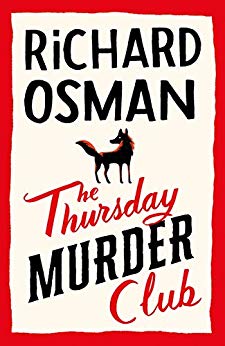
The Thursday Murder Club, by Richard Osman

At first, The Thursday Murder Club seems like a light read—charming and witty, with a murder or two thrown in for flavor. But below the fun façade lies a poignant and thought-provoking story about aging, love, loss, and hope.

The plot revolves around four “pensioners”—the book is set in Kent, England— who live in a countryside retirement home. They meet every Thursday to discuss cold cases and, as the plot progresses, they solve a few recent murders that stymie the local police. Elizabeth, a retired spy, is a catalyst for chaos who has a few tricks, plus a gun, up her classy sleeves. Joyce, a retired nurse, sees the humanity that Elizabeth can sometimes miss. She’s the book’s diarist, an outsider who couldn’t afford to live in Coopers Chase if her wealthy daughter hadn’t bought the place for her. Ibrahim still works as a psychologist and is the group’s data collector and analyst. Ron, a former labor organizer, provides a working-class perspective and a certain dim-witted clarity.

When a murder happens close to home, the group grinds into gear to find the murderer and, perhaps, report them to the police. Or not. As Joyce muses at one point:

“After a certain age, you can pretty much do whatever takes your fancy. No one tells you off, except for your doctors and your children.”

At the local police station, Donna longs to get into the detective squad, but doesn’t see it happening until Elizabeth intervenes. Chris, the DCI in charge of the murder investigation, is man enough to see Donna’s strengths, even if his skills as a detective fall far short of those of the murder club. (But whose don’t?) He’s preoccupied with a longing for a fantasy life he fears has escaped him. Good thing he takes to Donna so well, as she’s not only a solid investigator, but an impressive matchmaker.

The backstories and side characters give the book its depth. Steven, Elizabeth’s husband, is in the initial stages of dementia. Joyce is in deep grief over the loss of her husband and keeps looking for a replacement. Bernard, one option, has a grief he cannot live with. Ron’s son might be a murderer or at least a gangster. And Ibrahim fights racism with a sad aplomb.

The characters consume large quantities of wine and cakes as they plot their strategies and ensnare the bad guys. It keeps them young. As Joyce writes in her diary:

“In life you have to learn to count the good days. You have to tuck them in your pocket and carry them around with you.”

Author Richard Osman says he was motivated to write about senior citizens after visiting an upscale retirement home in England and meeting its accomplished residents who no longer went to work every day, but whose brains were still alive and quite well. This is the first book in a series; the fourth and most recent was published in mid-2023.

— Pat Prijatel

Forget Me Not Blue, by Sharelle Byars Moranville

Even though I finished Forget Me Not Blue some time ago, I have continued to think about the characters and wonder how they’re doing now. Our friend and novelist Sharelle Byars Moranville created a family of people who are fully believable, to the extent that my mind has them living just down the road off MLK — Martin Luther King Jr. Parkway, right here in Des Moines. If only they were real, I could drop by their place with some cookies or invite them to church at St. Timothy’s!

Written for a middle grade audience, the main characters of Forget Me Not Blue are siblings Sophie and Con, with emphasis on Sophie. From her perspective as a ten-year-old, we see what life is like with a mom who is loving but unstable – disappearing for days at a time, exposing the kids to harmful elements, and eventually landing in prison. Sophie and her brother, 13-year-old Con, lean on one another for support as they navigate daily life at school, meals and activities at the Community Center, and their barely habitable living space at home in the attic. In one especially poignant scene, Con buys Sophie a pair of red shoes at Walmart – her only pair – and she treasures them. They become part of her “signature look.”

Sophie and Con are both very smart, and they’re fearful of letting others know too much about their situation because of the threat of being removed from home and split up. Slowly and incrementally, over the course of the story, they develop relationships with others. Con has a girlfriend who he eventually confides in. Tommy, the restaurant owner who employs their mother, takes a special interest in them which evolves. And their great-grandfather, Gunner, works very hard to overcome his own addiction and past mistakes to earn their trust.

Sharelle Moranville is part of our BBB (Books, Brew & Banter) Club that meets weekly, so we had the honor of hosting her for an in-depth discussion over two Fridays. We learned a lot about the steps of the publishing process, the important (and sometimes challenging) relationships between authors and their agents and editors, and the various revisions and decisions that are made over months, and usually years before a book is released. Sharelle has been lucky to enjoy a fruitful relationship with both agent and editor, as well as some important personal consultants who are fellow writers.

A well-honed element of the story that our group particularly valued was the way the mother, Ashley, was portrayed. Sharelle did not sugar-coat the reality of living with a parent who is addicted and therefore not making sound choices for herself or her children, but neither did she demonize Ashley as someone who did not care about her kids. Having worked with women who are incarcerated as part of her background, she knows firsthand that most of them think about their kids above all else. As you’ll see in the story, even the title of “Forget Me Not Blue” is a nod to that maternal bond.

As an adult and a former teacher of middle grade students, I think this novel would be very valuable reading for kids. Some will see themselves represented in its hardships, but in a way that respects their resilience. Other young readers may develop some empathy about the fact that the playing field isn’t level. I also think it would be enlightening reading for teachers or any adult who works with kids. Ultimately it is hopeful and you’ll enjoy it. The quirky, endearing voice of Sophie will stick with you, and you’ll root for her family and her future.

— Julie Feirer

The Dictionary of Lost Words, by Pip Williams

Work on the Oxford English Dictionary began in 1857, and the enormous, crowd-sourced task finally ended with the dictionary’s publication in ten volumes in 1928. Pip Williams’s novel, The Dictionary of Lost Words, shows us the people (largely fictionalized) and the process of this amazing scholarly and technical achievement.

Via the very intimate first-person narrative of Esme, who basically grew up in the Scriptorium, Williams explores childhood, friendship, motherhood, the suffragist movement, sex, sexism, the brutality of World War I, and the shifting English class structure. Most of all, she explores the complexity of words. What they mean. How they make us feel. How we use them to include and exclude. How they bestow and deny power. How there are men’s words and women’s words. How not all words are welcome in the Oxford English Dictionary.

Esme is four years old when we meet her. She has an intuitive and visceral relationship with words even as a young child. As she tells us in the prologue, “Before the lost word, there was another.”As she sits on her dad’s lap in the Scriptorium on a snowy morning and helps him open envelopes into which readers have tucked words and citations of their use in publications, the word lily arrives. Because Lily is the name of Esme’s dead mother, her dad—in surprise and pain—throws the small piece of paper in the fire. Esme rushes to save it. She fails; and her scarred hands are lifelong physical reminders that words aren’t simple, straightforward things. They are profoundly powerful and complex. And they affect people differently.

In her intimate engaging voice, Esme invites us into her life as a motherless child and eventually a childless mother. We see her in her marriage to Gareth, who loves and understands her so well he has her collection of women’s words—with attribution cheekily in the spirit of the OED—typeset and beautifully bound as an engagement gift.

Motherhood is a huge theme in the story. It begins with Esme rescuing the word that is her mother from the fire and ends with her daughter, Megan, sixty-one years after publication of the first edition of the OED, speaking at a celebration of the recent second edition. She smooths an old piece of paper with the word bondmaid written on it. “Bondmaid. For a while this beautiful, troubling word belonged to my mother.” It was the word that launched a little girl into her passion for language, as she sat under the sorting table, catching word crumbs, studying the feet and legs of scholarly men enclosing her space.

Esme grows up without a mother, but she is not un-mothered. There is Lizzie, in service in Dr. Murray’s household, not a lot older than Esme, but wise beyond her years. Lizzie lets Esme keep her “lost” words in a trunk under Lizzie’s bed. Lizzie is not literate, but she is profoundly expressive. She explains to Esme that her needlepoint may be the only sign left to say she ever existed. The needlepoint makes her feel permanent. The rest of the time, bondmaid that she is, she feels like a dandelion just before the wind blows. –an image so perfect it made me shiver.

There’s Edith Thompson, who helps Esme navigate life much as a mother would, caring for Esme during a secret pregnancy, and brokering a good and loving home for the baby. Unlike illiterate Lizzie, Ditte, as Esme calls her, is an author and contributor to the OED, who is honored by getting to watch the men dine sumptuously in celebration—finally—of the full publication of the dictionary. Ditte is the one who passes on the first word that Esme pilfered from the Scriptorium—bondmaid—to Esme’s daughter, Megan, along with the message that Esme had always felt herself a bondmaid to the Dictionary.

While I know it’s just a story and Esme is a made-up character, I gasped when I read the news from Ditte to Megan, that Esme had been accidentally killed in a lorry accident in 1928, just as I had a two-hanky cry earlier when Gareth did not come home from the war. The Dictionary of Lost Words is a wonderful read. I wanted to turn the pages quickly and find out how Esme’s life was unfolding and, paradoxically, I wanted to savor the story of that life slowly, not to move too quickly from her innocent child’s voice, to her grown-up voice, to silence.

— Sharelle Moranville