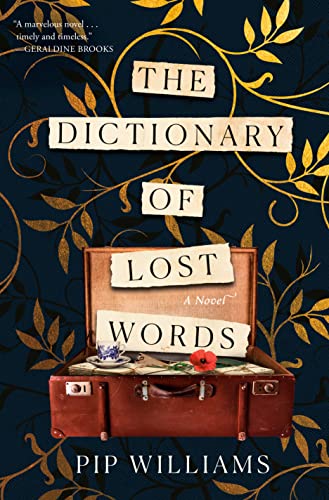
Work on the Oxford English Dictionary began in 1857, and the enormous, crowd-sourced task finally ended with the dictionary’s publication in ten volumes in 1928. Pip Williams’s novel, The Dictionary of Lost Words, shows us the people (largely fictionalized) and the process of this amazing scholarly and technical achievement.
Via the very intimate first-person narrative of Esme, who basically grew up in the Scriptorium, Williams explores childhood, friendship, motherhood, the suffragist movement, sex, sexism, the brutality of World War I, and the shifting English class structure. Most of all, she explores the complexity of words. What they mean. How they make us feel. How we use them to include and exclude. How they bestow and deny power. How there are men’s words and women’s words. How not all words are welcome in the Oxford English Dictionary.
Esme is four years old when we meet her. She has an intuitive and visceral relationship with words even as a young child. As she tells us in the prologue, “Before the lost word, there was another.”As she sits on her dad’s lap in the Scriptorium on a snowy morning and helps him open envelopes into which readers have tucked words and citations of their use in publications, the word lily arrives. Because Lily is the name of Esme’s dead mother, her dad—in surprise and pain—throws the small piece of paper in the fire. Esme rushes to save it. She fails; and her scarred hands are lifelong physical reminders that words aren’t simple, straightforward things. They are profoundly powerful and complex. And they affect people differently.
In her intimate engaging voice, Esme invites us into her life as a motherless child and eventually a childless mother. We see her in her marriage to Gareth, who loves and understands her so well he has her collection of women’s words—with attribution cheekily in the spirit of the OED—typeset and beautifully bound as an engagement gift.
Motherhood is a huge theme in the story. It begins with Esme rescuing the word that is her mother from the fire and ends with her daughter, Megan, sixty-one years after publication of the first edition of the OED, speaking at a celebration of the recent second edition. She smooths an old piece of paper with the word bondmaid written on it. “Bondmaid. For a while this beautiful, troubling word belonged to my mother.” It was the word that launched a little girl into her passion for language, as she sat under the sorting table, catching word crumbs, studying the feet and legs of scholarly men enclosing her space.
Esme grows up without a mother, but she is not un-mothered. There is Lizzie, in service in Dr. Murray’s household, not a lot older than Esme, but wise beyond her years. Lizzie lets Esme keep her “lost” words in a trunk under Lizzie’s bed. Lizzie is not literate, but she is profoundly expressive. She explains to Esme that her needlepoint may be the only sign left to say she ever existed. The needlepoint makes her feel permanent. The rest of the time, bondmaid that she is, she feels like a dandelion just before the wind blows. –an image so perfect it made me shiver.
There’s Edith Thompson, who helps Esme navigate life much as a mother would, caring for Esme during a secret pregnancy, and brokering a good and loving home for the baby. Unlike illiterate Lizzie, Ditte, as Esme calls her, is an author and contributor to the OED, who is honored by getting to watch the men dine sumptuously in celebration—finally—of the full publication of the dictionary. Ditte is the one who passes on the first word that Esme pilfered from the Scriptorium—bondmaid—to Esme’s daughter, Megan, along with the message that Esme had always felt herself a bondmaid to the Dictionary.
While I know it’s just a story and Esme is a made-up character, I gasped when I read the news from Ditte to Megan, that Esme had been accidentally killed in a lorry accident in 1928, just as I had a two-hanky cry earlier when Gareth did not come home from the war. The Dictionary of Lost Words is a wonderful read. I wanted to turn the pages quickly and find out how Esme’s life was unfolding and, paradoxically, I wanted to savor the story of that life slowly, not to move too quickly from her innocent child’s voice, to her grown-up voice, to silence.
— Sharelle Moranville

 Books, Brews & Banter