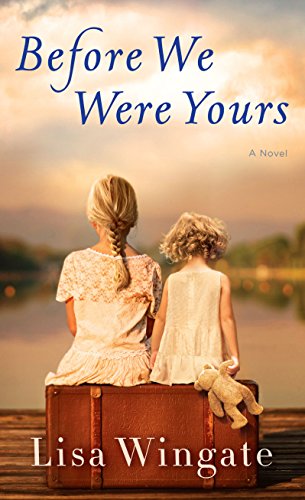
Before We Were Yours, by Lisa Wingate

This novel is based on true events that actually boggle the mind of the modern reader. Georgia Tann was a prominent maven of Tennessee society who sought to better society through the adoption of poor, underprivileged children into wealthy socially-advantaged families. Operating during the distressed times of the 1930s Depression, she established the Tennessee Children’s Home Society which operated orphanages across Tennessee and Georgia. That good intention went badly awry, however, and many of the children who ended up in these orphanages were never actually given up for adoption by their birth families. Some were snatched up on their way home from school. Others were taken from parents who were conned into signing away their parental rights by promises that their children would be returned when the family could get back on their feet. When the parents tried to reclaim their children, adoptions had been finalized, names changed, and records sealed. All of that is true and it is a grisly story that continued for more than a decade.

Against this history, Wingate structures her novel in two voices. The voice of 12-year-old Rill in Memphis, Tennessee, in 1939 alternates with that of Avery, a 30-something daughter of wealth and privilege in modern-day Aiken, South Carolina. Rill’s story moves us forward in time. Avery’s story ultimately unravels backward through the unsuspected secrets of her family,

Rill is the oldest of five children who were taken from their family’s vagabond houseboat on the Mississippi River when their father takes their mother to the hospital. Her story and the story of her siblings unfolds over a three-month period in alternating chapters of the book as Rill, rechristened May in the orphanage, fights to keep her sisters and brother with her.

In the interwoven story, Avery encounters a woman, May, in a nursing home who grabs her wrist and takes a bracelet that was given to Avery by her grandmother.  Avery’s grandmother is in the dementia unit of a different nursing home. As Avery retrieves her bracelet, she begins to talk with May and sees a photograph that looks suspiciously like one that her grandmother has. 

We see where this is going. And it does go there, at a fast tempo, and with some riveting scenes and phrases (such as fans trying to move humid summer air that has no desire to be moved). 

Our book club mostly enjoyed reading this book and it is indeed a good tale.  However, many thought the “Avery” story was too pat, too romance-novel-ish and used unnecessarily stereotyped characters, particularly Avery’s fiancé and the man who helps her unravel her family’s past. Our discussions of the book mostly centered around the character of Rill and her mighty efforts to save her siblings and their memories of their “real” parents; and around Georgia Tann, who died before she could be charged with the crimes she committed; and around our society’s changing views about adoption. The book did push us to consider what we might have done in the circumstances that confronted families in abject poverty during the Depression.  What might we have done to save our children? The scene where a father comes to the orphanage to reclaim his children and is told that they are already gone “to a better life,” is riveting. 

Review by Jeanie and Bill Smith

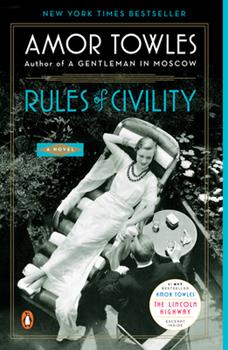
The Rules of Civility, by Amor Towles

We first meet Katey at an art exhibit in 1966. It’s a show of photographs by Walker Evans from 1938 — portraits of New Yorkers riding the subway, a mix of that city’s rich, poor, well dressed, haggard, harried, hurried. Katey is there with her husband, Val. We know she has done well for herself because an aspiring novelist is also at the opening with his agent. When the agent sees Katey, his eyes light up, and he motions for her to come over. She nods politely and starts walking—and she and Val go right out the door.

That little scene tells us much of what we ultimately get to know about Katey—driven to inevitable success, living her life on her own terms, with no patience for anybody trying to take advantage of her.

At the exhibit, she notices photographs of an old friend, Tinker, and shows them to Val. In one photograph, Tinker is well dressed, looking like the affluent young banker she knew. In another he’s in threadbare clothes, even a bit dirty, but most important, happy. Katey tells Val she knew Tinker but the two don’t talk very much about it. Val can sense that there is more to the story, but he knows his wife, and doesn’t push. He thinks the scruffy photograph came first, but Katey clarifies that Tinker’s looks changed for the worse as the year went by. 

The rest of the book goes back to 1938 and tells us that story. Towles evokes images of pre-war New York that feel like old black-and-white movies—the light, the sounds, the energy of that city. It’s an especially vivid portrait, as seen primarily through the eyes of  Katey, 24 at the time; her friend, Evie; and of course Tinker. Nobody is who we think they are. They may not even be who they think they are.

Even though Katey is the narrator, this is Tinker’s story. As Katey’s trajectory points toward success, Tinker’s takes a turn away from glamour and toward a more honest, connected life. Judging by the photographs, a happier life.

The novel takes place almost entirely in 1938 with these young vibrant New Yorkers drinking remarkable amounts of alcohol and having witty Spencer-Tracy- Katharine-Hepburn-type conversations as they wander to speakeasies, bars, and fancy homes. We learn the least about Katey. As the narrator, she can tell us as much or as little as she wants. We get a sense of who she is professionally, but not a clear understanding of her personal background.  

The novel is a delight to read, even though at times you might challenge some of its assumptions. The images and the characters, including New York itself, will stay with you long after you finish the book.

To add authenticity, Towles uses photos from Evans’ exhibit throughout the book.

The book takes its title from George Washington’s Rules of Civility, 110 pieces of advice the future president wrote when he was 14. Tinker uses them to try to fit into a society to which he feels he does not belong. The last rule may say the most about his life choices as the year progresses:

Labour to keep alive in your Breast that Little Spark of Celestial fire Called Conscience.

— Pat Prijatel

Sky Bridge, by Laura Pritchett

Miguel worries about ilegales crossing the desert—not his cousins and girlfriend, who are still waiting at the border, but others—the anonymous, but not anonymous to themselves, since this is, after all, their one life. (Libby in monologue)

In her novel, Sky Bridge, Laura Pritchett dips into the anonymous stew of struggling rural small-town humanity and shows us one life in fine detail: the life of Libby, the narrator, a young woman who became a mother in deed if not in fact when she was a child herself and took responsibility for her little sister, Tess. Now, in the time present of the story, Libby does not want pregnant Tess to have an abortion and promises to raise the child herself. And she does not want Tess to leave after the Amber’s birth, but Tess does.

And the rest is the story. And a compelling, fresh story it is.

Libby carries many voices in her head: Kay, Libby’s mom, telling her she’s a disappointment, not up to taking care of baby Amber. Derek, Libby’s boyfriend, telling her she is not beautiful. Miguel, husband of Libby’s best friend, telling her the two of them have been left behind, and now it’s too late for them to get out of Lamar, Colorado. Frank, her employer, telling her that where they live is “the last fine place to be.” Baxter, her mom’s employer, telling her “If you can suffer and not be bitter it will change you into a real human. A soft human.” Arlene, a coworker, telling her she’s a beautiful kid, though Libby feels this can’t possibly be true. Libby’s own narrative voice is so intimate the reader can’t help embracing her and hers as they each live “their one life.” Like Libby, we learn not to pay much attention to Kay’s soliloquies of rage and bitterness because we know that ultimately Kay, like almost everybody, will step up and do a version of the right thing. Exception: Tess’s associate, Clark.

Pritchett shows us the universal in the particular. Bad people do good things. Good people do bad things. Sometimes bad is good. Sometimes good is bad. Libby and Tess’s profligate and violent dad (bad) is still remembered for staying with the body of Frank’s fiancé (good) when she was killed in an auto accident. Miguel (good) grows pot (bad—at least in 2005) to pay for the coyotes (good, unless breaking the law is bad). Eventually, pretty much everybody gives a hand to the ilegales—some do it for money, but most do it out of kindness. Ed, the post-hippie beekeeping environmentalist, an outsider in an orange VW van, becomes a sort of guardian who posts his bee hives strategically so he can keep a protective eye on Libby and Amber (good) and his pot (arguably bad). Who strategically dumps a dog (in principle, bad), which Libby is sure to take in and be protected by (good).

Sometimes the bad things feel banal: Libby’s stealing beer from her employer. Arlene’s clipping unredeemed coupons and sending them in. Simon’s family deciding to take Amber from Libby because they can “raise it right”—banal because of the cliched assumption that a churchy couple will be better parents than an unmarried, unmoored young aunt.

But sometimes the bad things feel far from banal. They feel evil. Clark’s rape of Libby as entitled revenge on Tess, for example. His jacking up the price on the ilegales at the end of the trip. Yet even he gives Libby good advice when he tells her to learn to let go of certain people, which she eventually does.

 As the novel progresses, caring for a newborn wears Libby down, down, down beyond exhaustion. She comes to understand why moms sometimes do bad things to their kids, and she also comes to understand her strength and the strength of the community to do the fundamentally good thing: see other people.

See people, I want to tell her. See them, and especially see them if at first you don’t think they’re worth noticing. (Libby in monologue near the end, speaking of Tess)

Eventually the little row of marigolds in the yard begins to thrive, the bathroom gets cleaned, the house gets painted, even tough, cynical Kay pitches in to help the ilegales.Tess does the paperwork to make baby Amber legal. Libby lets Tess go. Amber wiggles with joy when she catches sight of Libby, her mom. A measure of contentment reigns, but it’s a dynamic contentment.

I keep seeing how everybody is pushing ahead, looking for a place with enough space for our dreams. The ilegales. Tess. Derek. Me. Moving forward, trying to cross those invisible boundaries so we can find the place where we’re most free and the most full.

Perhaps that place is the sky bridge—that special state of being where one can reach up and touch the blue sky.

Ed tells Libby, “Art is what gets us beyond what is real. It makes reality more real. It also shortens the distance we gotta travel to see how connected we are.” A good summation of this lovely novel.

— Sharelle Moranville