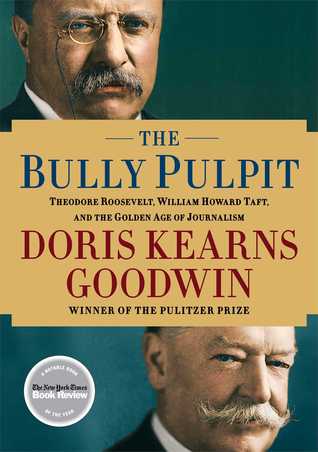
The Bully Pulpit: Theodore Roosevelt, William Howard Taft, and the Golden Age of Journalism, by Doris Kearns Goodwin

This book accomplishes several things at once. It gives us superbly researched accounts of three intriguing stories that peaked in the first decade of the 1900s – the familiar career of Theodore Roosevelt, the less known path of William Howard Taft, and the misunderstood investigative journalism of that period.  It shows how these three stories entwined with each other and fed each other.  It gives us a comprehensive feel for a period that echoes our own in many ways.  It is a long but wonderfully readable work of history.  

Teddy Roosevelt was a huge and energetic personality, a scholar, a prodigious reader and writer, and a man dedicated to progressive domestic policies but flawed by an impetuous temperament and muscularly nationalistic foreign policies.  After some initial political success, personal tragedy triggered a depression that he conquered by physical activity during an extended ranching sabbatical.  He returned to the meteoric political career we are familiar with.  In just over a decade he served as a reforming U.S. Civil Service Commissioner, New York City Police Commissioner, Governor of New York, Vice-President and President of the United States.  Goodwin gives us well-documented explanations of why and how he achieved a number of progressive social policies in each position.  

Goodwin gives us a welcome picture of Big Bill Taft.  We typically know him as an oversized president who was the regular Republican Party nominee in 1912, opposing Roosevelt’s “Bull Moose” campaign that allowed Woodrow Wilson’s campaign as the Democratic nominee to win.  But the full story is far more vibrant and impressive.  He was a popular and productive public servant in Ohio, especially in judicial service, which was his own preferred path.  He developed a close personal friendship with Roosevelt while working at the Justice Department; Roosevelt and Taft’s wife kept pushing him in political directions.  He served admirably as the first Governor General of the Philippines and the leader of Roosevelt’s cabinet.  He was a natural choice, and Roosevelt’s choice, to succeed TR in 1908.  Somewhat trivial bureaucratic squabbles during Taft’s presidency produced a serious division between them that led to Roosevelt’s third-party run in 1912.  Touchingly that rift was healed in 1918, shortly before Roosevelt’s death and Taft’s eventual appointment as Chief Justice of the United States.  

The rise of investigative journalism in the 1890s and 1900s is the third story Goodwin tells.  An increasingly educated and urban America provided a market for more thoughtful and probing journalism than daily newspapers could provide.  Goodwin introduces us to McClure’s, a monthly led by S.S. McClure and featuring well-researched articles by writers such as Ida Tarbell, Ray Stannard Baker, Lincoln Steffens, and William Allen White.  Despite their documentation of social issues with high standards of scholarly journalism, these writers were often included in the maligned category of muckrakers and yellow-press.  

Roosevelt was the perfect foil for these writers.  He invited them into his thinking, and in return used the relationship to project his policies, and not incidentally his personality, to the general public.  This relationship of press and politics gave Roosevelt the Bully Pulpit of the title.  It was unprecedented in American government but has become a necessity for successful governance ever since, and continues so with the evolution of the press to broadcast and electronic media.  Taft’s inability to understand and use this resource – due to his personal temperament and his judicial approach to public leadership – was a major barrier to his presidency and to his 1912 campaign.  

The period echoes themes of our own times.  Economic growth since the Civil Wat resulted in extremes of wealth and poverty, and the political divisions were equally extreme.  Industrial powerhouses of that day – railroads, oil companies, and meat packers – were eventually tamed, income taxation was introduced, popular election of senators was adopted, and labor and housing conditions were addressed. Goodwin shows how these accomplishments were the result of Roosevelt’s political skill, breaking legislative deadlocks by using the press to apply public pressure . 

It is an extensively documented period of history.  People still wrote meaningful letters and left thoughtful diaries.  Public documents are generally preserved.  Goodwin has distilled these resources to tell powerful stories, full of credible and nuanced characters, motivated by strong beliefs and purposes.  One member of our group stated that the book should be read by any current Republican as a reminder of what the party once stood for.  

— William H. Smith Jr.
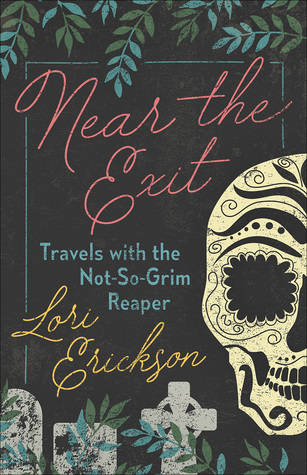
Near the Exit, by Lori Erickson

Being shown the world through the eyes of thoughtful people who are keen travelers and also engaging writers is a big treat to someone who doesn’t travel (me). Near the Exit: Travels with the Not So-Grim Reaper is a wonderful read and a thought-provoking discussion of death and death rituals.

As a huge fan of the movie Coco, I really enjoyed visiting the largest annual Day of the Dead celebration in Chicago with Erickson. Likewise, ancient Egyptian sites; nursing homes; the New Zealand Maori; Aztecs and Mayan ruins; funeral homes; the spiritual center in Crestone, Colorado; Assisi; and the Sacred Stone Circle at Harvest Preserve in Iowa City were each, in their way, fascinating destinations for conversations about death. After reading this book, I think I may be able to react to nursing homes with more peace and grace.

My favorite section of book is near the end, when Erickson describes what she saw at Eremo delle Carceri (a hermitage overlooking Assisi):

Just outside the building is a statue of Francis that’s the happiest depiction of a saint I’ve ever seen. It shows him lying on the ground, his hands behind his head, his sandals kicked off and ankles crossed, a contented smile on his face. Christianity might produce more saints if we pictured them like this, rather than carrying the tools of their martyrdom.

Erickson goes on to say:

When it came time for him to die, he wanted them (his brothers) to place his naked body on the ground, not long, just about the length of time it took someone to walk a mile.  . . . maybe he knew that after his death his bones—and his message—would become the property of the church, which would inevitably try to corral and domesticate the wild spirit he’d unleashed. Before that happened, he would have one last moment of communion with the earth he loved so much. It is said when Francis died, a chorus of larks wheeled and swooped above him for a long time, singing him home.

I’m not sure why that passage is so appealing. Maybe because it shows such a vibrant, living membrane between the spiritual and the physical–which is, indeed, something I sometimes, in lucky moments, feel.

Humans are apparently the only one of God’s creatures who grapple with their own mortality. In Near the Exit, Erickson shows us a way to circle closely to the inevitable and look at it without too much unease.

—Sharelle Moranville

Becoming, by Michelle Obama

In a nutshell, Becoming is a remarkable and inspirational story of an extraordinary woman. The book is a coming-of-age story; a love story of a pair of opposites; and a political saga by a woman who was skeptical, if not downright scornful of politics, but who became one of the most popular first ladies in American history.  

In telling her story, Michelle takes readers by the hand on an intimate tour of everyday African-American life and ambition, while recounting her rise from modest origins to the closest America has to nobility. Gracefully written and at times laugh-out-loud funny, she invites readers into her world, chronicling the experiences that have shaped her from her childhood to the White House.

I particularly liked the titles of the three sections of the book. The first third (Becoming Me), covers her childhood, growing up in lower middle class in southside Chicago, with parents who made their high expectations clear. Despite her family’s challenges and her ‘female blackness’, she managed to go to Princeton, then Harvard Law, and then to work at a prestigious law firm where she met Barack, fell for him and his wanderlust, while Barack was grounded by her traditionalism. In the second section (Becoming Us), she covers their marriage, marriage counseling, raising two down-to-earth daughters under an unforgiving media glare, winning the 2008 Iowa caucuses, and making it to the White House. But she never takes any of it for granted. On the contrary, her tone is one of wonderment as to how this all happened. Over and over again, from high school to the White House, she asks, “Am I good enough?”

She closes the last third of the book (Becoming More), talking about the stress of being in the spotlight, her desire to make an impact as First Lady, and the opportunity to offer her vision.  She knew that she would be held to a different standard, her every gesture scrutinized. Her story is not full of Washington gossip and political score-settling, though she does lay bare her contempt for Trump, who she believes put her family’s safety at risk with his false birther conspiracy theory.

Becomingis a warm, wise, revelatory and intimate, deeply personal coming-of-age story of a strong-minded girl who grew up to become one of the most powerful and influential black women in America. Her memoir sold more than 1.4 million copies in its first week and quickly became the best-selling book of the year. Through it all, her outlook is optimistic, her voice clear, witty, candid and insightful. She talks straight, with an openness and honesty rarely seen. She is gifted in her ability to express her emotions with meticulous attention to details, writing with tremendous insight and sensitivity from beginning to end. I loved it.

— Kenn Johnson