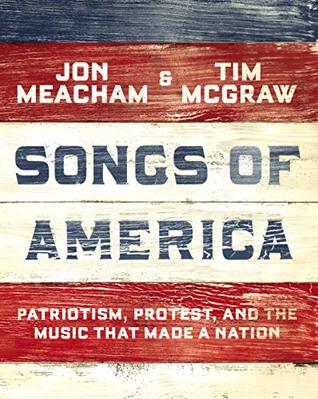
Songs of America, by Jon Meacham and Tim McGraw

In Songs of America, Pulitzer Prize-winning historian and biographer of Presidents Jon Meacham and Grammy-winning country singer Tim McGraw teamed up to trace America’s history through patriotic songs that shaped and reflected the country’s mood amid wars, social movements, and other times of conflict from before the American Revolutionary War up to the election of President Obama. Anyone who enjoys reading history or listening to music – or better, both – will find it irresistible. 

Meacham writes a celebration of the history and songs of the eras while McGraw reflects, as an artist and performer, on the songs selected in a series of sidebars. The two form an irresistible duo, connecting us to music as a force in our nation’s history. They begin their narrative early on, when tensions first arose between England and the 13 colonies. From there, they recount the next two-and-a-half century journey over our history’s rocky road.   

From the Star Spangled Banner and Yankee Doodle Dandy, to I Wish I was in DixieAmerica The Beautiful,This Land is Your Land and He’s Got the Whole World in His Hands, in early years, to the more current We Shall OvercomeBlowin’ in the WindOkie From Muskogee, and Born in the USA, to name a few, they connect us with music as an unsung (no pun intended) force in our country’s development.   

McGraw’s engaging commentary fits well with Meacham’s artful delivery in writing about each song and how it fits into the era. Rarely do such diverse talents mesh in a way that produces a result of a whole greater than the sum of the parts.  

In summary, they have written a wonderful and moving account of how the sounds of America have inspired us and contribute to our understanding of our past.   Toward the end, Meacham quotes Shakespeare:

The man who has not music in his soul
Or is not touched with Concord of sweet sounds,
Is fit for Treasons, Stratagems, & Spoils,
The Motions of his mind are dull as Night,
And his affections dark as Erebus.
Let no such Man be trusted.  

Perhaps this is why the authors halt their story just before the 45th President….  

p.s. A personal note of a segment of my early history and music. While a ninth-grader in 1956, I joined a group of boys who were skipping school to travel to Memphis to hear Elvis Presley at the Cotton Carnival, an event much like the Mardi Gras. Elvis had recently made the scene with his hit “Heartbreak Hotel”, and we were entranced by his sideburns, swiveling hips, ducktail haircut – all of which we quickly tried to emulate. We got back home well into the wee hours of the morning, and of course my parents had been extremely worried and now mad, but glad I was safe.  I think I was grounded forever. Several years later, Elvis and I were both serving in the Army at the same time in Germany.  

Ken Johnson

Pilgrim at Tinker Creek, by Annie Dillard

Dillard’s opening anecdote of the old fighting tom leaping through the window onto her bed at night and kneading her chest while she’s half-asleep is borrowed from someone else. But the reaction to the event is pure Dillard as poet and theologian. 

“I washed before the mirror in a daze, my twisted summer sleep still hung about me like sea kelp. What blood was this, and what roses? It could have been the rose of union, the blood of murder, or the rose of beauty bare and the blood of some unspeakable sacrifice or birth. The sign on my body could have been an emblem or a stain, the keys to the kingdom or the mark of Cain. I never knew. I never knew as I washed, and the blood streaked, faded, and finally disappeared, whether I’d purified myself or ruined the blood sign or the Passover. We wake, if we ever wake at all, to mystery, rumors of death, beauty, violence . . . ‘Seems like we’re just set down here,” a woman said to me recently, “and don’t nobody know why.”

In this opening, Dillard poses the question of the book very colloquially. Seems like we’re just set down here and don’t nobody know why. The opening also puts the reader on notice that her writing style is going to be poetic. She’s going to use words that need to be paused over and considered. And she’s going to use them abundantly in sentences with rhythm and repetition that convey feeling as much as they convey meaning. And she’s going to make lots of allusions to Scripture (just give a second glance to the quotation above as an example).

In her younger years, Dillard had turned away from organized religion because she couldn’t reconcile the easy, pious answers about Why? with the suffering she observed in the world. But in her mid-twenties, Dillard dared take a crack at answering the question of Why? herself. And she won the Pulitzer for her efforts. In Pilgrim at Tinker Creek, the young poet took on the absolutely biggest question of all, suspecting it was impossible to answer, but daring to try.

In her year-long, up-close observation of nature along Tinker Creek, Dillard does her best to show us “here” (as in Seems like we’re just set down here . . .) in blinding color, shifting shadow, ice and heat, big and small. Animal, vegetable, mineral. She serves up details of nature both adorable (the juvenile muskrat floating past with his feet over his stomach) and ghoulish. She observes the abundance of the natural world as something not altogether positive (all those parasites and predators). And trying to draw a conclusion about the nature of God from all this, she concludes merely “the creator loves pizzazz.” –which, honestly, made me laugh. And reminded me of the Psalmist claiming God made the great leviathan just for fun.

In her poetic, abundant way, in Pilgrim at Tinker Creek, Dillard show us nature in which the Creator must be because He is omnipresent, so He has to be in there, right? 

But questions linger. 

And in her later book, Holy the Firm, Dillard tries to answer them. That book was written while she lived on Lummi Island, off mainland Washington, where nature is sparse. She called Lummi Island “the edge of the known and comprehended world . . . the western rim of the real . . . the fringes’ edge . . . where time and eternity spatter each other with foam—a place, in other words, where nature stops and the darkness of Divinity begins.” Or, put more succinctly: “If God is in the abundance of creation, take away creation and get a better look at God.” Or, put a bit more esoterically, perhaps Creation was the fall.

Dillard invites us on a pilgrimage to understand God. But she also quotes Augustine: “If you do understand, then it is not God.” 

Or as Anne Lamott prays at the beginning of her day: Whatever.
Seems like we’re just set down here, and don’t nobody know why.

— Sharelle Moranville

The Bully Pulpit: Theodore Roosevelt, William Howard Taft, and the Golden Age of Journalism, by Doris Kearns Goodwin

This book accomplishes several things at once. It gives us superbly researched accounts of three intriguing stories that peaked in the first decade of the 1900s – the familiar career of Theodore Roosevelt, the less known path of William Howard Taft, and the misunderstood investigative journalism of that period.  It shows how these three stories entwined with each other and fed each other.  It gives us a comprehensive feel for a period that echoes our own in many ways.  It is a long but wonderfully readable work of history.  

Teddy Roosevelt was a huge and energetic personality, a scholar, a prodigious reader and writer, and a man dedicated to progressive domestic policies but flawed by an impetuous temperament and muscularly nationalistic foreign policies.  After some initial political success, personal tragedy triggered a depression that he conquered by physical activity during an extended ranching sabbatical.  He returned to the meteoric political career we are familiar with.  In just over a decade he served as a reforming U.S. Civil Service Commissioner, New York City Police Commissioner, Governor of New York, Vice-President and President of the United States.  Goodwin gives us well-documented explanations of why and how he achieved a number of progressive social policies in each position.  

Goodwin gives us a welcome picture of Big Bill Taft.  We typically know him as an oversized president who was the regular Republican Party nominee in 1912, opposing Roosevelt’s “Bull Moose” campaign that allowed Woodrow Wilson’s campaign as the Democratic nominee to win.  But the full story is far more vibrant and impressive.  He was a popular and productive public servant in Ohio, especially in judicial service, which was his own preferred path.  He developed a close personal friendship with Roosevelt while working at the Justice Department; Roosevelt and Taft’s wife kept pushing him in political directions.  He served admirably as the first Governor General of the Philippines and the leader of Roosevelt’s cabinet.  He was a natural choice, and Roosevelt’s choice, to succeed TR in 1908.  Somewhat trivial bureaucratic squabbles during Taft’s presidency produced a serious division between them that led to Roosevelt’s third-party run in 1912.  Touchingly that rift was healed in 1918, shortly before Roosevelt’s death and Taft’s eventual appointment as Chief Justice of the United States.  

The rise of investigative journalism in the 1890s and 1900s is the third story Goodwin tells.  An increasingly educated and urban America provided a market for more thoughtful and probing journalism than daily newspapers could provide.  Goodwin introduces us to McClure’s, a monthly led by S.S. McClure and featuring well-researched articles by writers such as Ida Tarbell, Ray Stannard Baker, Lincoln Steffens, and William Allen White.  Despite their documentation of social issues with high standards of scholarly journalism, these writers were often included in the maligned category of muckrakers and yellow-press.  

Roosevelt was the perfect foil for these writers.  He invited them into his thinking, and in return used the relationship to project his policies, and not incidentally his personality, to the general public.  This relationship of press and politics gave Roosevelt the Bully Pulpit of the title.  It was unprecedented in American government but has become a necessity for successful governance ever since, and continues so with the evolution of the press to broadcast and electronic media.  Taft’s inability to understand and use this resource – due to his personal temperament and his judicial approach to public leadership – was a major barrier to his presidency and to his 1912 campaign.  

The period echoes themes of our own times.  Economic growth since the Civil Wat resulted in extremes of wealth and poverty, and the political divisions were equally extreme.  Industrial powerhouses of that day – railroads, oil companies, and meat packers – were eventually tamed, income taxation was introduced, popular election of senators was adopted, and labor and housing conditions were addressed. Goodwin shows how these accomplishments were the result of Roosevelt’s political skill, breaking legislative deadlocks by using the press to apply public pressure . 

It is an extensively documented period of history.  People still wrote meaningful letters and left thoughtful diaries.  Public documents are generally preserved.  Goodwin has distilled these resources to tell powerful stories, full of credible and nuanced characters, motivated by strong beliefs and purposes.  One member of our group stated that the book should be read by any current Republican as a reminder of what the party once stood for.  

— William H. Smith Jr.