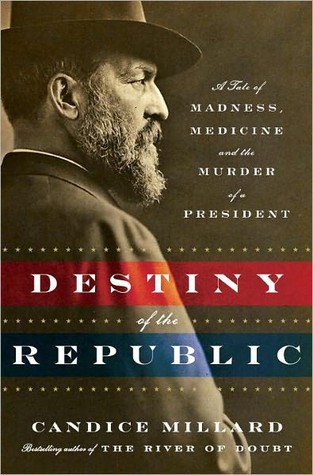
Destiny of the Republic: A Tale of Madness, Medicine and the Murder of a President, by Candice Millard

The book group took on this 2011 book with the reluctance of several members.  It deals, after all, with that somewhat distant period of American history between the civil War and World War I and focuses on the assassination of President James Garfield, one of the string of presidents thought of today as non-entities.  As we got into the book, however, all were taken by the immediacy of the political situation and assassination and by Candice Millard’s skillful weaving together of the political intrigues before and after Garfield’s election, the insanity of the assassin Charles Guiteau, the medical treatment of the President, and Alexander Graham Bell’s frantic efforts to perfect a device to locate the bullet.

The years following the Civil War were marked by deep political divisions and rapid technological change.  On the political side, reconstruction was ended in 1877 leaving civil rights issues unresolved, as they would remain for decades longer.  It was a time of enormous industrial expansion, with railroads, electricity, telephones, elevators, photography, and many other life-altering technologies becoming commercialized.  Millard brings some of this to life in a way that made us feel at home in the 1880s.

Garfield himself comes as a surprise.  From a log cabin background in frontier Ohio, he proved an able scholar and was president of a small liberal arts college in Ohio while still in his 20s.  He served with distinction in the Civil War, securing Kentucky as a part of the Union, and becoming a Brigadier General. Meanwhile, he had been elected to the Ohio legislature and the US Congress where he served until his compromise nomination by a stalemated Republican convention in 1880.  Millard presents him as a centrist politician, committed among other things to merit-based civil service appointments that would have ended the spoils system where a newly elected administration could replace the entire federal work force from top to bottom.  Garfield’s personal integrity and respect may have offered a bridge across political divides, and might have reconciled the post-reconstruction south, African-Americans, the conservative branch of the Republican Party (the “Stalwarts”), and Garfield’s own progressive branch of the Republican Party (the “Half-Breeds,” later exemplified by Theodore Roosevelt).  We can only speculate how the destiny of the Republic was altered by his assassination and whether later controversies might have been lessened or avoided had Garfield been able to complete his presidency.

Millard also portrays very real personalities, including Garfield’s likeable family, the venal Senator Roscoe Conkling, the arrogant Doctor Bliss, the utterly crazy Charles Guiteau, and the hyperactive Alexander Bell.  There are other characters we would have liked to know better, such as Doctor Susan Edson, a woman physician who was allowed only a subordinate role in treating the wounded Garfield, and Julia Sand, whose letters gave remarkably salient political advice to Vice-President Chester Arthur as he assumed the presidency.

Millard’s excellent telling of these interrelated stories won over all the members of the book group. A remote period became very immediate. Millard gives lucid clinical descriptions of the medical treatment of the wounded president by American practitioners who still resisted antiseptic practices that had gained acceptance in Europe, and that would probably have avoided the sepsis that ultimately killed Garfield after ten agonizing weeks of highly questionable treatment.  Though we know the outcome, Millard lets us feel the suspense as flawed characters pile tragedy upon tragedy to undo an admirable hero and change American destiny.  — Bill Smith
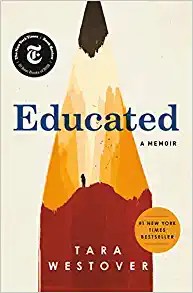
Educated, by Tara Westover

Educated is a multi-dimensional memoir in which Tara Westover traces her voyage from an isolated and troubling childhood to the highest levels of academia.  She grew up in a religiously conservative Mormon family in remote surroundings in the Idaho mountains.  The family outlook is more than conservative – as Westover describes it, the ethic is survivalist, isolationist, and distrustful of outside influences, even those from mainstream Mormon sources.  Telling are her father’s extensive preparations for Y2K and his ultimate disappointment when those preparations were proved unnecessary. The isolation grew, such that the older children attended community schools for a few years, but Tara never attended school, and her home schooling included little beyond the Bible and the Book of Mormon.    

The dominant themes of her youth are dangerous work in the family junkyard and controlling and abusive behavior by an older brother.  The picture is more nuanced, however, as she was exposed to outside forces in several ways. One set of grandparents lived in town and provided some contact with the larger world.  She developed a singing talent and participated in church music and community theater.  She occasionally held jobs in town and developed some trusting friendships with other young people.  An older brother went to Brigham Young University and ultimately opened an awareness of that avenue to Tara.    

These conflicting forces built Westover’s growing awareness of her talents and opportunities.  This section of the memoir left some of our group unsatisfied; some readers would have liked more description, for instance, of how she prepared herself for college admission without the benefit (or burden?) of any formal scholastic training.  Other themes were just as important as academic preparation, however. Westover covers how leaving for college allowed her to deal with mental instability and abusive relationships, her own sense of integrity, and the values of family relationships compared to academic work.  Ultimately that is unfinished work and she is still wrestling with being part of family without being trapped by it.  She deals very honestly with the reality that some of her observations and memories differ substantially from those of other members of the family.    

Our group had an interesting discussion of memoir writing.  Westover writes from the perspective of the age of about thirty. This gives her an advantage of proximity to the events she writes about, but limits the perspective that may come with more distance and maturity.  We expect that the bulk of Westover’s professional and personal development still lies ahead of her and might lead to new reflections of her forming experiences. The etymology of “educated” suggests a drawing out.  Usually this implies drawing lessons from the past or work of others or drawing the best out of oneself.  This tale also evokes Westover drawing herself away from the complexities of her birth family into the world of higher academia as she studies at Cambridge and Harvard.  As education should never end, we await what will fuel Westover’s future memoirs.   

— Bill Smith

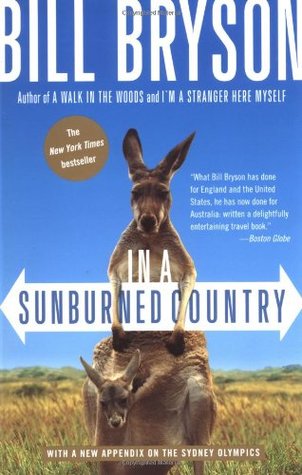
In A Sunburned Country by Bill Bryson

“And so once more to the wandering Road,” declares Bryson in his 2000 book In a Sunburned Country. His previous excursions were along the Appalachian Trial in the national bestseller A Walk in the Woods, and rambles through Britain in Notes from a Small Island, and now to his visits to Australia, the country that doubles as a continent, the hottest, driest weather, and the most lethal wildlife found on the planet (the ten most poisonous snakes, sharks and crocodiles in abundance, cassowary’s with razor claws, venomous seashells, spiders galore, even fluffy caterpillars and knife-like plants).

To travel with Bryson is not to simply experience a locale, but rather to enjoy his special visions and his humor – self-deprecating, but with a well-developed sense of the ridiculous, the outlandish and sublime. I lost track of how many times I laughed until there were tears running down my cheeks.  He doesn’t try to be funny at all costs, it’s just the way he is. For example, he says: “Cricket is the only sport that shares its name with an insect”, and “the following are all real places: Wee Waa, Poowon, Burrumbuttock, Suggan Buggan, Jiggalong, and the supremely satisfying Tittybong.”

Australia is fascinating, and Bryson has done an excellent job of telling us why – touching on a little bit of everything – history, politics, people, geology, biology, flora and fauna. Wherever he goes, he finds Australians who are cheerful, extroverted, obliging, and quirky. He says that Aussies spend half of any conversation insisting that the country’s dangers are vastly overrated and there is nothing to worry about, and the other half telling you how a snake bit Uncle Bob on his groin, but it’s okay now as he’s off the life support machine. Clearly, Bryson’s fascination and affection for Australia shines through.

On the other hand, Bryson tries to set the record straight about Australia\’s original people, pointing out that the Aborigines are the world\’s oldest continuously maintained culture and they were sophisticated enough to get to Australia from Asia by boat, long before Europeans even figured out how to sail. But he also writes about white Australians\’ racism and tragic treatment of the Aborigines, but acknowledges that, like most white Australians, he has had virtually no contact with the Aborigine population.

The result is a deliciously funny, fact-filled and adventurous performance by Bryson, who combines humor, wonder and unflagging curiosity. My only negative criticism is that the book would have benefited with the addition of better, more extensive maps.  Since Bryson was constantly on the move, I found myself frequently going back to the four maps at the beginning of the book. Pictures would have helped too. For example, here’s a panorama of Uluru (Ayers Rock), the world’s largest monolith. Words alone don’t convey the beauty one of Australia’s most recognizable natural landmarks around sunset, showing its distinctive red coloration. 

I highly recommend this enjoyable and delightful book. Bryson did a considerable amount of research before heading Down Under and his writing shows it. As the Aussies would put it, he’s done a fair dinkum job.

— Ken Johnson