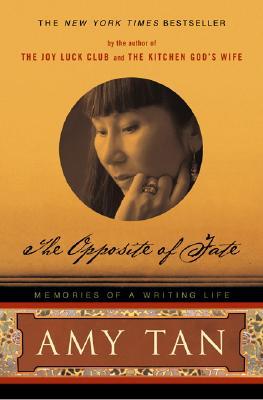
The Opposite of Fate: Memories of a Writer’s Life, by Amy Tan

Amy Tan’s mother believed in ghosts and curses and lived her life expecting bad luck. A typical maternal warning:

“Don’t ever let boy kiss you. You do, you can’t stop. Then you have baby. You put baby in garbage can. Police find you, put you in jail, then you life over, better just kill youself.”

Her father was a Baptist minister who was guided by his Christian faith. His approach:

“Faith is the confident assurance that something we want is going to happen. It is the certainty that what we hope for is waiting for us even though we still cannot see it ahead of us.”

So Tan lived her life amid contradictions, in a home full of invited and uninvited ghosts, holy and otherwise.

After reading this compilation of essays about her life, it’s easy to believe that the connection between other worlds is far more tenuous than most pragmatic Americans like to believe. Tan has used bits and pieces of her life in her fiction, especially her relationship with her mother, But she was holding back some of the most bizarre elements of her story:

Her friend and classmate Pete was brutally murdered when they were in graduate school. Amy communicated with him in dreams so vivid she learned the names of his killers. And he told her to leave school and start a career in writing that ultimately led to her novels, which include The Joy Luck Club, The Bonesetter’s Daughter, and The Kitchen God’s Wife.

Tan’s mother spent three years in a Chinese jail for having an affair while she was married. When she got out, a chance meeting reunited her with the man with whom she had an affair, and the two got married and became Tan’s parents. Her father died young, of a brain tumor, only months after losing his son and Tan’s brother, also to a brain tumor.

Tan’s mother’s morbid obsession with death no doubt stemmed from watching her mother kill herself by eating raw opium.

Because the book was built out of existing work—magazine articles, speeches, introductions to other books, even long emails—it is a bit disjointed, with repetition of several stories and too little details on others. It came out a year after Tan was diagnosed with Lyme disease, which weakened her physically and mentally. Perhaps she felt she would not recover well enough to write a formal memoir.

She recently published Where the Past Begins: A Writer’s Memoir, another series of essays, although she’s not comfortable with being a memoirist. In an interview with The New York Times, she said:

“It’s like taking the mask off, taking your clothes off, and having people say, oh my God. It’s nonfiction, and people can make fun of the way you think or say, oh that was trivial.”

Clearly, her life has been remarkable and far from trivial, but it’s possible she might be accused of being unbelievable. As she notes in The Opposite of Fate, her truth is far stranger than fiction.

—Pat Prijatel

Hallelujah Anyway: Rediscovering Mercy, by Anne Lamott

For people who have read Anne Lamott’s previous writings on faith and life, this book will come as no surprise.  It continues her own confessions, struggles, insights, longings, and gropings toward understanding herself and a fuller relationship with God and with her fellow human beings.
 
For those who have not read any of Lamott’s earlier books, pick this one up.  Lamott writes with humor and unfailing honesty as she confronts her own (and our) human greed and selfishness and love and honor and, yes, mercy.
 
Woven throughout are her own takes on various Bible passages and people that may well resonate with the reader.  They certainly do with me.  Listen to her about St. Paul with whom I have long had a difficult relationship:
 
“Putting aside the little problem with all the people he had killed, he was annoying, sexist, stuffy, and theoretical.  He was not a great storyteller like the Gospel writers. He often got preachy, and his message was frequently about trying to be more stoic, with dogmatic ‘Shape up’ and ‘Shame on you’ talks.  He was cranky, judgmental and self-righteous, worse even than I.  Yes, he had moments of genius and light, but then he’d start wagging his fingers again.  Yet, he knew my heart, he knew the struggle with our dark side:  ‘I do not understand what I do.  For what I want to do I do not do, but what I hate I do.’  And he preached the willingness to be loved and included, as is.  He knew that people like me would want to have the willingness to have the willingness, but that this is scary and hard.  He knew that it comes from the pain of staying the way we are, cut off from ourselves, squandering our lives, envying others, bingeing on whatever, terrified of making mistakes.”
 
Lamott explains that it is mercy – the promise to offer and receive relief and forgiveness – that lies at the heart of all great faith traditions and our own spiritual identity.  Mercy gives us the chance to “soften ever so slightly” so that we can understand one another more deeply.  Mercy is, in her words, “the medicine, the light that shines in dark places.”
 

This book is beautiful, with so many wonderful passages that beg to be read and savored, pulled close into your heart and pondered there.  Read it.  You won’t be disappointed.—Jeanie Smith

THE BOYS IN THE BOAT, by Daniel James Brown

Brown’s robust book tells the irresistible story of the University of Washington’s rowing team and their epic quest for a gold medal in the 1936 Olympics. I must admit that, before starting on the book, I was a little skeptical, primarily because I didn’t think there was much to rowing—a little arm exercise pretty much summed it up for me. You know what Mark Twain said about golf—a good walk ruined.  Well, I thought rowing was a good paddle ruined…

And, while the book itself could be a little plodding early on, perhaps providing too much detail for me, I did come to enjoy it very much, particularly when Brown described an early race, I could feel the splash of the oars. More important, perhaps, I learned that rowing is a very complicated, precise, and interesting sport that, contrary to my previous view, uses practically every muscle. It became clear that readers do not need an interest in competitive rowing to be captivated by this remarkably crafted history.

Brown offers a vivid picture of the relentlessly demanding effort of the rowers and the precision that goes into the making of a first-class boat. Mentored not just by visionary Coach Al Ulbrickson, but by the genius of eccentric boat-builder George Pocock, the teammates learned to trust themselves and to row with grace, unmatched precision, and power. Their collective result was perfection, as was the book by Brown.

At the heart of the book is a heart-warming story of Joe Rantz, who was abandoned by his father — left to fend for himself at a very young age, but who as a resourceful teenager won back his dignity to become an ideal hero by employing his determination to overcome the odds. Neither he, nor his team was ever expected to defeat the elite teams on the east coast, nor to have the opportunity to go on to shock the world by defeating the Germans in front of Adolf Hitler.

More than just a sports story, Boys in the Boat is a fascinating work of history. The reader gets a vivid picture of the depression era, the building of the Grand Coulee dam (where Joe worked during the summer to earn tuition money), the dust bowl, Hitler’s rise to power—all culminating in the 1936 Berlin Olympic Games. I was reminded somewhat of Bill Bryson’s One Summer, which similarly covered a variety of momentous events during the summer of 1927.

I also enjoyed reading about Leni Riefenstahl, the genius who directed Hitler’s propaganda films for the world, Triumph of the Will and Olympia, which won many awards. And I really enjoyed the conversations our book club had over a three-week period. I believe we all came away with a deep appreciation for the sport, and Karen Lynch’s added perspective as a coxswain for and member of the University of Iowa rowing team put the icing on the cake.

“Harmony, balance, rhythm; A symphony of motion,” said the legendary designer of racing shells George Pocock. “There you have it. That’s what life is all about.” And that’s what this book is all about.—Ken Johnson

NOTE: An episode of PBS’s American Experience was based on the book, titled The Boys of  ’36. You can livestream it through them or Netflix.