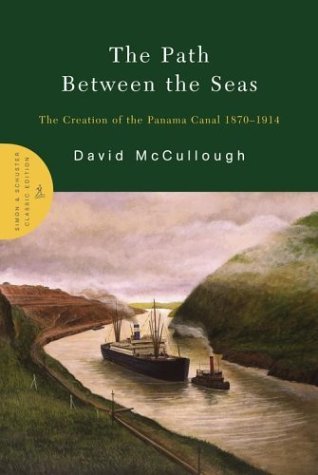
THE PATH BETWEEN THE SEAS, by David McCullough

At the outset, I have to admit that I’m biased, as McCullough is probably my favorite author, and I recommended reading the book to our Books, Brew and Banter Club.  That said, The Path Between the Seas won the National Book Award and several other awards, so I feel confident that it would be next to impossible for me to oversell his work.

The book is a first-rate drama of the bold engineering feat that was filled with both tragedy and triumph.  It is the story of the men who fought against all odds to fulfill a four-century dream of constructing a passageway between the Atlantic and Pacific oceans, which includes astonishing engineering undertakings, tremendous medical accomplishments, political power plays, tragic failures and heroic successes.

When Europeans first started to explore the possibilities of creating a link between the oceans, cutting off the long and dangerous journey round the southern tip of South America at Cape Horn, Panama was a remote part of Columbia. That changed when, in 1848, prospectors struck gold in California, creating an urgent need for quicker passage for California-bound ships. Thus, the United States built the Panama Railroad to serve that traffic and soon became the highest-priced stock on the New York Exchange.

Initially, building the canal appeared to be an easy matter, but the construction project eventually came to involve the efforts of thousands of workers from many nations, taking over four decades to complete.

In the beginning, French entrepreneur Ferdinand de Lesseps, secured capital to begin work on the canal, based on his recent success in constructing the Suez Canal between the Mediterranean and Red Seas. However, at the time, he had not set foot in Panama and had only a vague idea of the topographical setting, nor did he believe that the heat, humidity, insects, and snakes were a large problem.  In less than a decade, however, the scheme had collapsed, and his company went into receivership with only a third of the canal having been excavated.  Over 25,000 people died, including 5,000 Frenchmen, mostly succumbing to malaria, yellow fever, poisonous snakes and industrial accidents.

After a quarter century, President Theodore Roosevelt began a campaign of intervention, and negotiated a treaty to access to the Isthmus of Panama, allowing the US to buy-out the French interests. However, the Americans led a bloodless revolt after Columbia objected to the treaty, allowing for the creation of the Republic of Panama. Americans then set work along the French route using their equipment and the Panama Railroad, before shipping in more modern equipment to move billions of cubic yards of dirt and rock, to harness savage rivers, and to initiate an unprecedented lock system, that has lasted over a century, only recently being remodeled and opened again to larger ships.

Aside from President Roosevelt, two other Americans were heroes in this process.  Dr. William Gorgas found that mosquitos were the carrier of malaria and yellow fever and led efforts to destroy their breeding grounds, substantially reducing deaths from disease. Engineer John Stevens took charge of the canal project and quickly understood the French inability to remove rock and dirt was not a problem with digging, but transportation. So he led efforts to rebuild the Panama Railroad to transport not only people, but equipment and materials, and recruited the greatest engineering minds of the period to tackle the tremendous challenges.

Completing the canal was an impressive trial, but it got done. Eventually, the canal opened to traffic ahead of schedule and under budget, and became the useful waterway of commerce envisioned for centuries.

This comprehensive and captivating story is a must-read for anyone interested in American history, the history of engineering technology, international intrigue, advance of medicine and human drama. Clearly, McCullough wrote a story you won’t want to put down.

—Ken Johnson

The Life and Times of the Thunderbolt Kid, by Bill Bryson

Several years ago, my best friend, who grew up in Des Moines in the 1950’s, gave me a copy of Bill Bryson’s The Life and Times of the Thunderbolt Kid. I enjoyed it so much that I subsequently read and enjoyed virtually all of his numerous books. So, when the opportunity recently arose to suggest it to Books, Brews, and Banter, I heartily recommended it, although I rarely read books twice.
“I can’t imagine there has ever been a more gratifying time or place to be alive than in Iowa and the 50s,\” Bryson wrote in the first chapter, and then set out to corroborate it.  He and his friends found endless adventures on the streets of Des Moines at a time when all kids hung outside pretty much all day during the summers, only returning home for dinner.
In this hilarious memoir, Bryson captures the time and place of his boyhood in Des Moines in the 50s and 60s, reminding us of a happy time when cars, household appliances, and even nuclear weapons grew larger and more abundant each year, while DDT, cigarettes, and atomic fallout were considered harmless or even good for you. He writes about his loving but eccentric family, including warm portraits of his father, a gifted but often absent sportswriter for the Des Moines Register, and his absentminded mother, who was the home furnishing editor also for the Register.
His early childhood recollections include the first televisions, comic books, toys (electric football and erector sets), his mother’s bland cooking, the threat of the Atomic Bomb, movie matinees, fears of polio, TV dinners, the Iowa State Fair, and visits to Grandpa’s farm. His alter ego, The Thunderbolt Kid, born of his love for comic book super heroes and his need to vaporize awful evildoers, allowed him to see under women’s clothing, if only in his imagination. When adolescence took over, Bryson’s adventures were replaced with riskier hobbies of smoking, drinking, forging IDs, and his growing fascination with sex that included the discovery of Dad’s secret stash of girlie magazines, his attempts at gaining access to the notorious “strippers tent” at the State Fair, and his unfilled desire to see Mary O’Leary naked.
Bryson is a master of the detail.  He mined magazines and newspapers of the period with an eye for the tragic, the revealing and the just plain odd, including the story of the barmaid charged with obscenity for being able to carry two glasses of beer on her breasts, the black man sentenced to death for stealing $1.95, and parents climbing ladders outside polio wards to shout greeting to the children.
His book is so outlandish and improbably entertaining, you sometimes begin to doubt its veracity. For example, none of our book club members remember his contention that the Japanese sent balloons with bombs in them over the US during WWII, some going as far as Virginia.

Nonetheless, it’s a wondrous laugh-out-loud book, evoking both the unadulterated joys and everyday battles of childhood.  A great fun-read, especially for Baby Boomers nostalgic for the good old days. Ken Johnson

The Devil in the White City, by Erik Larson

Many of Erik Larson’s books explore the intersection of technological brilliance and human evil. In The Devil in the White City, he recreates the Chicago of 1893, where the nation’s foremost architects build the Chicago World’s Fair on Lake Michigan while a serial killer creates his own grotesque haven just blocks away.

It’s a city teeming with creativity, filth, growth, and chaos, which Larson captures so thoroughly that I could almost smell the stockyards and see the muck oozing down the Chicago River.

With meticulous attention to detail and storytelling prowess, Larson introduces us to chief architect Daniel Burnham, his partner John Root, and his talented team, including Louis Sullivan, with whom Burnham most often clashed; Frederick Law Olmsted, whose landscaping plans caused him nearly as much grief as his aching teeth; and Sophia Hayden Bennett, the lone woman, who was just 21 when she designed the Women’s Building.

And then there was H.H. Holmes, aka Herman Webster Mudgett, who built the horrifying World’s Fair Hotel, complete with a gas chamber and chute to smoothly dispose of bodies, which included those of three wives and one fiancée. He even sold a good many of their skeletons to a scientist who cleaned them and used them for research, conveniently expressing little curiosity as to their origins.

Larson intersperses the drama and delight of the fair with the horror of Holmes’ Murder Castle, both being built walking distance away from one another. The book’s tagline: Murder, Magic, and Madness at the Fair That Changed America.

The fair, also called the World’s Columbian Exposition, to celebrate the 400th anniversary of Columbus’s arrival in the United States, needed a show-stopper, a feature to compete with the Eiffel Tower, built for the 1889 World’s Fair in Paris.  Planners rejected several brilliant ideas, including an 8,000-foot elevator that would take riders to a toboggan run from which they would slide all the way to Boston (details to come later). After months of stressful searching, they finally found the solution: the first Ferris Wheel. This behemoth was 254-feet tall, with a capacity of 2,160 riders at a time. Riders were enclosed in 36 wooden cars the size of boxcars, which could hold up to 60 persons and included their own restaurants and bars. (The latter would probably come in handy for some riders.)

And to make the structures and landscaping work together, designers painted all buildings white, creating a magical city in the purest of colors, another contrast to the darkness blocks away in Holmes’ evil world.

It’s a wonder the fair opened at all, with constant squabbling between its architects, plus the unreceptive Chicago weather and boggy location in Jackson Park, which was largely a swamp before Burnham and Olmsted visited and saw the possibility of a lakeside wonder.  And it’s a wonder Holmes was ever caught, given the ineptitude of local police, the lack of any national data collection of missing women, and Holmes ability to lie brilliantly.

Most structures of the fair were covered essentially with papier-mache, so they were destroyed after the fair. Today’s Museum of Science and Industry is the only major building remaining; it had been the Palace of Fine Arts. Pat Prijatel

To see how the fair might have looked, check out this three-dimensional recreation.