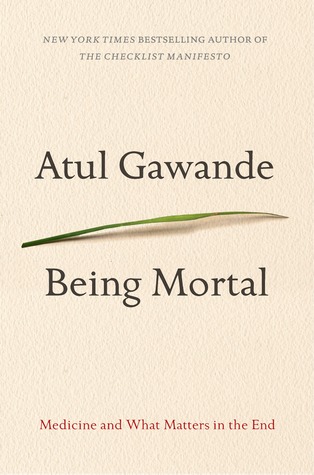
Being Mortal, by Atul Gawande


In Being Mortal, Gawande tackles a significant challenge of his profession: how medicine can improve life, as well as the process of its ending. In other words, he asserts that medicine can comfort and enhance our experience even to the end, providing not only a good life but also a good end. 

Being Mortal is a valuable contribution to the growing literature on aging, death and dying.  Despite advances in medicine, he calls for a radical transformation in how we approach the end of life.  He states that nursing homes are preoccupied with safety, pinning patients into railed beds and wheelchairs;  hospitals isolating the dying, checking for vital signs long after the goals of cure have become moot; and doctors, committed to extending life, continuing to carry out devastating procedures that in the end extend suffering.

His early description of how the body decays with age is nothing if not sobering. From the news that an elderly person’s shrinking brain can actually be knocked around inside the skull to the way a tooth can determine a person’s age, he goes through a litany of descriptions of how the body goes through scary decaying changes.

He states that it is unfortunate that the number of doctors willing to become geriatricians is shrinking, primarily because the field is not as lucrative as most other specialties and because it provides so little instant satisfaction, and requires such work as a detailed, lengthy examination of callused old feet. Patients are usually deaf and forgetful, can’t see, have trouble understanding what the doctor is saying, have not one complaint but fifteen, have high blood pressure, diabetes and arthritis. “There’s nothing glamorous about taking care of any of those things,\” he writes.  But, he contends that patients who receive good geriatric care stay happier and healthier, particularly those who can remain at home and aren’t forced into a nursing home.

At the end of the book, he states that, “The debate is about what mistakes we fear most – the mistake of prolonging suffering or the mistake of shortening valued life.” While posing that there are no perfect solutions, he asks that medicine commit itself to creating better options and making choices with the goal of a purposeful life in mind.

Aside from suggesting it be read by physicians, I also strongly believe it should be read by everyone over sixty, and well as their children who will like be involved in the decisions that need to be made toward the end of life. 

—Ken Johnson

An Altar in the World, by Barbara Brown Taylor


“Spiritual but not religious” is one of the newer and increasingly common ways people describe themselves. But what do they mean and what does the phrase mean for those of us struggling to keep the Church — at least, organized religion — relevant?

These are the central questions in “An Altar in the World,” by Barbara Brown Taylor, a religion professor who was a parish priest. 

‘Spiritual’ may be the name for a longing – for more meaning, more feeling, more connection, more life. … They know there is more to life than what meets the eye.  They have drawn close to this ‘More’ in nature, in love, in art, in grief. They would be happy for someone to teach them how to spend more time in the presence of this deeper reality, but when they visit the places where such knowledge is supposed to be found, they often find the rituals hollow and the language antique.

People aren’t as interested in being told about God as they are in experiencing God.  Taylor offers 12 practices for building an altar in the world, for experiencing God.  Most of them are variations on the “mindfulness” theme — being aware of yourself, your feelings, your surroundings, those around you — strangers as well as friends — even your own pain. Because of the pace at which most of us live today in our culture, we are rarely truly present in the moment as we dash from deadline to deadline and crisis to crisis, unaware of God’s presence and the opportunity to experience it.

Reverence, Taylor says, is an important part of Paying Attention (practice #2). While our culture reveres money, power, education and religion, philosopher Paul Woodruff argues that true reverence is by definition “the recognition of something greater than the self — something that is beyond human creation or control, that transcends full human understanding.”

Taylor asks, “What awakens awe in you by reminding you of your true size?” This is where and how you will experience the divine More.

She also advises Getting Lost (practice #5) as the only way to find unexpected treasures and blessings, and Feeling Pain (practice #10), for the world’s great religions all grew out of pain.

The practice that took me by the throat and left me breathless was #8 — Saying No.  Much has been said in many contexts about the pitfalls of our over-scheduled lives, but Taylor makes a strong case for the extent to which this lifestyle separates us from God.

“Remember the Sabbath and keep it holy” is a commandment, she points out,  just like “Have no other Gods before me,” “Do not commit murder,” “Do not bear false witness,” “Honor your parents” and “Do not steal.”  When did we decide it was optional?

Think about THAT for a moment.

Certainly, there are people for whom Sunday must be a day of work — those who keep us all safe and healthy. But what about the rest of us? Does Sunday need to be a day just all the others except for 90 minutes in the morning?

My husband, Martin, and I talked about this at length and decided to try to keep the Sabbath during Lent. We knew it would be challenging, but as of January 15, we are both retired and no longer have Monday morning deadlines to worry about.

Traditionally, those who keep the Sabbath also avoid things that cause other people to work — so no brunches or suppers out, no movies, no shopping.  We have to plan ahead to have food prepared that can be simply put in the oven or crockpot and offer left-overs for reheating for supper.  Anything that will need to be ironed for church must be ironed before bedtime Saturday night. The coffee is made so we only push a button Sunday morning.

For purely sanitation/health reasons, we do put dishes in the dishwasher on Sunday, but unloading must be done on SaturdayDusting, sweeping, folding clothes, picking up — all attended to on Saturday or they go undone until Monday.

With all that time on Sunday, we breathe.  We breathe in the sunlight or the shadows, the warm or the cold, the snow or budding trees, our cardinals and now our robins, each other’s presence and the Holy Spirit.  We pray, we talk, we read things that help keep us centered on the Sabbath. In the interests of full disclosure, March Madness was allowed; but strangely enough, the despair over losses didn’t provoke the depth of feeling we usually experience around here. They were games, and we were aware of the joy of playing at this level.

As the weeks have gone by, I’m finding I enjoy Saturdays more. I’m busy getting ready for Sunday with a real sense of anticipation!

We are talking about continuing the Sabbath after Easter. Martin had concerns about golf, but I think play should be allowed, especially when it’s outside in God’s creation. We hope to spend more time with family and friends on our Sabbaths — when we can find some who aren’t too busy with “things.” Call us, if you are so moved.

One other thought: Taylor says the rabbis she knows tell her their people who keep the Sabbath also tend to keep the other commandments.  Seems the Israelites were really onto something!

by Ronda Menke Haas


Animal, Vegetable, Miracle, by Barbara Kingsolver

 
A family moves from its home in Arizona to a farm in southern Appalachia and, by trial and error, build a new life reflecting on the age old saying: “We are what we eat.” Throughout this work are detailed accounts of the art of growing vegetables, fruit trees, and raising animals for human consumption. Barbara Kingsolver asks:
 

Will North Americans ever have a food culture to call our own? Can we find or make up a set of rituals, recipes, ethics, and buying habits that will let us love our food and eat it too? Some signs point to “yes.” Better food – more local, more healthy, more sensible – is a powerful new topic of the American conversation.” … 

This book tells the story of what we learned or didn’t, what we ate, or couldn’t, and how our family was changed by one year of deliberately eating food produced in the same place where we worked, loved our neighbors, drink the water, and breathe the air.

Daughter Camille and husband Steven L.  Hopp contribute throughout the text with collaborating essays and mouthwatering recipes. Some of Kingsolver’s discourses surround controversy all topics such as global climate change;  CAFO’s, or concentrated animal feeding operations, commonly known as factory farms; genetic modification, currently known as GMO, or genetically modified organisms: fair trade: and pesticides , to name a few. Kingsolver’s emphasis is on growing our own produce in our backyard and becoming regular customers a farmers’ markets, whose vendors sell local and organic produce.

One section of the book is devoted almost exclusively to the authors’ curiosity and eventual observing and caring for the family’s Bourbon Red turkeys and their offspring, which is quite comical and interesting. Several chapters give accounts of the family’s endeavors of seed saving, harvesting, and freezing are canning items when the season has passed.

Animal, Vegetable, Miracle is filled with helpful anecdotes, such as what to eat when the food is out of season. It is not preachy, but commonsensical and witty. There is an extensive references and resource section at the back of the book for additional research. And the authors have added a handy online site with recipes specific to the four seasons. Check it out here.

—Laurie Jones