Dinners with Ruth: A Memoir on the Power of Friendships, by Nina Totenberg

The title of Nina Totenberg’s memoir Dinners with Ruth immediately hooks the reader, but the subtitle nails the essence of this engaging narrative on the power of friendships. Through the lens of Nina’s professional career as a legal affairs correspondent and also her personal life, readers do learn much about Ruth Bader Ginsberg’s long public law career as well as a basic outline of her fifty-year friendship with Nina, but the book’s focus is on Nina.

The two women had a number of things in common. They were also very different. Nina was a daughter of privilege whose father, Roman Totenberg, was a world famous violinist. Ruth was born in Brooklyn to a humble family who lived in the shadow of an older sibling’s early death. Nina dropped out of college. Ruth excelled at Cornell University and Harvard Law School. Both were Jewish and the children of immigrants who had high expectations for their ambitious daughters. Both loved to shop and dress well.

Nina and Ruth were outsiders in their chosen fields and among the first women to storm the ramparts of male domination in the workplace. Both learned to brush aside catcalls, sexual harassment (before the term was coined) and were invective about displacing men in the workplace. They respected each other’s work, but were strictly personal friends. From time to time and more frequently as Ruth rose to prominence, Nina interviewed her in person or for radio broadcasts. Following Ruth’s public comments criticizing President Trump and then walking them back, Nina pointedly asked in an interview “why did you apologize?” despite Ruth’s obvious discomfort with the topic.

The two met in 1971 when Nina had just begun covering the Supreme Court and Ruth was an attorney for the ACLU. Their friendship blossomed when Ruth was appointed to the US Court of Appeals and moved to Washington D.C. with her husband Marty, who had used his connection with a prominent senator to secure her selection. Now they could more often meet for dinner and enjoy both husbands’ culinary skills, one of the few talents Ruth definitely did not possess. 

Over the years both women were essential supports for each other through good times and bad –illness and death of spouses; Ruth’s appointment to the Supreme Court; Nina’s second marriage; Ruth’s 20 year challenges with cancer and other ailments; Nina’s refusal to reveal her sources to a Senate Committee following her ground breaking coverage of the Clarence Thomas and Anita Hill hearings; Ruth’s refusal to accept membership in a prestigious club, because Nina had earlier been black-balled.

The book explores numerous examples of how making and utilizing friendships and connections propelled both women’s careers. At one point Nina says Ruth had an instinctive ability to make connections, which often came into play when working toward consensus on the Supreme Court as well as personally, typified by her long term personal friendship with philosophical rival Justice Scalia. Nina also excelled in this arena, something she learned growing up. An early example:  Nina’s mother wrote Eleanor Roosevelt seeking help to land a prestigious D.C. internship for Nina. Mrs. Roosevelt replied, and Nina got the internship. After she was hired at NPR as a legal correspondent and began regularly covering the Supreme Court, Nina cultivated friendships with justices, sometimes fairly easily as with Justice Powell and Justice Scalia and sometimes only after great effort as with Justice Brennan. Nina does note such connections among Washington’s governing elite, including White House poker games, would not be possible or tolerated today.   Those were very different times.

Friendships often deepened over a meal. Supreme Court justices and other Washington notables were frequent dinner guests at Nina and husband David’s table.  The couple also had a standing date for dinner and a movie with her NPR work friends Cokie Roberts and Linda Wertheimer and their spouses. David loved to cook for Ruth, especially after the death of her spouse, and even more after Covid-19 hit when Ruth began coming for dinner every Saturday night. Speaking for herself and David, Nina says feeding Ruth was “one of the great privileges of their lives.”

The friendship between Nina and Ruth expanded in the years following Sandra Day O’Connor’s retirement from the Supreme Court when Ruth gradually found her voice and developed her powerful influence in furthering the cause of women’s rights. Largely thru social media she became The Notorious RBG. Nationwide popularity made RBG visible nearly anywhere she went, so Nina’s long standing friendship was her port of reliable and authentic connection until her death.

Totenberg uses an interesting device to develop her story – seventeen chapters, each titled with an aspect of friendship – Friends in Need, Friends in Joy, etc. Though this structure could get in the way and seem artificial, it actually keeps the focus on the overriding theme and creates an opportunity to reflect on the components of the friendships in readers’ own lives. Chapter Thirteen, Fame and Friendship, reveals the most detailed anecdotal information about RBG. For example, her prowess at horseback riding and especially at confounding males who underestimate her.

The book club enjoyed this memoir though some were left wanting more detail about Ruth Bader Ginsberg. They did appreciate learning that her firm belief a democrat would be elected in 2016 kept her from resigning during the Obama years. Her death on September 18, 2019 brought her very close to Biden’s election less than two months later. Readers were appalled at Mitch McConnell’s decision not to allow her to lie in state in the Capitol Rotunda – a partisan ploy that only served to burnish Ruth Bader Ginsberg’s legacy as a lifetime champion of consensus and connection.

— Sue Martin

Sea of Glory, by Nathaniel Philbrick

Exploration! Adventure! See the world! The U.S. Exploring Expedition of 1838-1842 offered all that. With a task force of six sailing ships and 346 men, the Expedition discovered Antarctica, mapped much of the South Pacific and the Pacific Northwest, and circled the globe. It returned with materials that formed the basis of the collections of the Smithsonian Institution and the U.S. Botanic Garden, and sparked the formation of the U.S. Hydrographic Office and the Naval Observatory. 

Why is this Expedition not ranked alongside Lewis and Clark in our history?  Nathaniel Philbrick, noted for histories of Washington, Custer, and the whaling ship Essex, takes on that question through a review of the journals and correspondence of the principal officers of the Expedition and other historical records. 

Those records revealed a corking tale of the inner turmoil of the commander of the Expedition, Charles Wilkes, and the resulting tension among the officers and crew.  Throughout the voyage, Philbrick traces the deteriorating relations between Wilkes and his officers, particularly William Reynolds, who started as an admirer of Wilkes and by 1842 was his adamant opponent. Wilkes was at once supremely self-confident and supremely insecure. This internal tension (Philbrick quotes Thoreau’s description of “the private sea”) was reflected in inconsistent and ineffective leadership of the Expedition’s officers and crew, unwarranted transfers, unnecessary and brutal floggings. 

Our group’s discussions kept coming back to Wilkes’s tragic character flaws. Was it arrogance and self-conceit? Yes, but the accomplishments of the Expedition deserved high regard. Would Wilkes have been better balanced and more tolerant if he had been given the recognition he thought was deserved? Melville is quoted: “All mortal greatness is but disease.” Could another commander have managed the personnel better? Maybe, but no senior officer of the Navy wanted to take this command. And maybe a more collaborative commander would not have achieved as much as Wilkes did. The title “Sea of Glory” comes from Shakespeare’s Henry VIII as Cardinal Wolsey laments his loss of office: “I have ventured . . . this many summers in a sea of glory, but far beyond my depth.” These are universal questions, but they are magnified by small ships, large oceans, and four years at sea. 

Ah, but the adventure. The Expedition brought together threads of scientific investigation, the commercial needs of traders and whalers, and the U.S. diplomatic expansion of the Jackson and Van Buren era. It visited Antarctica twice, once from the tip of South America, and a year later from Australia. The seamanship needed to take sailing vessels through the fog and ice of the high southern latitudes was a real adventure, which Philbrick tells skillfully. Between and after the Antarctic visits, the Expedition surveyed hundreds of Pacific Islands, had a hostile encounter with Fijians, climbed through the climate changes of Mauna Loa in Hawaii to make pendulum observations which would increase scientific understanding of the earth’s gravity, shape, and density. After completing that task, the Expedition moved to the Pacific Northwest, surveyed the coast from California to Vancouver Island and the Puget Sound, and entered the mouth of the Columbia River, traversing some of the most dangerous waters in the United States. 

The Expedition returned to the United States in 1842 to a Tyler administration whose interests had shifted to westward expansion, the annexation of Texas, and conflict with Mexico. In the naval culture of that time, after-action disputes were taken to courts martial. Wilkes, Reynolds, and three others were given suspensions and reprimands that gave no sense of vindication for anyone, and undercut the public image of the Expedition. Over the next few years, its scientific output gained greater appreciation as books, memoirs, and findings were written. But the public had moved on to other interests and the Expedition missed the moment of accolade that Wilkes and his crew had expected. But what an adventure they had.

— Bill Smith

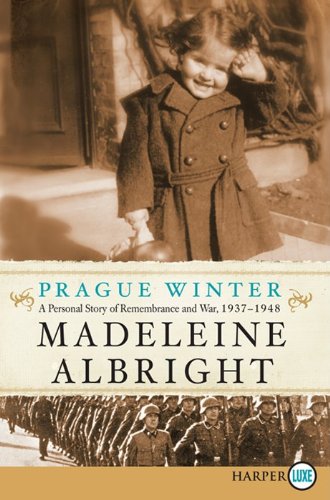
Prague Winter, by Madeleine Albright

Full Title: Prague Winter, A Personal Story of Remembrance and War, 1937-1948

We found Prague Winter engaging on many levels. Albright tells personal and family stories that play out across the mid-20th Century history of Central Europe, with a focus on the ethical choices that confronted her family, their friends, professional colleagues, and national leaders during this tumultuous time. Prague Winter is not a conventional history book, but it explains a large sweep of history in these personal contexts.

The family story is an absorbing one of her parents’ slow motion courtship in the Czechoslovakia of the 1930s, her father’s development as a professional diplomat, and the family’s relocation to Belgrade, London, back to Prague, and eventually to the United States. (Albright’s own professional story as a diplomat and Secretary of State is told in other books).

The European history is anchored in the familiar elements of World War 2 and the Communist takeover of Central/Eastern Europe. But Albright’s telling of her family’s story gives us a highly personal and accessible view of the historic events. She explains the emergence of Czechoslovakia, its sacrifice on the altar of world peace at Munich, its suffering during World War 2, its brief democratic resurgence, and the bungling that took it into the Communist fold in 1948. 

Albright lets us see the personalities of Masaryk, Beneš, and other key players in the story, and many people who weren’t in positions to drive history but nevertheless had to navigate it. This is Albright’s real theme in this book: the painful personal and ethical choices people had to make throughout this period. What did Nazi occupation look like from Prague? From the concentration camp? And from exile in London? How did people weigh international peace with national integrity? How do people take political positions that risk the welfare of family and friends? These are questions with no easy answers, and often with no good answers. But they provide great discussion, and that’s what we enjoyed so much about this book.

— Bill Smith