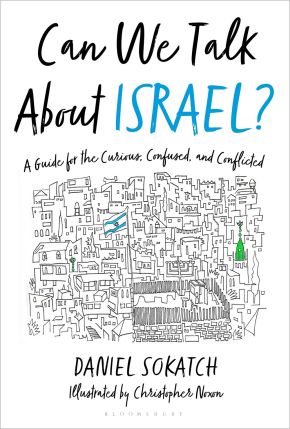
Can We Talk About Israel? by Daniel Sokatch

Can We Talk About Israel?: A Guide for the Curious, Confused, and Conflicted was written by Daniel Sokatch, an American Jewish activist and CEO of the New Israel Fund since 2009. His aim with this book, as he states in the first chapter, is to break down the conflict between Israel and Palestine into a thorough but understandable narrative so that the average uninvolved (but interested) person can understand it enough to participate in discussion to some degree.  

Based on the fact that our group had several interesting discussions about it, I think he achieved that goal.  

The first half of the book starts at the very beginning – God telling Abraham of Canaan – and steps through the full history of the conflict, highlighting the major incidents, competing interests and philosophies, milestone events, and most notable leaders on both sides to the present day. Though it was definitely engaging, this part was so full of facts that it was hard to stay focused and keep the details straight. Overall, it left us with a better understanding of the motivations and emotions behind both sides.  

The second half went into greater detail about the “current” state of the conflict, such as it was in 2021 when the book was published. Sokatch stated that he endeavored to present it in a balanced way, and we felt that he achieved this also (or as our Bill Smith said, as even-handed a resource as we’re likely to find). We learned about the carved-up and walled-off map of the territory, the political climate and living conditions of the major hubs, the bond between America and Israel, the creeping Israeli Settlements, the debates around apartheid and BDS (Boycott, Divestment and Sanctions against Israel), what constitutes antisemitism versus fair criticism of Israel, and so much more. None of it told us how to feel, which is not a comfortable place for Americans who are used to being able to claim one position or another for every issue.  

Much has happened since the book was published, most notably the attack on Israel by Hamas on October 7th, 2023, which is still a full-scale conflict at this moment. Sokatch continues to weigh in on the subject on the website for The New Israel Fund, an organization which was established in 1979 and “designed to expand the work that the United Jewish Appeal was then doing … to protect Israel’s strength by protecting democracy, human rights, justice, and equality for all Israelis – Jews and Arabs” (from jewishvirtuallibrary.org). His latest post can be found here: https://www.nif.org/blog/finding-light-in-the-darkness/. In it, he makes a statement that I find to be somewhat more hopeful than the last chapter of the book, which was titled “The Case for Hope.”  

President Biden has offered us a light in this darkness. But there is another light, one that shines today in the darkness in Israel: Activists in Israeli civil society—regular Israelis, Arab and Jews, seeking a better, shared future—are leading the way towards a different path—especially grantees like Standing Together, Combatants for Peace, Bereaved Parents—Families Forum, Breaking the Silence, and Yesh Din—who either are co-led by Arabs and Jews or have worked hand in hand with Palestinians for years.  

They know that Israelis share the responsibility for envisioning a horizon where tomorrow is better than today—for everyone. 

On December 20, 2023, my daughter came home from college on Christmas break and we didn’t get through one full day before the issue of Israel/Palestine came up at the dinner table. I was glad to be able to understand her fervent opinion and offer thoughts of my own, which I would not have been comfortable doing if not for this book. I would definitely recommend it to anyone who is interested in learning more. 

— Julie Feirer

Poverty by America, by Matthew Desmond

Matthew Desmond puts the central question of his book this way: 

“This is who we are: the richest country on earth, with more poverty than any other advanced democracy. If America’s poor founded a country, that country would have a bigger population than Australia or Venezuela. Almost one in nine Americans – including one in eight children – live in poverty…. Books about poverty tend to be books about the poor. It’s been this way for more than a hundred years…. Bearing witness, these kinds of books help us understand the nature of poverty. They are vital.  But they do not – and in fact cannot – answer the most fundamental question, which is: Why? Why all this American poverty?”

That IS the question. And this book is important because Desmond takes great pains to examine all of the supposed root causes of poverty in this land of plenty. One by one he refutes the arguments (and mostly pejorative arguments) about why people in this country are poor. And he comes to the conclusion that the reason why we have poverty in this country is that we like it that way. Too many of us profit from the penury of our neighbors.

Desmond outlines how we, the not-poor in this country, undercut workers, how we force the poor to pay more, how we rely on welfare, how we buy opportunity. He ends with three powerful chapters exhorting us to invest in ending poverty by empowering the poor and tearing down the walls that separate us.

The book is exhaustively researched and documented. Fully one-third of the pages in the book are devoted to citations of studies, quotes and powerful examples that shore up his statistics. And Desmond is angry. He wants us to be ashamed of ourselves. He wants us to become poverty abolitionists. 

“There are a good many challenges facing this big, wide country, but near the top of the list must be concerns about basic needs. We must ask ourselves – and then ask our community organizations, our employers, our places of worship, our schools, our political parties, our courts, our towns, our families: What are we doing to divest from poverty? Every person, every company, every institution that has a role in perpetuating poverty also has a role in ameliorating it. The end of poverty is something to stand for, to march for, to sacrifice for. Because poverty is the dream killer, the capability destroyer, the great waster of human potential. It is a misery and a national disgrace, one that belies any claim to our greatness. The citizens of the richest nation in the world can and should finally put an end to it. We don’t need to outsmart this problem. We need to outhate it.”

Yes, this is an important book. A really important book. I wish everyone would read it and begin to think, “What can I do today to be a poverty abolitionist?”

— Jeanie Smith

Dinners with Ruth: A Memoir on the Power of Friendships, by Nina Totenberg

The title of Nina Totenberg’s memoir Dinners with Ruth immediately hooks the reader, but the subtitle nails the essence of this engaging narrative on the power of friendships. Through the lens of Nina’s professional career as a legal affairs correspondent and also her personal life, readers do learn much about Ruth Bader Ginsberg’s long public law career as well as a basic outline of her fifty-year friendship with Nina, but the book’s focus is on Nina.

The two women had a number of things in common. They were also very different. Nina was a daughter of privilege whose father, Roman Totenberg, was a world famous violinist. Ruth was born in Brooklyn to a humble family who lived in the shadow of an older sibling’s early death. Nina dropped out of college. Ruth excelled at Cornell University and Harvard Law School. Both were Jewish and the children of immigrants who had high expectations for their ambitious daughters. Both loved to shop and dress well.

Nina and Ruth were outsiders in their chosen fields and among the first women to storm the ramparts of male domination in the workplace. Both learned to brush aside catcalls, sexual harassment (before the term was coined) and were invective about displacing men in the workplace. They respected each other’s work, but were strictly personal friends. From time to time and more frequently as Ruth rose to prominence, Nina interviewed her in person or for radio broadcasts. Following Ruth’s public comments criticizing President Trump and then walking them back, Nina pointedly asked in an interview “why did you apologize?” despite Ruth’s obvious discomfort with the topic.

The two met in 1971 when Nina had just begun covering the Supreme Court and Ruth was an attorney for the ACLU. Their friendship blossomed when Ruth was appointed to the US Court of Appeals and moved to Washington D.C. with her husband Marty, who had used his connection with a prominent senator to secure her selection. Now they could more often meet for dinner and enjoy both husbands’ culinary skills, one of the few talents Ruth definitely did not possess. 

Over the years both women were essential supports for each other through good times and bad –illness and death of spouses; Ruth’s appointment to the Supreme Court; Nina’s second marriage; Ruth’s 20 year challenges with cancer and other ailments; Nina’s refusal to reveal her sources to a Senate Committee following her ground breaking coverage of the Clarence Thomas and Anita Hill hearings; Ruth’s refusal to accept membership in a prestigious club, because Nina had earlier been black-balled.

The book explores numerous examples of how making and utilizing friendships and connections propelled both women’s careers. At one point Nina says Ruth had an instinctive ability to make connections, which often came into play when working toward consensus on the Supreme Court as well as personally, typified by her long term personal friendship with philosophical rival Justice Scalia. Nina also excelled in this arena, something she learned growing up. An early example:  Nina’s mother wrote Eleanor Roosevelt seeking help to land a prestigious D.C. internship for Nina. Mrs. Roosevelt replied, and Nina got the internship. After she was hired at NPR as a legal correspondent and began regularly covering the Supreme Court, Nina cultivated friendships with justices, sometimes fairly easily as with Justice Powell and Justice Scalia and sometimes only after great effort as with Justice Brennan. Nina does note such connections among Washington’s governing elite, including White House poker games, would not be possible or tolerated today.   Those were very different times.

Friendships often deepened over a meal. Supreme Court justices and other Washington notables were frequent dinner guests at Nina and husband David’s table.  The couple also had a standing date for dinner and a movie with her NPR work friends Cokie Roberts and Linda Wertheimer and their spouses. David loved to cook for Ruth, especially after the death of her spouse, and even more after Covid-19 hit when Ruth began coming for dinner every Saturday night. Speaking for herself and David, Nina says feeding Ruth was “one of the great privileges of their lives.”

The friendship between Nina and Ruth expanded in the years following Sandra Day O’Connor’s retirement from the Supreme Court when Ruth gradually found her voice and developed her powerful influence in furthering the cause of women’s rights. Largely thru social media she became The Notorious RBG. Nationwide popularity made RBG visible nearly anywhere she went, so Nina’s long standing friendship was her port of reliable and authentic connection until her death.

Totenberg uses an interesting device to develop her story – seventeen chapters, each titled with an aspect of friendship – Friends in Need, Friends in Joy, etc. Though this structure could get in the way and seem artificial, it actually keeps the focus on the overriding theme and creates an opportunity to reflect on the components of the friendships in readers’ own lives. Chapter Thirteen, Fame and Friendship, reveals the most detailed anecdotal information about RBG. For example, her prowess at horseback riding and especially at confounding males who underestimate her.

The book club enjoyed this memoir though some were left wanting more detail about Ruth Bader Ginsberg. They did appreciate learning that her firm belief a democrat would be elected in 2016 kept her from resigning during the Obama years. Her death on September 18, 2019 brought her very close to Biden’s election less than two months later. Readers were appalled at Mitch McConnell’s decision not to allow her to lie in state in the Capitol Rotunda – a partisan ploy that only served to burnish Ruth Bader Ginsberg’s legacy as a lifetime champion of consensus and connection.

— Sue Martin